Choosing a hydraulic attachment is not simply a matter of matching an attachment to an excavator, skid steer loader, wheel loader or other carrier by machine name. A machine can appear to be in the correct size class and still require a different mounting configuration, hydraulic flow range, operating pressure, attachment weight or connection arrangement.
For contractors, equipment dealers, rental companies, OEMs, distributors and fleet managers, compatibility should therefore be treated as an engineering verification process rather than a simple catalog search.
Before releasing a purchase order, buyers should confirm five core areas: carrier capacity, hydraulic requirements, mounting interface, working configuration and application conditions. The same principle applies whether the attachment is a hydraulic breaker, sweeper, compactor, bucket, quick coupler, cold planer, forestry attachment or snow removal tool.
HCN Attachments Manufacture Co., Ltd. uses carrier information, mounting dimensions, operating weight and hydraulic data as part of its fitment review process. This approach helps buyers reduce the risk of receiving an attachment that requires unexpected modification or cannot operate correctly with the intended machine.
Why Attachment Compatibility Matters
Hydraulic attachments are part of a working machine system. Their performance depends on the relationship between the carrier and the attachment.
A hydraulic attachment may have the correct physical dimensions but insufficient hydraulic power from the carrier. Conversely, a carrier may provide adequate hydraulic flow but use an incompatible mounting interface.
Compatibility problems can lead to:
- Reduced attachment productivity
- Poor hydraulic performance
- Excessive heat generation
- Premature component wear
- Difficult or unsafe attachment installation
- Additional bracket fabrication
- Unexpected downtime
- Higher total cost of ownership
For rental fleets and equipment dealers, the consequences can be even greater because one attachment may need to serve multiple machines or customers.
The correct procurement approach is therefore to verify the complete carrier-to-attachment interface before production or shipment.
1. Start With the Exact Carrier Model
The first step is always to identify the actual machine that will operate the attachment.
Do not rely only on a general machine category such as “20-ton excavator” or “medium skid steer.” The exact carrier make and model should be provided to the attachment manufacturer.
For example, HCN product pages request information such as:
- Carrier make
- Carrier model
- Operating weight
- Mounting dimensions
- Coupler type
- Hydraulic flow
- Hydraulic pressure
- Application requirements
This information allows the manufacturer to determine whether the standard attachment configuration is appropriate or whether a different mounting solution is required.
For procurement teams managing multiple machines, it is useful to prepare a carrier compatibility sheet for each machine in the fleet.
2. Verify Carrier Operating Weight and Attachment Weight
Carrier operating weight is an important consideration because the attachment becomes part of the working machine.
The attachment should be suitable for the carrier’s operating class and intended working conditions. Buyers should not select an attachment only because its dimensions appear suitable.
Attachment weight can affect:
- Machine stability
- Lift capacity
- Working reach
- Transportation requirements
- Hydraulic performance
- Overall machine balance
The appropriate relationship between carrier and attachment varies according to attachment type and application. A hydraulic breaker, compactor, sweeper, bucket and forestry attachment do not impose identical operating requirements.
For this reason, buyers should use the manufacturer’s published compatibility information rather than applying a single attachment-to-machine weight formula to every attachment category.
3. Check Hydraulic Flow Before Ordering
Hydraulic flow is one of the most important technical parameters for powered attachments.
The carrier’s auxiliary hydraulic circuit must provide the flow required by the attachment. If the flow is too low, the attachment may not achieve its intended operating performance. If the hydraulic system supplies more flow than the attachment is designed to accept, the system may require appropriate control or configuration.
The correct procedure is:
Step 1: Identify the carrier’s auxiliary hydraulic flow
Obtain the hydraulic flow specification from the carrier manufacturer or machine documentation.
Step 2: Identify the attachment’s required flow range
Use the exact specification for the selected attachment and configuration.
Step 3: Compare the two values
Do not assume that all attachments for the same machine class require the same hydraulic flow.
For example, HCN’s published product data demonstrates significant variation between attachment types.
The 0202 Sweeper Broom for skid steer and compact loader applications lists a carrier flow requirement of 60–80 L/min, while the 0201 Angle Broom configurations list different hydraulic flow ranges depending on model. The BM12 Forward Sweeper for wheel loaders requires substantially higher hydraulic flow, with published model ranges of 180–200 L/min and 200–240 L/min.
This illustrates why “wheel loader attachment” or “skid steer attachment” is not sufficient information for hydraulic sizing.
The exact attachment model and configuration must be checked.
4. Verify Hydraulic Pressure
Hydraulic pressure should be reviewed together with flow.
Two attachments may require similar flow but operate at different pressure ranges. Buyers should therefore confirm both parameters before ordering.
For example, HCN’s 0202 F72NPI Sweeper lists an operating pressure range of 15–21 MPa and hydraulic flow of 60–80 L/min. The 0202 Sweeper Broom lists a maximum allowable pressure of 21 MPa with a carrier flow requirement of 60–80 L/min.
For a hydraulic breaker, pressure and flow become especially important because they directly influence the attachment’s operating performance.
The HCN BM16 Hydraulic Breaker, for example, has a published hydraulic flow range of 80–110 L/min and operating pressure range of 150–170 bar, with compatibility listed for specified excavator and wheel-loader applications.
The important procurement lesson is simple:
Never select a hydraulic attachment from carrier weight alone. Verify both hydraulic flow and pressure against the exact attachment specification.
5. Confirm the Mounting Interface
Hydraulic compatibility does not guarantee mechanical compatibility.
The attachment must also connect correctly to the carrier.
Depending on the machine and attachment type, buyers may need to confirm:
- Pin diameter
- Pin-to-pin distance
- Mounting bracket dimensions
- Coupler type
- Attachment plate dimensions
- Mounting height
- Hose routing
- Clearance during full machine movement
For excavator attachments, the mounting interface is often highly dependent on the exact carrier model.
For skid steer attachments, quick-attach compatibility can be especially important because the attachment plate must match the carrier’s interface.
HCN’s 0103 Standard Bucket, for example, is designed around the skid steer quick-attach interface and the product page identifies ISO 24410 compatibility.
However, even when a product belongs to a recognized interface class, buyers should still confirm the actual carrier configuration before production.
6. Quick Coupler Compatibility Should Be Verified Separately
A quick coupler can significantly improve fleet flexibility, but it introduces another interface that must be checked.
The attachment, coupler and carrier must work as one mechanical system.
For high-frequency attachment changes, rental fleets and multi-purpose contractors may prefer hydraulic quick couplers because attachment changes can be completed without the operator leaving the cab.
Manual couplers can remain practical for applications where attachments are changed infrequently.
The procurement decision should therefore consider:
| Selection Factor | Manual Quick Coupler | Hydraulic Quick Coupler |
|---|---|---|
| Initial complexity | Lower | Higher |
| Attachment change frequency | Low | High |
| Operator involvement | Ground-level engagement required | Cab-controlled locking system |
| Rental fleet suitability | Moderate | High |
| Multi-attachment operations | Moderate | High |
| Procurement priority | Simplicity and cost | Productivity and fleet utilization |
HCN’s published attachment information specifically discusses the difference between manual and hydraulic quick couplers and identifies hydraulic couplers as particularly relevant to rental fleets and high-frequency attachment changes.
For procurement teams, the important question is not simply “Which coupler is better?”
The better question is:
How frequently will the attachment be changed, and what machines will use it?
7. Match Working Width to the Application
Attachment dimensions should also be evaluated against the working environment.
A larger attachment may improve productivity in open areas, but a smaller attachment can be more practical in confined work zones.
For sweepers, working width should be considered alongside:
- Road width
- Parking area dimensions
- Site access
- Machine maneuverability
- Debris volume
- Required collection capacity
- Working speed
HCN’s sweeper range demonstrates different configurations for different carriers and applications.
The 0202 Sweeper Broom has a published effective sweeping width of 1,530 mm, while the 0202 F72NPI Sweeper has a published sweeping width of 1,820 mm. The BM12 Forward Sweeper for wheel loaders has published effective sweeping widths of 2,580 mm and 2,800 mm, depending on model.
The correct choice depends on the carrier and working environment rather than width alone.
8. Consider the Application Before Selecting the Attachment
The same carrier can perform completely different jobs depending on the attachment.
For example:
- Construction contractors may require buckets, breakers, compactors or trenching attachments.
- Municipal operators may need sweepers, planers, snow equipment and utility attachments.
- Forestry contractors may require mulchers, brush cutters, stump grinders, tree shears or grapples.
- Mining operations may require heavy-duty breakers, buckets, rippers and material-handling attachments.
- Agricultural users may need material-handling and land-management attachments.
- Ports and industrial operators may require specialized material-handling tools.
HCN currently organizes its attachment offering across multiple application environments including construction engineering, mining, municipal maintenance, forestry and parks, material handling, livestock and ranching, metallurgical operations and port equipment.
This application-first approach is important because the “best attachment” is determined by the combination of machine, material, duty cycle and working environment.
9. Do Not Ignore Attachment-Specific Requirements
Different attachment categories require different technical checks.
Hydraulic Breakers
Verify:
- Carrier operating weight
- Hydraulic flow
- Operating pressure
- Mounting bracket
- Tool diameter
- Hose routing
- Working environment
HCN’s hydraulic breaker guidance already emphasizes carrier weight, hydraulic compatibility and mounting interface as core procurement criteria.
Compactors
Verify:
- Carrier type
- Carrier operating weight
- Hydraulic flow
- Maximum pressure
- Attachment weight
- Compaction force
- Plate or drum configuration
- Mounting dimensions
HCN’s HN39 Vibratory Compactor, for example, lists different model widths and centrifugal-force values while maintaining a defined hydraulic flow range, demonstrating why model-level verification is necessary.
Sweepers
Verify:
- Carrier type
- Hydraulic flow
- Pressure
- Sweeping width
- Brush diameter
- Hopper capacity
- Dust-control configuration
- Mounting interface
Buckets
Verify:
- Bucket width
- Capacity
- Attachment weight
- Carrier class
- Coupler compatibility
- Cutting-edge or tooth configuration
HCN’s 0103 Standard Bucket illustrates how different model variants can provide different widths, capacities and weights while remaining within the same product family.
Forestry Attachments
For mulchers, brush cutters, tree shears and other forestry tools, buyers should additionally consider the material being processed, vegetation density, working environment, hydraulic requirements and carrier stability.
HCN’s forestry attachment range includes mulchers, brush cutters, stump grinders, log grapples and tree shears for excavator and skid steer applications.
10. Ask for Technical Drawings When Standard Compatibility Is Unclear
A product photograph is not enough to verify a complicated mechanical interface.
If the carrier or coupler is unusual, procurement teams should request:
- Mounting drawings
- Pin dimensions
- Hydraulic connection information
- Attachment dimensions
- Weight
- Center-of-gravity information where applicable
- Technical specification sheet
- Installation requirements
Providing the supplier with the carrier’s own technical drawing can also accelerate the fitment review.
For OEM and private-label projects, technical drawings become even more important because the attachment may need a customized mounting bracket, hydraulic configuration or branding specification.
HCN’s Fitment Review Approach
HCN’s current website states that its fitment review considers the submitted carrier model, mounting dimensions, operating weight, hydraulic flow and pressure before production.
This is particularly relevant for international B2B procurement.
HCN currently reports more than 400 product models, more than 1,000 specifications, more than 10 years of OEM experience, a 21,000 m² manufacturing campus and exports to more than 60 countries. The company also states that its manufacturing and engineering capabilities support OEM and private-label programs, including reverse engineering, CAD, prototyping, branding and mass production.
For a distributor or OEM buyer, this means the procurement process can begin with the machine and application requirements rather than forcing every customer into a fixed standard configuration.
A Practical Attachment Compatibility Checklist
Before sending an RFQ or purchase order, prepare the following information:
- Exact carrier make and model
- Carrier operating weight
- Auxiliary hydraulic flow
- Hydraulic operating pressure
- Coupler type
- Pin-to-pin dimensions where applicable
- Pin diameter where applicable
- Required attachment width
- Intended working application
- Working environment
- Required attachment configuration
- OEM or private-label requirements
- Required technical drawings
- Destination market and shipping requirements
The more complete the information provided at the quotation stage, the easier it is for an engineering team to confirm the correct configuration.
What Procurement Teams Should Ask an Attachment Manufacturer
Before placing an order, ask the supplier:
1. Is the attachment compatible with my exact carrier model?
Do not accept only a general answer such as “compatible with excavators” or “fits skid steers.”
2. What hydraulic flow and pressure are required?
Confirm the exact specification for the selected model and configuration.
3. What mounting information is required?
Ask whether the supplier needs pin dimensions, coupler information, drawings or photographs.
4. Is a custom bracket available?
This can be important for OEM, dealer and fleet applications involving non-standard interfaces.
5. Can the supplier provide technical documentation?
For professional procurement, request the specification sheet, mounting drawing and relevant operating information before final approval.
Compatibility Is More Than a Product Specification
The most reliable attachment procurement process does not begin with “Which attachment should I buy?”
It begins with:
What machine will operate it, what work will it perform, and what interface connects the two?
Once those questions are answered, buyers can evaluate hydraulic flow, pressure, carrier weight, mounting dimensions, coupler configuration, working width and application requirements in the correct order.
This approach is particularly important for international B2B purchasing because equipment fleets often contain machines from multiple OEM brands and different generations.
For contractors and fleet managers, better compatibility verification can reduce downtime and unnecessary modification.
For distributors and rental companies, it can improve fleet utilization and reduce fitment-related returns.
For OEMs and private-label customers, it creates a more reliable engineering process from initial specification through production.
Final Procurement Recommendation
Before ordering any hydraulic attachment, provide the manufacturer with the exact carrier model, operating weight, hydraulic flow, hydraulic pressure, mounting or coupler information and intended application.
If any of these parameters are unclear, request an engineering compatibility review before releasing the purchase order.
HCN’s current product range covers hydraulic breakers, buckets, quick couplers, sweepers, compactors, forestry attachments, snow-removal equipment, construction attachments, mining equipment and other specialized tools. Its website also provides model-level specifications and fitment information across different carrier types.
For a standard product, the manufacturer’s published specification may be sufficient for an initial assessment. For customized, OEM or non-standard applications, buyers should request an exact specification, technical drawing and compatibility confirmation before production.
That extra engineering step can be far less costly than discovering a compatibility problem after the attachment has arrived on site.
Frequently Asked Questions
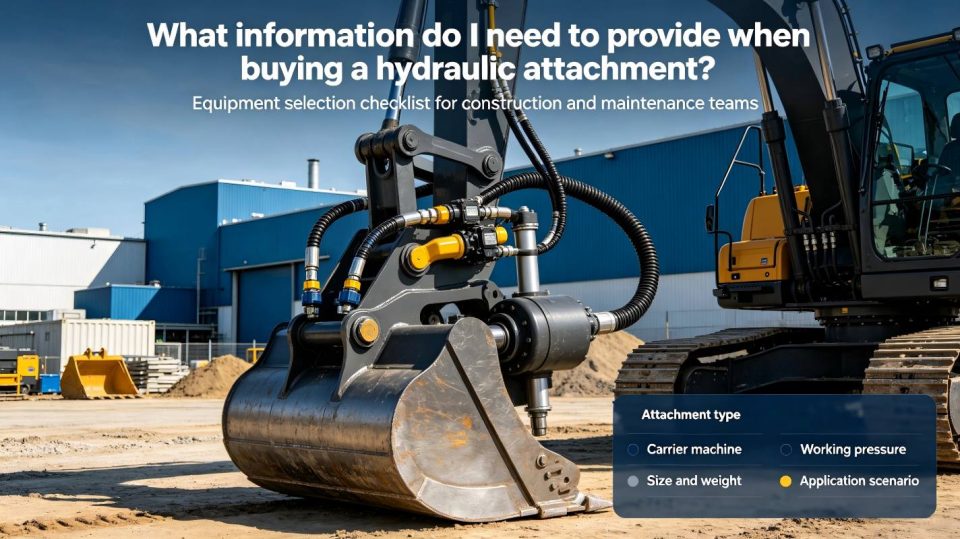
What information do I need to provide when buying a hydraulic attachment?
At minimum, provide the exact carrier make and model, operating weight, hydraulic flow, hydraulic pressure, mounting or coupler type and intended application. Additional mounting dimensions or technical drawings may be required for non-standard configurations.
Is carrier weight enough to select an attachment?
No. Carrier weight is only one part of compatibility. Hydraulic flow, pressure, mounting interface, attachment weight and application requirements should also be checked.
Why is hydraulic flow important for attachment selection?
Powered hydraulic attachments depend on the carrier’s auxiliary hydraulic circuit. Insufficient or unsuitable hydraulic flow can affect operating performance, while an unsuitable hydraulic configuration can create reliability or system-protection concerns.
Can one attachment fit different excavator or loader brands?
It can, depending on the attachment and mounting configuration. The correct approach is to verify the exact carrier model and interface rather than assuming that different brands use identical mounting dimensions.
Do I need a quick coupler?
A quick coupler is particularly useful when attachments are changed frequently. Rental fleets, multi-purpose contractors and high-utilization equipment fleets may benefit from faster attachment changes, while low-change-frequency applications may prioritize simpler mounting arrangements.
What should I check before ordering a sweeper attachment?
Check carrier type, operating capacity, hydraulic flow, hydraulic pressure, sweeping width, brush configuration, hopper capacity where applicable, mounting interface and the type of debris or surface being cleaned.
Can HCN provide customized mounting configurations?
HCN’s website states that mounting interfaces and configurations can be customized according to carrier requirements, and its OEM programs include reverse engineering, CAD, prototyping, branding and mass production. Buyers should provide the exact machine and mounting information for engineering confirmation.
Should I request a technical drawing before placing an OEM order?
Yes. For OEM, private-label, dealer and non-standard applications, a technical drawing can help verify the mounting interface, dimensions and configuration before production. It is especially useful when the attachment will be integrated into a specific carrier or fleet standard.
Related Product Lines & Technical Guides
Use these HCN resources to compare specifications, carrier fit, and export procurement options referenced in this article.