Selecting the wrong compactor attachment costs time and money. This step-by-step buyer's guide walks you through carrier matching, centrifugal force sizing, soil type compatibility, and the five questions to ask any supplier before ordering.
Step 1: Identify Your Carrier Machine
The carrier machine — excavator, skid steer loader, or wheel loader — determines which compactor attachment sizes are physically compatible. Three parameters must be verified before looking at any attachment specification sheet:
- Operating weight (tonnes): The carrier’s operating weight (including fuel, operator, and standard attachments) determines the maximum attachment weight. Compactor attachments should be 8–12% of the carrier operating weight for stable operation during vibration.
- Hydraulic output (L/min and bar): The carrier’s auxiliary hydraulic circuit must supply sufficient oil flow (L/min) at adequate pressure (bar) to spin the compactor’s eccentric mass at rated frequency. Underpowering causes low centrifugal force; overpowering risks motor damage.
- Attachment mounting (coupler type): The compactor must match the carrier’s quick coupler or pin-to-pin dimensions. HCN provides mounting brackets for all major skid steer quick-attach standards and excavator pin dimensions.
Step 2: Match Centrifugal Force to Your Project
Note: These are guidelines for granular soils (sand, gravel, crushed stone). Cohesive soils (clay, silt) may require higher centrifugal force for the same target compaction depth.
| Carrier Weight | Recommended Centrifugal Force | Typical Application |
|---|---|---|
| 1.5 – 4 t (mini excavator, skid steer) | 20 – 50 kN | Residential trench backfill, small pavers, landscaping |
| 4 – 8 t (compact excavator) | 50 – 80 kN | Utility trenches, foundation backfill, small road repairs |
| 8 – 15 t (mid excavator) | 80 – 120 kN | Road subbase, commercial foundation, pipeline corridors |
| 15 – 25 t (large excavator) | 120 – 160 kN | Highway subbase, dam embankment, industrial foundation |
| 25 – 35 t (large excavator) | 160+ kN | Airport subbase, port terminal, large civil earthworks |
Step 3: Choose Plate Compactor vs. Drum Compactor
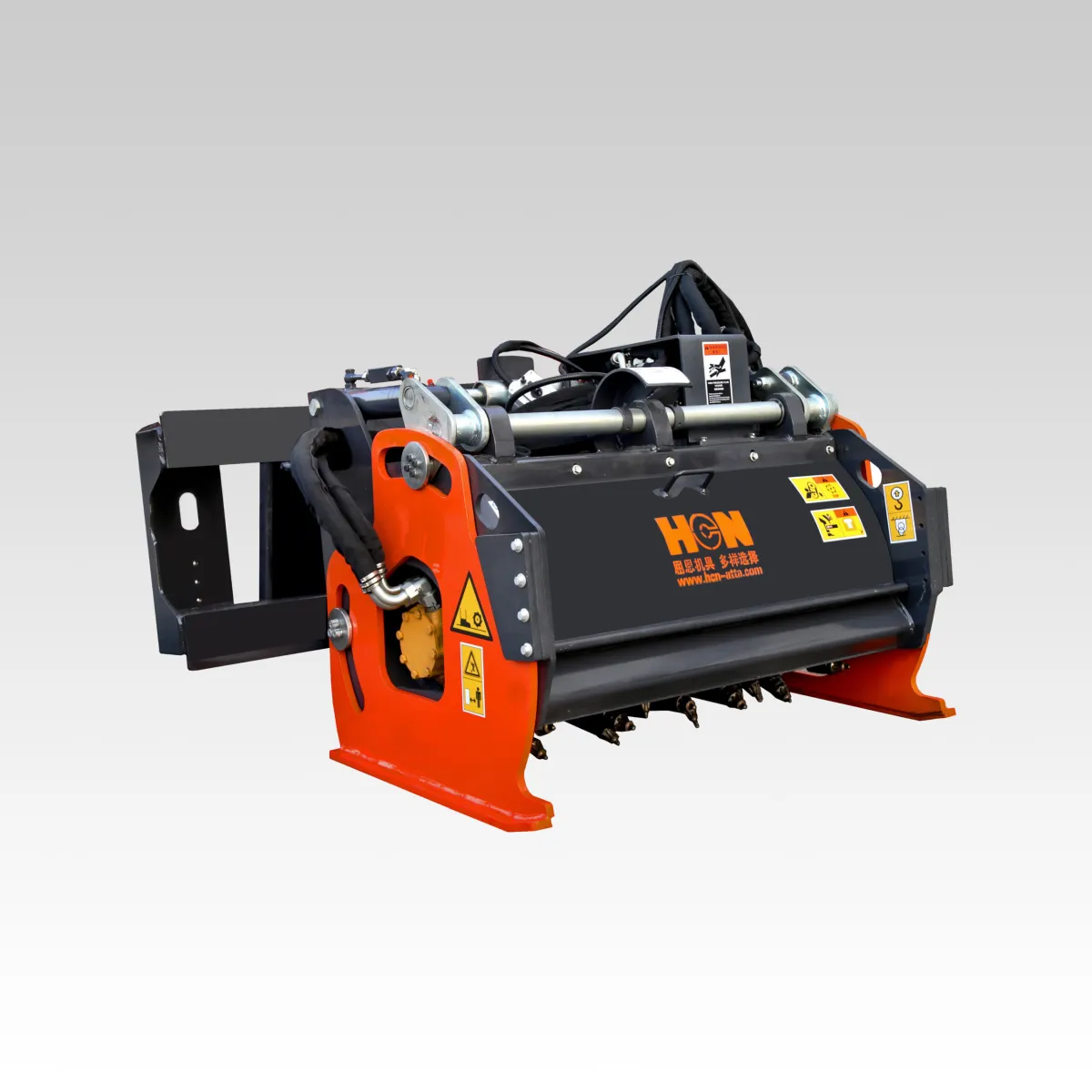
Two primary compactor attachment configurations exist for machine-mounting: plate compactors and drum (cylindrical) compactors. The right choice depends on your site geometry:
- Plate Compactor: Flat base plate contacts the soil. Best for open areas, road base, foundation pads, and general fill compaction. Wider plates (500–1200 mm) cover more area per pass. HCN plates from 450 mm to 1,200 mm width.
- Drum (Trench) Compactor: Cylindrical drum matches the trench width and depth. Compacts only within the trench, avoiding disturbance of surrounding undisturbed soil. Best for utility pipeline and cable trench backfill. HCN drums from 300 mm to 800 mm width.
- Impact Tamper: Reciprocating impact foot for highly cohesive soils and hard-to-reach corners. Higher peak force than vibratory plate but lower average production rate.
Step 4: Verify Hydraulic Compatibility
This step is critical and commonly overlooked. A compactor attachment that is correctly sized by weight and centrifugal force will still underperform if the carrier’s hydraulic system cannot supply the required oil flow.
- Check your carrier’s auxiliary hydraulic flow rate (L/min) from the service manual or manufacturer specification sheet.
- Compare to the compactor’s minimum and maximum required flow — typically 40–180 L/min depending on model size.
- Verify the carrier’s auxiliary relief valve pressure setting (bar) matches the compactor’s working pressure range.
- Confirm the hydraulic coupling (flat-face or pioneer type) matches the carrier’s auxiliary ports.
- For high-flow attachments on carriers with limited flow, consider a flow amplifier valve (available as an option from HCN).
5 Questions to Ask Your Supplier Before Ordering
Not all compactors marketed with the same centrifugal force specification deliver the same performance. Use these questions to evaluate any supplier:
- “What is the eccentric shaft material and rated service life?” — HCN uses 42CrMo alloy steel shafts rated for 5,000+ operating hours. Cheaper alternatives use mild steel that deflects or cracks under high centrifugal load.
- “Is the centrifugal force verified by third-party testing or just a catalog claim?” — Ask for factory test reports. Reputable manufacturers perform centrifugal force verification on each unit before shipment.
- “What is the hydraulic motor type and rated pressure?” — Direct-drive hydraulic motors (no belts or chains) are more reliable and require less maintenance. Verify working pressure matches your carrier.
- “What mounting hardware and hydraulic hose set is included?” — Adapter brackets, hydraulic hoses, and fittings should be included in the price for your specific carrier model.
- “What is the warranty and spare parts lead time?” — A 12-month warranty with replacement seals and bearing kits available for international express shipment is the industry standard.
Common Mistakes When Buying Compactor Attachments
These are the most frequent errors that lead to poor compaction performance, premature failure, or carrier damage:
- Buying based on price alone without verifying centrifugal force test data
- Selecting centrifugal force based only on carrier weight, ignoring hydraulic flow requirements
- Ignoring the manufacturer’s recommended maximum lift (layer) thickness and number of passes
- Operating at the wrong hydraulic flow rate — both under- and over-supply damage the eccentric motor
- Failing to verify coupler dimensions before ordering, resulting in expensive adapter fabrication on delivery
- Choosing a plate compactor for a narrow trench application where a drum compactor is required
Related Products:
Related Product Lines & Technical Guides
Use these HCN resources to compare specifications, carrier fit, and export procurement options referenced in this article.