Choosing the right snow removal attachment is not simply a question of buying the widest blade or the most powerful snow blower. For contractors, municipal operators, airport maintenance teams, rental companies, equipment dealers, fleet managers and OEM procurement teams, the correct choice depends on where snow must go, how quickly it must be removed, the carrier machine available, hydraulic capacity, surface conditions and the operating environment.
Three attachment types cover a large share of professional snow-clearing requirements:
- Snow pushers for moving large volumes of snow across open surfaces
- Snow blowers for collecting and throwing snow where pushing it aside is impractical
- V-plows and angle plows for flexible snow displacement, lane clearing and changing site conditions
HCN Attachments manufactures all three categories within its snow and ice removal product line, together with snow buckets, angle brooms, de-icing equipment and truck-mounted snow equipment. Its current product range is designed around skid steer loaders, wheel loaders and municipal carriers.
The best procurement decision begins with the application rather than the attachment.
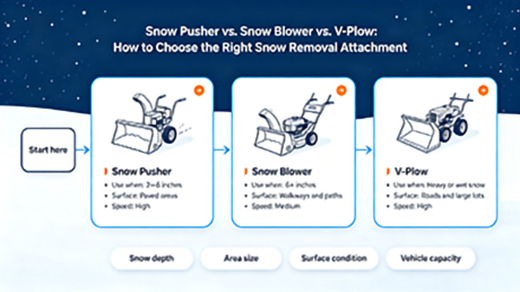
Snow Pusher vs. Snow Blower vs. V-Plow: Quick Comparison
| Selection Factor | Snow Pusher | Snow Blower | V-Plow / Angle Plow |
|---|---|---|---|
| Primary function | Push and contain snow | Collect and throw snow | Push, angle and redirect snow |
| Best environment | Open lots, roads, aprons | Confined areas and locations without snow storage | Roads, lanes and variable site layouts |
| Snow destination | Edge or designated pile | Away from the carrier | Edge or windrow |
| Productivity on open areas | Excellent | Good | Good |
| Ability to relocate snow far from site | Limited | Excellent | Limited |
| Flexibility | Moderate | Moderate | High |
| Hydraulic demand | Depends on configuration | Often higher | Depends on configuration |
| Best procurement priority | Width and carrier stability | Hydraulic capacity and throw performance | Geometry, control and carrier compatibility |
There is no universally superior snow attachment. Each design solves a different operational problem.
1. When Should You Choose a Snow Pusher?
A snow pusher, also called a containment snow pusher or pusher box, is designed to move accumulated snow forward while containing it within the attachment.
This makes it particularly effective when there is sufficient space at the edge of the working area for snow storage.
Typical applications include:
- Large parking lots
- Logistics and distribution-center aprons
- Commercial properties
- Industrial yards
- Open access roads
- Municipal facilities
- Large paved areas
HCN’s current snow-removal catalog describes snow pusher boxes as particularly suitable for large open areas such as parking lots and logistics hub aprons. The catalog lists containment pushers across a range of widths, allowing the configuration to be matched to different carrier classes and working environments.
The main advantage: moving snow efficiently
A pusher does not need to process snow mechanically before moving it. The carrier simply pushes the accumulated material toward a designated storage area.
For a contractor clearing a large parking lot, this can make the pusher an efficient choice when the site layout allows snow to be windrowed or piled.
The key question is therefore:
Where will the snow go after it is moved?
If there is a suitable snow-storage area, a pusher may be more productive and operationally straightforward than a blower.
What should buyers check?
Before selecting a pusher, evaluate:
- Carrier operating weight
- Attachment weight
- Blade or box width
- Mounting interface
- Carrier lift and stability
- Surface condition
- Snow depth and density
- Available snow-storage area
- Required working speed
- Transport and storage requirements
A wider pusher is not automatically better. Excessive width can affect maneuverability, carrier stability and the practical working width available on narrow roads or congested sites.
2. When Is a Snow Blower the Better Choice?
A snow blower solves a fundamentally different problem.
Instead of pushing snow to another location, the attachment collects snow and throws it through a discharge chute. This becomes important when snow cannot simply be pushed to the edge of the site.
Typical applications include:
- Airport taxiways and aprons
- Narrow roads
- Mountain access routes
- Confined urban areas
- Areas surrounded by buildings
- Locations with limited snow-storage space
- Sites where windrows are unacceptable
HCN’s snow-equipment range includes hydraulic snow blowers for skid steer loaders and wheel loaders. Its 0209 Snow Blower, for example, is listed for high-flow skid steer loaders and has published hydraulic requirements of 120–150 L/min and a maximum allowable pressure of 21 MPa.
The 0209 models also have a published maximum throw distance of 12 m and a high-throw configuration with a maximum discharge height of 3.3 m. These specifications illustrate why a blower should be evaluated as a hydraulic attachment system rather than simply as a snow-clearing tool.
The main advantage: snow placement
The biggest reason to choose a blower is not necessarily clearing speed. It is control over where the snow ends up.
If snow must be thrown over a roadside barrier, away from an airport operating area, or into a location that cannot be reached by a conventional pusher, the blower provides an operational capability that a pusher cannot reproduce.
Hydraulic capacity becomes critical
Snow blowers are powered attachments, so carrier hydraulic specifications must be checked carefully.
For example, HCN’s 0209 Snow Blower requires 120–150 L/min hydraulic flow. A carrier that does not provide the required auxiliary flow should not be assumed to be compatible simply because its physical size appears suitable.
Before ordering a blower, provide the manufacturer with:
- Exact carrier make and model
- Operating weight
- Auxiliary hydraulic flow
- Hydraulic pressure
- Coupler or mounting configuration
- Available electrical connections where applicable
- Expected snow conditions
- Required discharge direction
- Required throw distance
HCN’s published fitment process similarly recommends checking carrier model, operating weight, mounting dimensions, hydraulic flow and pressure before production.
3. When Should You Choose a V-Plow or Angle Plow?
V-plows and angle plows sit between the simple pushing function of a box pusher and the specialized snow-throwing function of a blower.
Their strength is directional flexibility.
A V-plow can be configured for different snow-clearing patterns, while an angle plow can redirect snow toward one side of the working route.
This makes plows particularly useful where:
- Road geometry changes frequently
- Snow must be moved to different sides of the route
- The operator needs more directional control
- The carrier works on roads rather than large open lots
- Access lanes are narrower than commercial parking areas
- Multiple clearing patterns are required
HCN’s current snow category includes 0213 V-Plow Snow Pusher for skid steer loaders and BM28 V-Plow Snow Pusher for wheel loaders, alongside conventional snow pushers and snow blades.
Why plow geometry matters
A plow’s working width alone does not tell the whole story.
Procurement teams should also consider:
- Straight position
- Angled position
- V configuration where applicable
- Effective width at an angle
- Trip or oscillation capability
- Surface-following characteristics
- Carrier visibility
- Mounting height
- Hydraulic or electrical controls
The effective clearing width can change significantly when a blade is angled.
For road maintenance, this can be more important than the nominal width shown in a product catalog.
4. Snow Pusher vs. Snow Blower: The Most Important Decision
The simplest way to distinguish the two is to ask:
Can the site accept a snow pile or windrow at the edge?
If the answer is yes, a pusher may be the better starting point.
If the answer is no, a blower becomes much more attractive.
| Site Condition | Recommended Starting Point |
|---|---|
| Large open parking lot | Snow pusher |
| Logistics yard with snow-storage area | Snow pusher |
| Long open access road | Pusher or plow |
| Narrow urban road | V-plow / angle plow |
| Airport apron with restricted snow storage | Snow blower |
| Snow must be thrown over a barrier | Snow blower |
| Confined area between buildings | Snow blower |
| Variable road geometry | V-plow / angle plow |
| Contractor handling mixed sites | Combination of attachments |
| Fleet serving multiple customer types | Multiple attachment configurations |
The decision is therefore driven by snow logistics, not just attachment power.
5. Compare Carrier Requirements Before Comparing Attachments
A common procurement mistake is to compare snow attachments independently of the carrier.
The attachment and carrier should be treated as one working system.
Carrier operating weight
Attachment weight affects machine stability, lift capacity and maneuverability.
For wheel-loader applications, HCN’s BM18 Snow Pusher illustrates the importance of matching attachment size to carrier class. Its published configurations range from 2-ton to 7-ton wheel-loader applications, with model weights from 1,250 kg to 1,700 kg and widths from 2,500 mm to 4,100 mm.
These figures should not be applied to another attachment or carrier without confirmation. Buyers should always use the exact specification for the selected configuration.
Hydraulic flow and pressure
Hydraulic requirements are particularly important for snow blowers and hydraulically controlled plows.
For example, HCN publishes 120–150 L/min hydraulic flow and 21 MPa maximum allowable pressure for the 0209 Snow Blower, while the BM18 Snow Pusher has a published maximum allowable pressure of 20 MPa and is configured around wheel-loader carrier classes.
This illustrates an important procurement principle:
Do not assume that two snow attachments designed for the same general machine category have identical hydraulic requirements.
Always verify the exact model.
6. Working Width Is Not the Same as Productivity
It is tempting to select the widest attachment available.
However, productivity depends on more than nominal width.
Consider:
- Carrier stability
- Snow depth
- Snow density
- Surface conditions
- Turning radius
- Working speed
- Number of passes
- Snow-storage location
- Required clearing pattern
- Attachment weight
A very wide pusher can be highly productive in a large open lot but impractical on narrow access roads.
Similarly, a high-capacity snow blower may be unnecessary for a contractor whose primary work consists of open parking areas where snow can be pushed directly into storage zones.
The best attachment is the one that minimizes the number of operational steps required for the actual site.
7. Think About Snow Density and Weather Conditions
Snow is not a consistent material.
Fresh, light snow behaves differently from compacted or wet snow. Ice, frozen windrows and mixed debris can create additional loads on the attachment and carrier.
For professional winter fleets, procurement teams should therefore define the expected operating environment rather than simply specifying annual snowfall.
Consider:
- Typical snow depth
- Fresh vs. compacted snow
- Wet vs. dry snow
- Ice content
- Sand and salt contamination
- Road surface
- Ambient temperature
- Frequency of clearing
- Required response time
HCN’s snow product range is positioned for professional winter-maintenance applications and includes equipment intended for sub-zero operation. The company also states that its snow attachments use polyurethane skid shoes to help protect road surfaces.
For a specific project, however, buyers should request the exact operating limits and configuration rather than relying on general category-level claims.
8. What About a Mixed Snow-Removal Fleet?
For larger contractors, rental companies and municipal fleets, the answer may not be to choose only one attachment type.
A mixed fleet can be more practical.
For example:
Parking lots and logistics yards
Use snow pushers where snow can be moved efficiently to designated storage areas.
Airport or restricted sites
Use snow blowers where snow must be thrown away from operating surfaces.
Roads and access routes
Use V-plows or angle plows where directional control and route flexibility are more important.
Final cleanup
Angle brooms or sweepers can support post-storm cleanup and removal of residual loose material. HCN’s current snow and municipal product categories include angle brooms and sweepers for skid steer and wheel-loader applications.
This approach allows one carrier platform to perform different stages of winter maintenance when the carrier has the required hydraulic and mechanical capability.
9. Quick Coupler and Mounting Configuration
A snow attachment is only useful if it can be safely and correctly connected to the carrier.
Before ordering, verify:
- Carrier make and model
- Mounting interface
- Quick coupler type
- Pin dimensions where applicable
- Mounting dimensions
- Attachment plate configuration
- Hydraulic hose routing
- Electrical connections
- Clearance throughout the working range
HCN’s current procurement guidance emphasizes that hydraulic compatibility does not automatically guarantee mechanical compatibility. The attachment, coupler and carrier must be evaluated together.
For rental fleets and contractors changing attachments frequently, quick-coupler compatibility can also affect fleet utilization.
The goal is not simply to make the attachment fit. It is to create a repeatable configuration that operators can install, use and remove safely and efficiently.
10. Procurement Checklist for Snow Removal Attachments
Before requesting a quotation, prepare the following information:
Carrier information
- Machine make
- Exact machine model
- Operating weight
- Auxiliary hydraulic flow
- Hydraulic pressure
- Coupler type
- Mounting dimensions
Application information
- Working area
- Surface type
- Typical snow depth
- Snow density and condition
- Required clearing width
- Available snow-storage area
- Required throw distance if using a blower
- Road or site geometry
- Expected operating temperature
Commercial information
- Quantity
- Rental or contractor fleet application
- OEM/private-label requirements
- Destination market
- Required documentation
- Spare parts requirements
- Delivery schedule
- Technical drawing requirements
The more complete the RFQ, the less likely the buyer is to receive an attachment that requires unexpected modifications after delivery.
HCN Snow Equipment: Building the Right Configuration
HCN’s current snow-removal portfolio covers several carrier and attachment configurations rather than a single generic snow blade.
The catalog includes:
- Hydraulic snow blowers
- Snow pusher boxes
- V-plows
- Snow blades
- Snow buckets
- Angle brooms
- De-icing equipment
- Truck-mounted snow equipment
The 0209 Snow Blower is listed for high-flow skid steer loaders, while the BM18 Snow Pusher is designed for wheel-loader applications. HCN also lists V-plow and other snow-removal configurations for skid steers and wheel loaders.
This product breadth is useful for B2B buyers because attachment selection can begin with the carrier and application rather than forcing every operation into one standard attachment design.
HCN states that it operates a 21,000 m² manufacturing campus in Xuzhou and maintains in-house engineering, welding, machining, assembly and export-documentation capabilities. Its current website also reports more than 400 product models, more than 500 registered patents, more than 10 years of OEM experience and exports to more than 60 countries.
For OEM, distributor and fleet procurement, the practical value is the ability to request carrier-specific fitment review, technical drawings and configuration confirmation before production.
Final Recommendation: Choose the Snow Destination First
The best way to select a snow removal attachment is to work backward from the snow-management requirement.
Choose a snow pusher when:
- The working area is large and open
- Snow can be stored at the edge
- High productivity per pass is important
- The carrier has sufficient stability and capacity
Choose a snow blower when:
- Snow cannot be pushed to the edge
- Snow must be thrown over a barrier
- Airport or restricted-area operations require controlled snow placement
- The site has limited storage space
- Hydraulic capacity is available for the selected configuration
Choose a V-plow or angle plow when:
- Route geometry changes frequently
- Directional control is important
- The attachment must work across different road layouts
- The fleet needs a flexible road-clearing solution
For larger fleets, the most effective solution may be a combination of these attachment types rather than a single universal tool.
The critical procurement step is to verify the complete carrier-to-attachment relationship before placing the order. Provide the exact machine model, operating weight, hydraulic flow, hydraulic pressure, mounting or coupler information and application requirements. If any specification is uncertain, request an exact technical specification, drawing and compatibility confirmation from the manufacturer.
A snow attachment should be selected according to the work it needs to perform—not simply according to its size, appearance or purchase price.
For professional contractors, equipment dealers, rental companies, municipal operators and OEM procurement teams, that application-first approach can produce a more productive, better-matched and easier-to-support winter fleet.
Frequently Asked Questions
1. Is a snow pusher better than a snow blower?
Neither is universally better. A snow pusher is generally better for large open areas where snow can be moved to the edge or a designated storage area. A snow blower is better where snow must be thrown away from the working surface or there is insufficient space for snow storage.
2. What is the main difference between a snow pusher and a V-plow?
A snow pusher is primarily designed to contain and move snow forward, while a V-plow provides more directional flexibility for clearing routes and changing snow-clearing patterns.
3. When should I use a hydraulic snow blower?
A hydraulic snow blower is useful when snow cannot be pushed to a suitable location, such as narrow roads, airport areas, confined sites or locations where windrows are not acceptable.
4. How much hydraulic flow does a snow blower require?
The requirement depends on the exact model and configuration. For example, HCN’s 0209 Snow Blower has a published hydraulic-flow requirement of 120–150 L/min. Buyers should confirm the exact specification against their carrier before ordering.
5. What information should I provide when ordering a snow attachment?
Provide the carrier make and model, operating weight, hydraulic flow and pressure, mounting or coupler type, working conditions, required width and intended application. For unusual configurations, technical drawings and mounting dimensions may also be required.
6. Can one skid steer use different snow attachments?
Yes, provided the carrier has the required hydraulic capacity and the attachments use compatible mounting systems. A fleet may use a pusher for open lots, a blower for confined areas and a plow for route work.
7. Are HCN snow attachments available for wheel loaders?
Yes. HCN’s current snow product range includes wheel-loader snow pushers, V-plows, snow blowers, snow buckets and other winter-maintenance equipment. The BM18 Snow Pusher, for example, is listed for wheel loaders from 2-ton through 7-ton carrier classes depending on configuration.
8. What should I confirm before placing an international snow-equipment order?
Confirm the exact attachment model, carrier compatibility, hydraulic requirements, mounting configuration, technical documentation, spare-parts requirements, packaging, destination-market compliance and delivery terms. For OEM or private-label programs, also confirm drawings, branding, documentation and production requirements before approving the final specification.
Related Product Lines & Technical Guides
Use these HCN resources to compare specifications, carrier fit, and export procurement options referenced in this article.