Selecting an excavator compactor attachment is not simply a matter of choosing the model with the highest published vibration force. The correct attachment depends on the geometry of the work area, required coverage, carrier capacity, hydraulic system, mounting configuration and the type of material being compacted.
For contractors, equipment rental companies, distributors, fleet managers and procurement teams, two different HCN solutions deserve particular attention: the HN31 Plate Compactor and the HN39 Vibratory Compactor.
Both are hydraulic compaction attachments designed for excavators, but their working configurations are different. The HN31 uses a flat compaction plate, while the HN39 uses a cylindrical drum. That difference directly affects where each attachment makes the most sense.
This comparison examines the published specifications and intended configurations of the two HCN products and explains how buyers can determine which solution better fits a particular application.
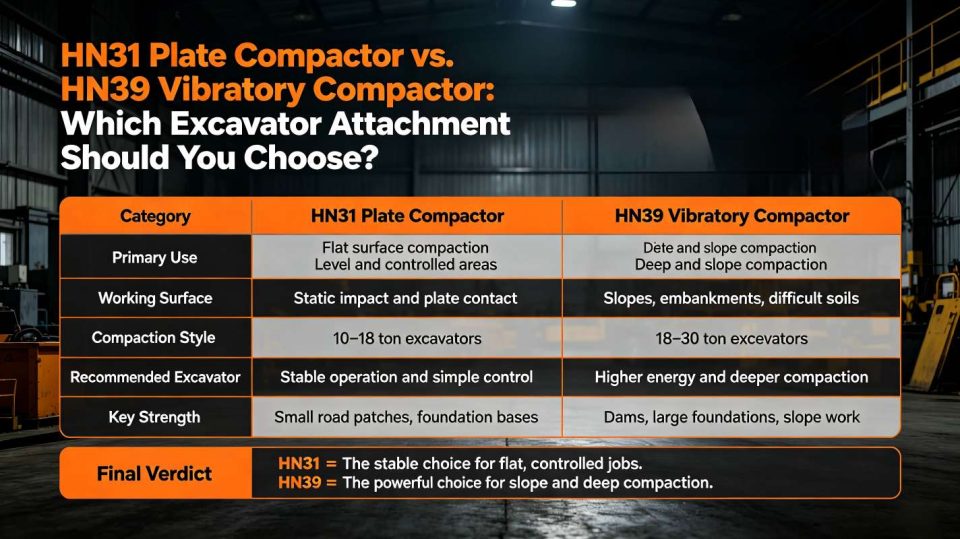
HN31 vs. HN39 at a Glance
| Selection Factor | HN31 Plate Compactor | HN39 Vibratory Compactor |
|---|---|---|
| Attachment type | Vibratory plate compactor | Drum-type vibratory compactor |
| Carrier | Excavators | Excavators |
| Published models | HN3110 | HN3940, HN3960, HN3972 |
| Published hydraulic flow | 60–80 L/min | 60–70 L/min |
| Maximum allowable pressure | 18 MPa | 20 MPa |
| Published weight | 330 kg | 760–960 kg, depending on model |
| Working configuration | Flat plate | Cylindrical drum |
| Published centrifugal force | 2,500 kg vibration force | 31–40 kN, depending on model |
| Best starting point | General soil and base compaction | Higher-capacity drum compaction and defined working widths |
| Carrier matching | 4–9 tonne excavator | Exact carrier fitment must be confirmed |
| Mounting | Excavator mounting configuration | Excavator mounting configuration |
The specifications above are taken from HCN’s current product pages. Final hydraulic, mounting and compatibility requirements should always be confirmed against the exact carrier and selected configuration before a purchase order is released.
1. The Main Difference: Plate vs. Drum
The most important distinction between the HN31 and HN39 is not simply their rated vibration performance. It is the contact geometry used to transfer vibration into the ground.
HN31: Flat-Plate Compaction
The HN31 uses a flat compaction surface. Its published dimensions are 1,040 mm long by 580 mm wide, with a total weight of 330 kg and a published compaction area of 0.6 m². HCN lists the HN3110 for 4–9 tonne excavators.
A flat plate is particularly logical where the objective is to compact a relatively broad soil surface rather than remain within a narrow trench.
Typical applications include:
- Road subbase preparation
- Foundation backfill
- General granular fill
- Embankment work
- Utility backfill where the working geometry allows plate access
- Confined areas that larger conventional rollers cannot reach
The HN31 therefore provides a relatively compact attachment format for excavators that need hydraulic compaction capability without bringing a separate compaction machine into every work area.
HN39: Drum-Type Vibratory Compaction
The HN39 uses a cylindrical drum with a published diameter of 590 mm.
HCN currently lists three configurations:
- HN3940
- HN3960
- HN3972
The published overall widths are 1,320 mm, 1,830 mm and 2,130 mm respectively. Published theoretical weights including the mount are 760 kg, 880 kg and 960 kg.
This gives the HN39 a fundamentally different working envelope from the HN31.
Instead of asking only, “How much compaction force do I need?”, the buyer should ask:
What shape of working surface do I need to compact, and how should the attachment physically contact that surface?
That question can often determine the preferred configuration before hydraulic specifications are considered.
2. HN31 vs. HN39: Technical Comparison
The two products have overlapping hydraulic requirements but significantly different physical characteristics.
HN31 Published Specifications
For the HN3110, HCN publishes:
- Length: 1,040 mm
- Width: 580 mm
- Height: 820 mm
- Total weight: 330 kg
- Vibration force: 2,500 kg
- Compaction area: 0.6 m²
- Maximum allowable pressure: 18 MPa
- Hydraulic flow: 60–80 L/min
- Compatible carrier: 4–9 tonne excavator
HN39 Published Specifications
The HN39 range is published as follows:
| Specification | HN3940 | HN3960 | HN3972 |
|---|---|---|---|
| Overall length | 850 mm | 850 mm | 850 mm |
| Overall width | 1,320 mm | 1,830 mm | 2,130 mm |
| Overall height | 670 mm | 670 mm | 670 mm |
| Drum diameter | 590 mm | 590 mm | 590 mm |
| Weight incl. mount | 760 kg | 880 kg | 960 kg |
| Centrifugal force | 31 kN @ 60 L/min | 37 kN @ 60 L/min | 40 kN @ 70 L/min |
| Hydraulic flow | 60–70 L/min | 60–70 L/min | 60–70 L/min |
| Maximum allowable pressure | 20 MPa | 20 MPa | 20 MPa |
| Carrier | Excavator | Excavator | Excavator |
These are published factory values and should be treated as model-level reference specifications rather than a substitute for final carrier compatibility confirmation.
3. Which Attachment Is Better for Open-Area Compaction?
For general open-area soil compaction, the HN31 Plate Compactor can be the more straightforward choice when its published carrier and hydraulic requirements match the excavator.
A plate provides direct contact across its working surface, making it suitable for applications such as:
- Subbase preparation
- Foundation work
- Backfill
- Embankment work
- General granular fill
- Road construction support
The HN31’s published 330 kg weight also makes it substantially lighter than the HN39 configurations. This can be important when the excavator has limited attachment handling capacity or when transport weight is an important procurement consideration.
However, buyers should not interpret lower attachment weight as automatically meaning “better.”
The attachment must still provide the required compaction performance for the project’s soil type, lift thickness and specification.
The correct question is:
Does the HN31 provide sufficient compaction capability for the required application while remaining comfortably within the excavator’s operating envelope?
If yes, its smaller attachment format can be an advantage.
4. When Does the HN39 Make More Sense?
The HN39 becomes particularly interesting when the project calls for a drum-based compaction configuration and a larger working envelope.
The three published HN39 models provide different widths:
- HN3940: 1,320 mm
- HN3960: 1,830 mm
- HN3972: 2,130 mm
The centrifugal force also increases across the published range from 31 kN to 40 kN.
This gives procurement teams more than one HN39 configuration to evaluate instead of treating the product as a single fixed-size attachment.
The HN39 can therefore be considered where the project benefits from:
- Drum-based compaction
- A wider working configuration
- Higher published centrifugal-force levels
- A heavier-duty attachment format
- An excavator capable of safely carrying the selected configuration
However, the larger physical size and weight must be evaluated carefully.
A wider attachment is not automatically more productive if the carrier cannot handle it effectively, if site access is restricted, or if the working area requires narrow passes.
5. HN31 vs. HN39 for Utility Trenches
Utility trench work requires special attention because working width and surrounding soil disturbance can be just as important as compaction force.
HCN’s Engineering Guide distinguishes plate and drum compactors by site geometry: plate compactors are generally suited to open areas, while drum configurations are particularly relevant where the compaction zone corresponds to a trench width.
For a narrow trench, neither product should be selected solely from its nominal force rating.
The buyer should first establish:
- Trench width
- Required compaction depth or lift thickness
- Soil type
- Required density or specification
- Available excavator working envelope
- Required attachment width
- Hydraulic flow and pressure
- Required number of passes
A trench that is physically too narrow for the selected attachment can create poor coverage or unnecessary contact with surrounding material.
For trench-specific projects, a purpose-designed drum configuration may therefore be more appropriate than a general-purpose plate.
6. Hydraulic Compatibility: Similar Flow Does Not Mean Identical Fit
The HN31 and HN39 have relatively close published hydraulic requirements, but that does not mean they are interchangeable from a hydraulic or mechanical perspective.
The HN31 is published at 60–80 L/min with a maximum allowable pressure of 18 MPa.
The HN39 range is published at 60–70 L/min with a maximum allowable pressure of 20 MPa.
Before ordering either attachment, the procurement team should verify:
Hydraulic flow
Confirm the excavator’s actual auxiliary hydraulic output and compare it with the selected attachment’s published range.
Hydraulic pressure
Confirm that the carrier’s auxiliary circuit operates within the attachment’s specified limits.
Hydraulic connections
Check hose routing, port configuration and coupling requirements.
Mounting interface
Verify the excavator’s pin dimensions, mounting dimensions or quick-coupler configuration.
Carrier capacity
Attachment weight affects machine balance, lift capacity, reach and overall working stability.
HCN specifically recommends submitting the carrier make and model, operating weight, mounting dimensions, coupler information and hydraulic data for fitment confirmation before order release.
7. Why Attachment Weight Matters in the Comparison
One of the clearest differences between the two products is weight.
The HN31 is published at 330 kg.
The HN39 configurations range from 760 kg to 960 kg including the mount.
That difference can influence procurement in several ways.
A lighter attachment may offer advantages where:
- The excavator has a smaller operating class
- Transport payload is limited
- Frequent attachment changes are required
- The application does not require the higher-capacity HN39 configurations
- Working reach is important
A heavier attachment may be justified where:
- The carrier has sufficient capacity
- The project benefits from the HN39’s drum configuration
- Higher published centrifugal-force levels are required
- A wider working configuration is valuable
This is why attachment selection should not be reduced to a simple “higher force = better machine” calculation.
8. Which HCN Compactor Should a Procurement Team Choose?
A practical decision framework is:
| Project Requirement | Recommended Starting Point |
|---|---|
| Smaller excavator within published HN31 range | HN31 |
| General soil and subbase compaction | HN31 |
| Lower attachment weight is important | HN31 |
| Flat-plate working surface preferred | HN31 |
| Drum-based compaction required | HN39 |
| Larger working width required | HN39 |
| Higher published centrifugal-force configuration required | HN39 |
| Excavator has sufficient capacity for a 760–960 kg attachment | HN39 |
| Exact configuration depends heavily on project geometry | Request HCN engineering review |
This table is a starting point, not a substitute for engineering verification.
The final selection should be based on the actual carrier and application.
9. HN31 or HN39? Five Questions to Ask Before Ordering
Before issuing an RFQ, procurement teams should answer five questions.
1. What excavator will operate the attachment?
Provide the exact manufacturer and model rather than only saying “8-ton excavator” or “mid-size excavator.”
2. What hydraulic flow and pressure are available?
Provide the auxiliary circuit specifications from the machine documentation.
3. What is the working geometry?
Is the project an open foundation, road subbase, embankment, utility trench or another confined area?
4. What attachment weight can the excavator safely handle?
Do not assume that an attachment with the correct hydraulic flow is automatically suitable for the carrier.
5. What mounting system is required?
Provide pin dimensions, mounting dimensions and coupler information where applicable.
HCN’s product pages explicitly recommend confirming carrier model, mounting interface, operating weight, hydraulic flow and pressure before production.
10. Total Cost of Ownership: Look Beyond the Purchase Price
For professional fleets, the lowest purchase price is not necessarily the lowest-cost solution.
A compactor attachment should be evaluated over its operating life.
Consider:
- Initial purchase cost
- Carrier utilization
- Attachment weight
- Productivity per pass
- Hydraulic efficiency
- Wear-part availability
- Maintenance requirements
- Downtime risk
- Transport requirements
- Compatibility with existing couplers
- Spare-parts support
- Documentation requirements
- Future OEM or private-label requirements
HCN’s current product pages emphasize factory engineering, CE conformity, ISO 9001:2015 quality management and compatibility verification as part of the procurement process. The company states that its manufacturing campus covers 21,000 m² and that it supplies customers in more than 60 countries.
For international procurement, technical documentation and compatibility confirmation can be just as important as the initial attachment price.
11. How HCN Can Support a More Reliable Procurement Process
HCN’s current product system covers compaction attachments alongside hydraulic breakers, excavator buckets, quick couplers, road-maintenance equipment, forestry attachments, snow-removal equipment, mining attachments, material-handling equipment and agricultural attachments.
This broader product structure is useful for fleet buyers because compaction is rarely an isolated requirement.
For example, a road contractor may need:
- A cold planer for pavement removal
- A compactor for base preparation
- A sweeper for cleanup
- A breaker for localized demolition
A municipal fleet may require compactors alongside sweepers and road-maintenance attachments.
An equipment distributor may need several attachment configurations built around different carrier brands.
For these applications, the supplier’s engineering and manufacturing capability becomes part of the purchasing decision.
HCN states that it operates a 21,000 m² manufacturing campus and supports OEM programs, with its current site describing more than 400 product models, more than 1,000 specifications, 500+ patents and exports to more than 60 countries.
For OEM and private-label procurement, buyers should still request the exact technical drawing, mounting configuration, hydraulic specification and documentation for the specific production configuration rather than relying on general corporate figures.
Final Recommendation: Choose by Site Geometry First, Then by Specification
The HN31 and HN39 should not be treated as two versions of the same compactor.
They solve related but different compaction requirements.
Choose the HN31 Plate Compactor as the starting point when a relatively lightweight, flat-plate excavator attachment is appropriate for general soil, subbase, foundation or embankment compaction and the carrier falls within the published 4–9 tonne range.
Choose the HN39 Vibratory Compactor as the starting point when a drum configuration, larger working width or higher published centrifugal-force configuration better matches the project, provided that the excavator can safely carry the selected model.
Most importantly, do not make the final decision from attachment weight, centrifugal force or hydraulic flow alone.
A professional specification should connect four elements:
Carrier → Hydraulic System → Mounting Interface → Working Application
If those four elements are matched correctly, the attachment has a much better chance of delivering the expected productivity and service life.
For an HN31 or HN39 quotation, provide the excavator make and model, operating weight, hydraulic flow and pressure, coupler or mounting dimensions, working conditions and intended application. HCN can then confirm the appropriate configuration and provide the exact technical specification and mounting information before purchase-order release.
Frequently Asked Questions
1. What is the difference between the HN31 and HN39 compactors?
The HN31 is a flat-plate compactor listed for 4–9 tonne excavators, while the HN39 is a drum-type vibratory compactor available in three configurations: HN3940, HN3960 and HN3972. Their published weights, working widths and centrifugal-force ratings are different.
2. What hydraulic flow does the HN31 require?
The HN31 HN3110 is published with a hydraulic flow requirement of 60–80 L/min and a maximum allowable pressure of 18 MPa. Final configuration should be confirmed with HCN engineering.
3. What hydraulic flow does the HN39 require?
The HN39 models are published with a hydraulic flow range of 60–70 L/min and a maximum allowable pressure of 20 MPa. The centrifugal-force rating varies by model.
4. Which is better for utility trench compaction?
The answer depends on trench geometry, width, soil type and required compaction performance. Drum-type compactors can be advantageous where the compaction zone follows a defined trench width, while plate compactors are generally more versatile for broader surfaces.
5. Can the HN31 fit any 4–9 tonne excavator?
Not automatically. HCN lists the HN31 for 4–9 tonne excavators, but final compatibility should be confirmed using the exact carrier model, operating weight, mounting dimensions, hydraulic flow and pressure.
6. What are the HN39 model differences?
The HN3940, HN3960 and HN3972 have different published widths, weights and centrifugal-force ratings. Their hydraulic flow range is 60–70 L/min across the listed models.
7. Should I select a compactor based on centrifugal force alone?
No. Centrifugal force is only one selection parameter. Carrier capacity, hydraulic flow and pressure, mounting interface, soil conditions, working width, lift thickness and site geometry should all be evaluated before ordering.
8. What information should I send HCN for a compactor quotation?
Provide the exact carrier make and model, operating weight, auxiliary hydraulic flow and pressure, coupler or mounting dimensions, intended application and working conditions. HCN recommends using these details for final fitment confirmation before production.
Recommended Internal Linking Structure
- HN31 Plate Compactor →
/products/hn31-plate-compactor/ - HN39 Vibratory Compactor →
/products/hn39-vibratory-compactor/ - Soil Compaction Machines & Vibratory Compactors →
/products/soil-compaction-machines/ - How to Choose a Compactor Attachment →
/guide/how-to-choose-compactor-attachment/ - Engineering Guides →
/guide/ - Road Construction & Pavement Maintenance Equipment →
/products/road-construction-equipment/ - Construction Engineering Applications →
/applications/construction-engineering/ - Case Studies →
/case-studies/ - Request a Quote / Contact HCN →
/contact/
This creates a logical comparison article → individual product → product category → technical guide → application → case study → RFQ conversion path.
Related Product Lines & Technical Guides
Use these HCN resources to compare specifications, carrier fit, and export procurement options referenced in this article.
- Hydraulic Breakers & Rock Hammers →
- Snow Removal Equipment & Attachments →
- Soil Compaction Machines & Vibratory Compactors →
- Excavator Buckets & Grapples →
- Forestry Mulchers & Land Clearing Attachments →
- Mining & Port Loader Attachments →
- Construction Attachments →
- Road Construction & Municipal Attachments →