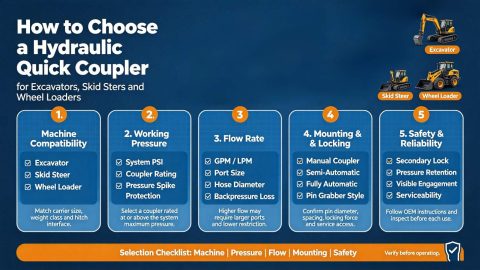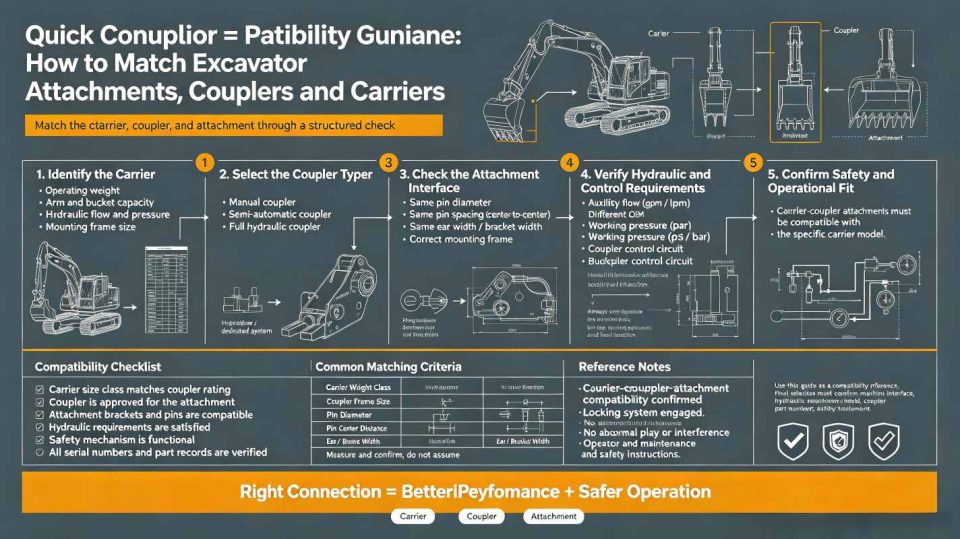
Choosing a quick coupler for an excavator or other construction machine is not simply a matter of selecting a coupler that matches the machine’s operating weight.
The coupler, carrier and attachment form one mechanical system. If the pin geometry, mounting dimensions, locking mechanism, hydraulic connections or attachment interface are incorrect, a technically capable attachment can still become difficult to install, unsafe to operate or unsuitable for the intended fleet.
For contractors, equipment dealers, rental companies, OEMs, distributors and fleet managers, quick coupler selection should therefore be treated as an engineering and procurement decision.
This guide explains the key compatibility checks to complete before ordering a hydraulic or manual quick coupler and shows how the same principles apply across excavator buckets, hydraulic breakers, compactors, grapples and other attachments.
Why Quick Coupler Compatibility Matters
A quick coupler sits between the carrier and the attachment. That means it introduces another interface into the equipment system.
The carrier must connect correctly to the coupler, while the coupler must engage correctly with the attachment.
A successful installation therefore depends on three interfaces:
- Carrier to coupler
- Coupler to attachment
- Hydraulic or mechanical systems supporting the coupler and attachment
This is especially important for fleets using several attachments on the same carrier. A contractor may change between a bucket, breaker, compactor, grapple or other tool during the working day. A rental company may need one coupler configuration to support repeated attachment changes across demanding duty cycles.
HCN’s current procurement guidance similarly emphasizes that hydraulic compatibility does not automatically guarantee mechanical compatibility. Pin diameter, pin-to-pin distance, mounting dimensions, coupler type, mounting height, hose routing and movement clearance all need to be verified.
What Information Should You Collect Before Ordering?
Before requesting a quotation, collect the machine and attachment information available from the original equipment manufacturer.
At minimum, prepare:
- Carrier make and model
- Carrier operating weight
- Existing attachment type
- Pin diameter
- Pin-to-pin distance
- Stick or mounting width
- Existing coupler make and model, if applicable
- Auxiliary hydraulic flow
- Auxiliary hydraulic pressure
- Hydraulic connection type
- Attachment mounting dimensions
- Required attachment applications
- Photos of the existing mounting interface
For OEM and private-label programs, technical drawings are preferable to measurements taken from memory or informal descriptions.
The more complete the input data, the easier it is for an attachment manufacturer to verify the configuration before production.
HCN states that its engineers check bracket geometry against OEM pin groups and can produce custom bracket drawings for non-standard carriers.
1. Verify the Carrier Before Selecting the Coupler
The carrier is the starting point.
An excavator’s nominal tonne class is useful for initial screening, but it is not enough to determine the correct coupler.
Two machines in the same operating-weight class can have different:
- Pin dimensions
- Pin spacing
- Stick widths
- Hydraulic configurations
- Coupler interfaces
- Attachment geometries
- Manufacturer-specific mounting arrangements
For that reason, procurement teams should provide the exact carrier model rather than simply specifying “20-ton excavator” or “30-ton excavator.”
Carrier information checklist
| Parameter | Why it matters |
|---|---|
| Machine make and model | Identifies the basic carrier configuration |
| Operating weight | Helps establish suitable attachment and coupler class |
| Pin diameter | Determines mechanical connection |
| Pin-to-pin distance | Determines mounting geometry |
| Stick width | Determines bracket fit |
| Auxiliary flow | Required for hydraulic couplers and powered attachments |
| Hydraulic pressure | Must remain within the attachment/coupler operating range |
| Coupler type | Determines attachment interface |
| Machine photos | Helps verify real-world geometry |
The exact specification should always be confirmed against the carrier manufacturer’s technical information.
2. Check the Coupler-to-Attachment Interface
A common procurement mistake is checking only whether the coupler fits the excavator.
The second question is equally important:
Will the coupler correctly engage the attachments that the fleet intends to use?
An excavator may need to operate with several attachment types, such as:
- General-purpose buckets
- Rock buckets
- V-ditch buckets
- Skeleton buckets
- Hydraulic breakers
- Grapples
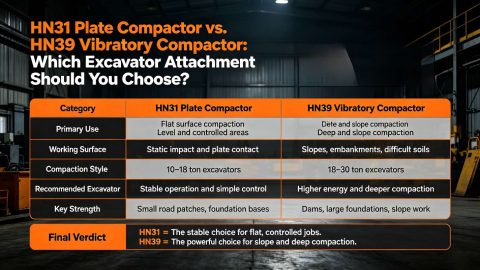
- Compaction attachments
- Forestry attachments
- Other specialty tools
Different attachments can have different mounting geometry.
For example, an excavator bucket may be mechanically straightforward, while a hydraulic breaker adds hydraulic hoses, working clearance and potentially different bracket geometry.
A compactor or grapple may introduce additional hydraulic requirements.
The correct procurement process is therefore to define the attachment fleet first, then confirm whether the selected coupler supports the required attachment interfaces.
3. Manual vs Hydraulic Quick Couplers
The choice between a manual and hydraulic quick coupler depends heavily on operating frequency, fleet structure and productivity requirements.
| Factor | Manual Quick Coupler | Hydraulic Quick Coupler |
|---|---|---|
| Initial system complexity | Lower | Higher |
| Attachment change process | Requires manual engagement | Hydraulic/cab-controlled system |
| Frequent attachment changes | Less suitable | Strong fit |
| Rental fleet applications | Moderate | Strong fit |
| Multi-attachment contractors | Moderate | Strong fit |
| Procurement priority | Simplicity | Productivity and utilization |
| Operator involvement | Greater | Reduced ground-level involvement |
A manual system can be appropriate where attachments are changed relatively infrequently and simplicity is the main priority.
A hydraulic quick coupler becomes more attractive when attachment changes are frequent and machine utilization is important.
HCN’s current compatibility guidance identifies hydraulic quick couplers as particularly relevant to rental fleets and high-frequency attachment changes.
The correct decision should therefore be based on the fleet’s operating pattern rather than assuming that one coupler type is universally better.
4. Hydraulic Compatibility Still Matters
A quick coupler may be primarily a mechanical interface, but hydraulic systems cannot be ignored when selecting a hydraulic coupler or when the carrier will operate hydraulic attachments.
The procurement team should verify:
- Auxiliary hydraulic flow
- Operating pressure
- Hydraulic hose size
- Coupling type
- Hose routing
- Connection location
- Available auxiliary circuits
- Pressure-relief configuration where applicable
This becomes particularly important when the same carrier operates multiple hydraulic attachments.
For example, HCN’s current product range includes powered attachments such as hydraulic breakers, sweepers and compactors with different published hydraulic requirements. The 0202 Sweeper Broom, for example, lists a carrier flow of 60–80 L/min, while the BM12 Forward Sweeper has model-specific requirements of 180–200 L/min and 200–240 L/min.
The lesson for fleet procurement is simple:
Do not assume that a carrier capable of using one hydraulic attachment will automatically meet the requirements of every attachment in the fleet.
The exact attachment specification should be checked separately.
5. Check Pin Geometry and Mounting Dimensions
Pin geometry is one of the most important mechanical compatibility checks.
Before ordering, confirm:
Pin diameter
The pin must match the relevant attachment and coupler interface.
Pin-to-pin distance
The distance between mounting points affects the geometry of the connection and must be checked against the actual carrier and attachment configuration.
Stick or bracket width
The mounting structure must fit the carrier without excessive clearance or interference.
Mounting height
Changes in mounting geometry can affect:
- Digging geometry
- Breakout force
- Working reach
- Attachment angle
- Machine balance
- Clearance
Full-range movement
The attachment should be checked throughout the intended working range.
A connection that looks correct when parked may still create interference when the boom, stick or attachment is fully curled, extended or lifted.
HCN’s published compatibility process specifically calls for checking pin diameter, pin-to-pin distance, mounting bracket dimensions, coupler type, attachment plate dimensions, mounting height, hose routing and clearance during machine movement.
6. Do Not Ignore Hose Routing and Clearance
Hydraulic hoses are often treated as a secondary detail during procurement.
They should not be.
Incorrect hose routing can result in:
- Abrasion
- Pinching
- Excessive bending
- Contact with the attachment
- Contact with the carrier
- Damage during full articulation
When evaluating a hydraulic quick coupler or hydraulic attachment, inspect the complete movement envelope.
Ask:
- Where are the hydraulic ports located?
- Where will hoses run after installation?
- Can the hoses move freely through the full working range?
- Can the hoses contact the boom, stick or attachment?
- Is there sufficient clearance when the attachment is fully curled?
- Does the configuration remain practical during transport?
This is particularly important for rental fleets because equipment may be operated by different operators with different levels of familiarity with the attachment system.
7. Consider How the Coupler Changes Attachment Geometry
Installing a quick coupler can change the relationship between the excavator and the attachment.
The additional structure can influence:
- Attachment offset
- Working height
- Reach
- Digging depth
- Breakout geometry
- Attachment angle
- Machine balance
For buckets, this may influence digging performance.
For breakers, the mounting geometry affects the position of the breaker relative to the stick and coupler.
For compactors and other powered attachments, clearance and operating orientation must also be considered.
This is why “the coupler fits the excavator” is not the same as “the coupler is optimized for every attachment in the fleet.”
The final configuration should be checked against the intended application.
8. Quick Coupler Selection by Fleet Application
Different buyers have different priorities.
| Buyer | Main Priority | Recommended Evaluation Focus |
|---|---|---|
| Contractor | Productivity | Changeover speed, attachment range, fitment |
| Rental company | Fleet flexibility | Repeatable interfaces, durability, operator usability |
| Equipment dealer | Product range | Carrier coverage, attachment compatibility, documentation |
| OEM | Integration | Drawings, mounting geometry, hydraulic interfaces, repeatability |
| Distributor | SKU management | Compatibility coverage, documentation, spare parts |
| Fleet manager | Total cost | Utilization, maintenance, attachment interchangeability |
| Procurement team | Risk control | Drawings, certification, testing, lead time, supplier support |
A rental fleet, for example, may place greater value on fast and repeatable attachment changes than a contractor who changes attachments only occasionally.
An OEM may place more emphasis on technical drawings, interface consistency, documentation and repeatability across production batches.
The purchasing decision should reflect the actual operating model.
9. Think Beyond the Initial Purchase Price
The cheapest coupler is not necessarily the lowest-cost option over its service life.
For professional fleets, evaluate the total cost of ownership.
Consider:
Attachment change time
Frequent manual attachment changes can accumulate significant labour and downtime.
Maintenance
Check access to wear components, locking components, hydraulic components and replacement parts.
Compatibility
A coupler that supports more of the fleet’s existing attachment inventory can increase equipment utilization.
Spare parts
Ask whether seals, locking components and other service parts can be supplied separately.
Technical support
For non-standard carrier configurations, engineering support can prevent expensive field modifications.
Documentation
OEM and international procurement programs may require technical drawings, conformity documentation and product records.
HCN states that its manufacturing operation includes CNC machining, laser cutting, robotic welding, heat treatment, hydraulic testing and final quality inspection on its integrated manufacturing campus. Its OEM programs also include private-label configuration, packaging and export documentation.
10. What Should an RFQ Include?
A well-prepared RFQ can significantly reduce the risk of receiving an unsuitable configuration.
For a quick coupler or attachment procurement project, provide:
Machine information
- Make
- Model
- Operating weight
- Pin diameter
- Pin-to-pin distance
- Stick width
- Hydraulic flow
- Hydraulic pressure
Coupler information
- Manual or hydraulic
- Existing coupler, if replacing one
- Required attachment interface
- Number of attachments to be used
Attachment information
- Bucket type
- Breaker
- Grapple
- Compactor
- Sweeper
- Forestry attachment
- Other specialty equipment
Application information
- Material
- Duty cycle
- Working environment
- Frequency of attachment changes
- Required productivity
- Transport requirements
Documentation
Request, where applicable:
- Technical drawing
- Mounting dimensions
- Hydraulic requirements
- Compatibility confirmation
- Declaration of Conformity or applicable certification documentation
- Spare-parts information
- Warranty terms
- Lead time
This approach turns an RFQ from a price request into an engineering specification.
Quick Coupler Procurement Checklist
Before releasing a purchase order, confirm the following:
- Exact carrier make and model identified
- Carrier operating weight confirmed
- Pin diameter confirmed
- Pin-to-pin distance confirmed
- Stick width confirmed
- Coupler type selected
- Attachment interface confirmed
- Hydraulic flow checked
- Hydraulic pressure checked
- Hose routing reviewed
- Full movement clearance checked
- Attachment geometry reviewed
- Intended attachments listed
- Technical drawing approved
- Certification/documentation requirements confirmed
- Spare-parts availability confirmed
- Lead time confirmed
- OEM/private-label requirements documented where applicable
If any critical dimension is unknown, the safer approach is to obtain the manufacturer’s technical information before placing the order.
How HCN Supports Attachment and Coupler Procurement
HCN Attachments Manufacture Co., Ltd. operates as an engineering and manufacturing supplier rather than simply a trading company.
The company was established in 2008 and currently describes a 21,000 m² manufacturing campus in Xuzhou, China, with 400+ product models, more than 1,000 SKU-level variants and 500+ registered patents. HCN also states that it serves customers in more than 60 countries and has more than 10 years of OEM program experience.
Its product portfolio covers hydraulic breakers, excavator buckets, quick couplers, compaction equipment, forestry attachments, snow-removal equipment, road-maintenance attachments, material-handling equipment and other specialized attachment categories.
For non-standard applications, HCN states that its engineering team can work with unusual pin dimensions, non-standard carrier brands and specialized mounting requirements.
This is particularly relevant for international procurement teams because attachment sourcing often involves mixed fleets, different OEM interfaces and market-specific configurations.
The most useful information to provide HCN is therefore not simply “I need a quick coupler.”
Instead, provide the carrier model, mounting dimensions, existing attachment interface, hydraulic information and intended attachment fleet.
That allows the engineering team to evaluate the complete system.
FAQ
1. How do I know if a quick coupler will fit my excavator?
Start with the exact excavator make and model, then verify pin diameter, pin-to-pin distance, stick width and mounting geometry. Do not rely only on the excavator’s tonne class.
2. Can one quick coupler work with different excavator attachments?
It can, provided the attachments use a compatible interface and the coupler is correctly matched to the carrier and attachment geometry. Each attachment should still be checked before procurement.
3. Are hydraulic quick couplers better than manual couplers?
Neither is universally better. Manual couplers can suit applications with infrequent attachment changes, while hydraulic couplers are particularly useful for high-frequency changes and rental or multi-attachment fleets.
4. Does hydraulic flow matter when buying a quick coupler?
It matters when the coupler itself uses hydraulic actuation and whenever the carrier will operate hydraulic attachments. The exact flow and pressure requirements should be checked against the selected configuration.
5. What measurements should I provide to a coupler manufacturer?
At minimum, provide the carrier make and model, operating weight, pin diameter, pin-to-pin distance, stick width, existing coupler information and relevant hydraulic specifications. Photos and technical drawings are also useful.
6. Can a quick coupler change excavator performance?
Yes. Adding a coupler changes the attachment’s mounting geometry and can influence reach, digging geometry, breakout characteristics, attachment angle and overall machine balance.
7. Should I use a quick coupler with a hydraulic breaker?
A breaker can be used with a suitable quick coupler, but the complete breaker, coupler and carrier configuration should be checked for mounting geometry, hydraulic requirements, hose routing and operating clearance before ordering.
8. Can HCN manufacture a custom mounting configuration?
HCN states that it can engineer custom attachment solutions for non-standard carrier brands, unusual pin dimensions and specialized applications. Buyers should provide the carrier and attachment interface information so the engineering team can confirm the required configuration.
Final Procurement Recommendation
A quick coupler should never be purchased as an isolated component.
The correct approach is to evaluate the carrier + coupler + attachment + hydraulic system + application as one working system.
Before issuing a purchase order, confirm the mechanical interface, hydraulic requirements, movement clearance, attachment geometry, documentation and long-term service requirements.
For contractors and rental fleets, this can reduce attachment-change downtime and improve equipment utilization. For dealers and distributors, accurate compatibility information can reduce specification errors and returns. For OEM buyers, detailed interface verification provides a stronger foundation for repeatable production and private-label programs.
When exact dimensions or hydraulic requirements are unavailable, do not guess.
Provide the machine model, mounting measurements, hydraulic data and intended attachment to the manufacturer and request an exact compatibility confirmation, technical drawing or configuration review before production.
That is the most reliable way to turn a quick coupler from a simple accessory into a productive part of a professional attachment system.
Related Product Lines & Technical Guides
Use these HCN resources to compare specifications, carrier fit, and export procurement options referenced in this article.
- Hydraulic Breakers & Rock Hammers →
- Snow Removal Equipment & Attachments →
- Soil Compaction Machines & Vibratory Compactors →
- Excavator Buckets & Grapples →
- Forestry Mulchers & Land Clearing Attachments →
- Mining & Port Loader Attachments →
- Construction Attachments →
- Road Construction & Municipal Attachments →