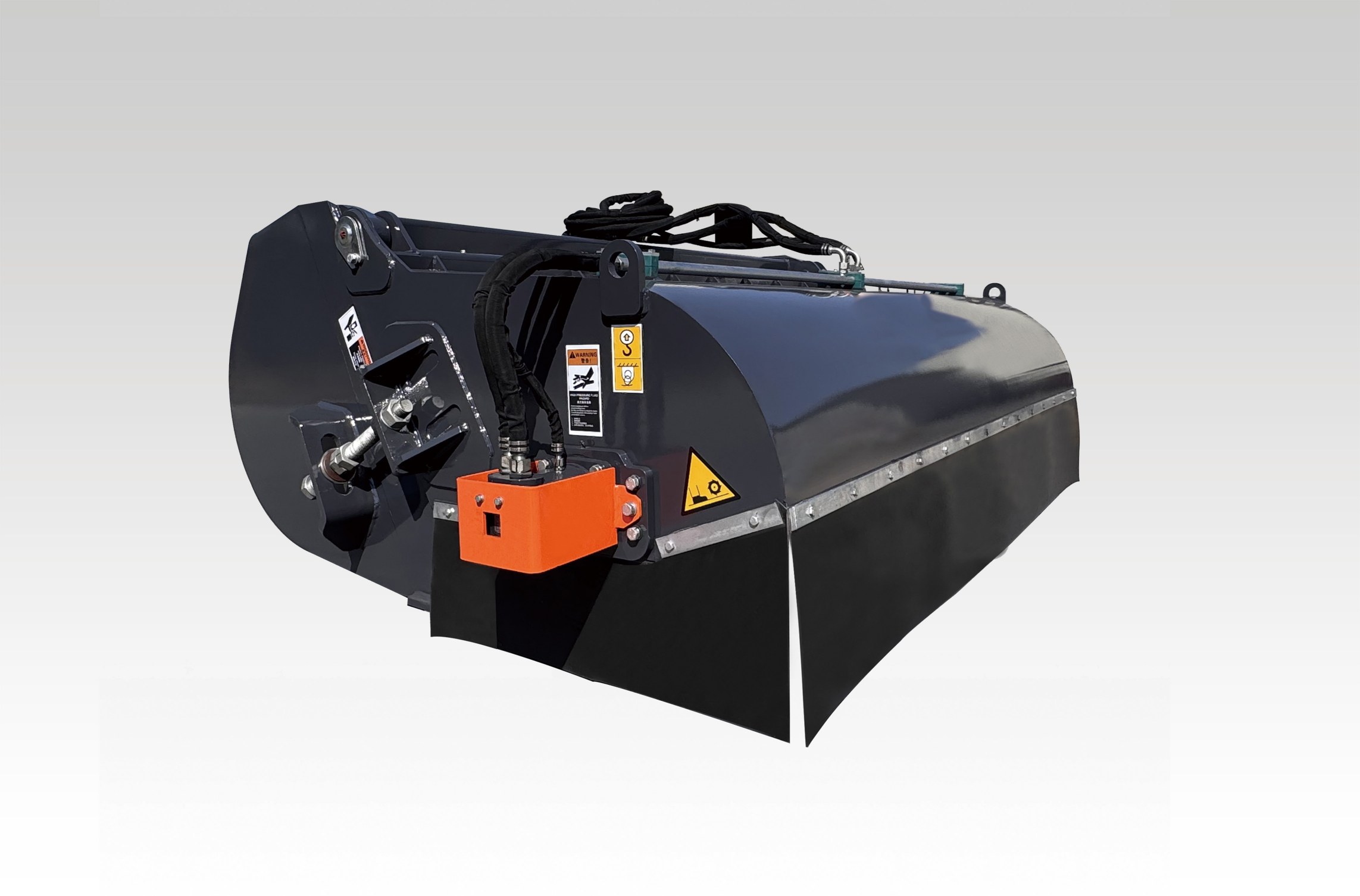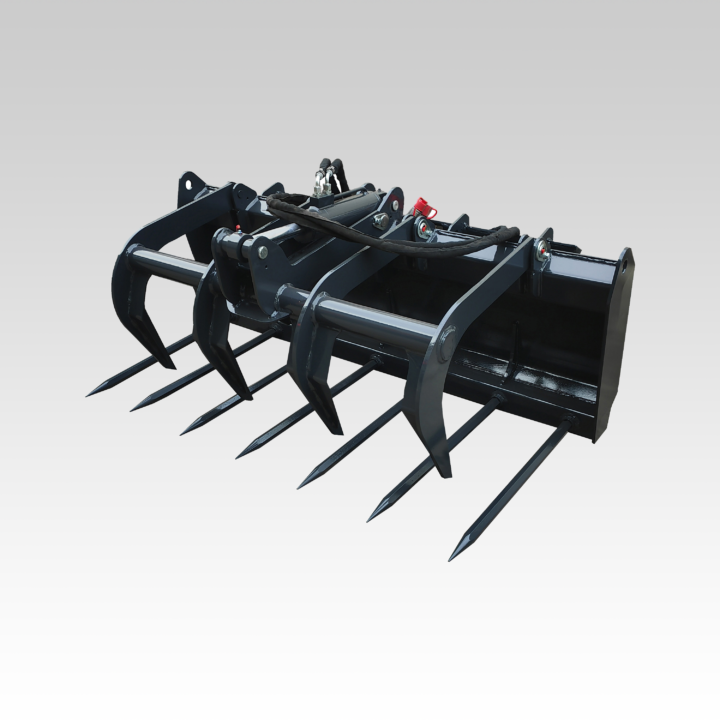
For agricultural contractors, livestock operators, farm managers and equipment dealers, moving hay, straw and silage bales is a regular material-handling task. The right attachment can make loading, stacking, transporting and feeding operations more efficient while reducing unnecessary handling and the risk of damaging valuable forage.
However, not every bale handling attachment works in the same way.
A bale spear supports a bale using penetrating tines. A bale clamp holds material between opposing gripping surfaces. A hay grapple uses a jaw arrangement to collect and retain hay or other bulky agricultural material.
Choosing between these options requires more than comparing attachment prices. Bale dimensions, bale weight, wrapping, moisture content, machine lifting capacity, hydraulic flow, mounting interface and the frequency of handling all influence the final selection.
HCN Attachments Manufacture Co., Ltd offers several bale handling products for skid steer loaders and wheel loaders, including the 0509 Hay Grapple, 0501 Bale Clamp, 0405 Soft Bale Clamp, BM24 Soft Bale Clamp, BM10 Bale Fork and 0507 Bale Fork/Bale Spear.
This guide explains how these attachment types differ, how to evaluate their specifications and what agricultural equipment buyers should confirm before purchasing.
1. Understanding the Three Main Bale Handling Attachment Types
Before comparing individual models, buyers should understand the mechanical differences between bale spears, bale clamps and hay grapples.
1.1 Bale Spear: Supporting Bales with Tines
A bale spear uses one or more steel tines to penetrate and support a bale during lifting and transport.
The attachment transfers the bale’s weight through the tines into the carrier’s mounting structure.
Typical applications include:
- Moving dry round hay bales.
- Handling suitable square bales.
- Loading and unloading agricultural trailers.
- Stacking bales in storage areas.
- Moving forage around farms and livestock facilities.
The main advantage is its relatively straightforward mechanical arrangement.
A bale spear does not require the same gripping action as a hydraulic clamp, making it worth considering for operations where the bale structure can safely support penetration.
However, spear selection requires attention to tine length, spacing, strength and the position of the bale’s centre of gravity.
Wrapped silage bales require particular care. Penetrating the plastic film can damage the wrapping and compromise preservation. A spear should not be used on wrapped bales unless the handling method and attachment are specifically suitable for that purpose.
1.2 Bale Clamp: Holding Bales Between Gripping Surfaces
A bale clamp uses opposing arms or gripping surfaces to hold a bale without relying entirely on penetrating support.
This arrangement is useful when the bale’s surface or construction makes a penetrating attachment undesirable.
Potential applications include:
- Handling suitable soft or compressed bales.
- Moving selected wrapped forage bales.
- Stacking agricultural materials.
- Loading and unloading bales.
- Repeated handling operations in livestock facilities.
HCN offers both standard and soft bale clamp configurations.
The 0501 Bale Clamp and 0405 Soft Bale Clamp are listed for skid steer loaders, while the BM24 Soft Bale Clamp is listed for wheel loaders.
An important consideration is gripping pressure.
Too little gripping force can allow the bale to slip. Excessive or uneven force can deform the bale or damage its wrapping.
For wrapped silage, buyers should confirm the jaw contact design, surface protection and suitability for the specific wrapping material before ordering.
1.3 Hay Grapple: Handling Bulky Agricultural Material
A hay grapple uses a jaw mechanism to grip and retain bulky material.
Unlike a simple fork, it provides an additional holding action that can help control material during lifting, transport and stacking.
Typical applications to evaluate include:
- Hay handling.
- Forage movement.
- Agricultural material loading.
- Bale stacking, subject to bale dimensions and grapple geometry.
- Moving irregular agricultural material.
HCN’s 0509 Hay Grapple is designed for skid steer loaders and is available in three configurations.
The published product information includes a jaw opening distance of 1,200 mm and tooth spacing of 240 mm.
The attachment’s overall length and weight vary by model.
Buyers should confirm whether the grapple geometry is suitable for their actual bale dimensions, particularly when handling large round bales or irregularly shaped material.
2. Bale Spear vs. Bale Clamp vs. Hay Grapple: Technical Comparison
The following table summarizes the main differences.
| Comparison | Bale Spear / Fork | Bale Clamp | Hay Grapple |
|---|---|---|---|
| Working principle | Supports material using tines | Holds material between gripping surfaces | Collects and retains material using jaws |
| Main application | Bale lifting and transport | Controlled bale gripping | Hay and bulky material handling |
| Bale penetration | Yes | No, in normal clamping operation | Depends on tine and jaw design |
| Hydraulic operation | Depends on configuration | Hydraulic clamping on powered models | Depends on configuration |
| Main selection factor | Tine arrangement and load capacity | Grip range and rated gripping capacity | Jaw opening and tooth arrangement |
| Wrapped bale handling | Risk of damaging wrapping | Worth evaluating with suitable contact design | Must be confirmed for the specific design |
| Carrier options in HCN range | Skid steer and wheel loader models | Skid steer and wheel loader models | Skid steer model listed |
| Important limitation | Penetration and tine loading | Gripping pressure and bale deformation | Jaw geometry and rated capacity |
These attachment types are not interchangeable in every operation.
A farm handling dry, dense round bales may prioritize a different attachment from a livestock business handling wrapped silage or a contractor moving irregular hay material.
The best selection begins with the actual material and handling process.
3. Which Attachment Is Better for Different Bale Types?
Bale type is one of the most important factors in attachment selection.
3.1 Dry Round Hay Bales
Dry round bales are commonly handled through repeated lifting, transport and stacking operations.
A bale spear can be considered where the bale structure and required support arrangement allow safe penetration.
A hay grapple may also be worth evaluating when additional retention is needed during movement.
The choice depends on:
- Bale diameter.
- Bale width.
- Bale mass.
- Bale density.
- Storage and stacking arrangement.
- Required transport distance.
A larger bale does not automatically require a more powerful attachment. The carrier’s rated capacity and the attachment’s load characteristics must also be checked.
3.2 Square Bales
Square bales vary considerably in dimensions and mass.
Smaller square bales and large agricultural square bales should not be treated as the same handling requirement.
For larger bales, buyers should consider:
- Bale length and cross-section.
- Number of bales handled per operation.
- Required stacking height.
- Fork or spear support position.
- Carrier visibility.
- Attachment width.
A fork arrangement may be suitable when the bale can be supported securely.
A grapple can be evaluated where additional retention is needed, but the jaw opening must accommodate the actual bale dimensions.
3.3 Wrapped Silage Bales
Wrapped silage requires special consideration because the plastic film protects the forage during storage.
Damaging the film can allow air and moisture to enter, affecting preservation.
For this reason, a clamp designed for suitable soft or wrapped bales may be preferable to an attachment that penetrates the wrapping.
However, the product name alone does not prove that a clamp is suitable for every wrapped bale.
Before purchasing, confirm:
- Jaw contact surface.
- Available gripping width.
- Maximum rated gripping capacity.
- Clamping force control.
- Compatibility with the bale diameter.
- Whether the design is suitable for the specified wrapping material.
HCN’s 0405 and BM24 Soft Bale Clamp models provide two different carrier configurations worth evaluating for this type of operation.
3.4 Loose Hay and Irregular Forage
Loose hay and irregular agricultural material may require a grapple rather than a simple spear.
The jaw arrangement can help retain material that does not have the consistent shape of a compact bale.
The 0509 Hay Grapple is an option to evaluate for skid steer applications.
Its tooth spacing and jaw opening should be checked against the material being handled.
For loose hay, buyers should also consider whether the attachment geometry provides adequate retention without excessive material loss.
4. HCN Bale Handling Attachments: Product and Specification Comparison
HCN’s agricultural and material-handling catalog includes several models for different carrier platforms.
The following table uses the published product specifications.
| HCN Product | Carrier Type | Published Weight | Key Specification |
|---|---|---|---|
| 0507 Bale Fork / Bale Spear | Skid Steer Loader | 140 kg | Three-tine arrangement |
| BM10 Bale Fork | Wheel Loader | 465 kg | Three fork tines |
| 0501 Bale Clamp | Skid Steer / Compact Loader | 230 kg | 950 mm jaw opening |
| 0405 Soft Bale Clamp | Skid Steer / Compact Loader | 405 kg | 500–1,500 mm clamp range |
| BM24 Soft Bale Clamp | Wheel Loader | 720–1,100 kg | 700–2,090 mm grip range |
| 0509 Hay Grapple | Skid Steer Loader | 310–580 kg | 1,200 mm jaw opening |
The product pages do not publish a complete rated bale capacity for every model. Therefore, the weights above must not be interpreted as lifting capacities.
4.1 0507 Bale Fork / Bale Spear
The HCN 0507 Bale Fork/Bale Spear is listed for skid steer loaders.
Published specifications:
- Model: 050701.
- Overall length: 1,400 mm.
- Overall width: 1,206 mm.
- Overall height: 906 mm.
- Tine arrangement: Three tines, consisting of two short tines and one long tine.
- Weight including mounting: 140 kg.
This configuration is worth evaluating for skid steer operators requiring a compact bale-handling attachment.
However, the product page does not publish a rated load capacity.
Buyers should request the approved load rating, tine dimensions, material specification and carrier compatibility confirmation before ordering.
Product details: HCN 0507 Bale Fork / Bale Spear.
4.2 BM10 Bale Fork for Wheel Loaders
The BM10 Bale Fork is listed for wheel loaders.
Published specifications:
- Model: BM10A30.
- Overall length: 1,750 mm.
- Overall width: 2,200 mm.
- Overall height: 2,500 mm.
- Number of fork tines: 3.
- Total weight including mounting hardware: 465 kg.
Its larger overall dimensions make carrier geometry and visibility important purchasing considerations.
The current product page does not publish a rated lifting capacity.
For wheel loader fleets, buyers should request the load rating at the relevant operating position and verify the machine’s load chart.
Product details: HCN BM10 Bale Fork.
4.3 0501 Bale Clamp for Skid Steer Loaders
The HCN 0501 Bale Clamp is a hydraulic attachment listed for skid steer and compact loaders.
Published specifications:
| Parameter | Published Value |
|---|---|
| Overall length | 980 mm |
| Overall width | 1,524 mm |
| Closed height | 710 mm |
| Open height | 1,140 mm |
| Jaw opening | 950 mm |
| Weight including mount | 230 kg |
| Hydraulic flow | 20–30 L/min |
| Maximum allowable pressure | 21 MPa |
The relatively compact attachment weight is worth considering when evaluating a skid steer configuration.
The hydraulic flow requirement should be compared with the actual auxiliary circuit output.
Buyers should also confirm the intended bale dimensions and rated gripping capacity, which are not stated in the current specification table.
Product details: HCN 0501 Bale Clamp.
4.4 0405 Soft Bale Clamp
The 0405 Soft Bale Clamp is listed for skid steer and compact loaders.
Published specifications:
| Parameter | Published Value |
|---|---|
| Overall length | 1,200 mm |
| Overall width | 1,630 mm |
| Overall height | 735 mm |
| Clamp range | 500–1,500 mm |
| Weight including mount | 405 kg |
| Hydraulic flow | 30–60 L/min |
| Maximum allowable pressure | 21 MPa |
| Maximum load | 600 kg |
The clamp range is an important selection factor.
A bale must fit within the operating range without requiring excessive jaw travel or unsuitable gripping pressure.
The published maximum load of 600 kg should be confirmed against the manufacturer’s rating conditions and must not be treated as the carrier machine’s lifting capacity.
This model may be worth evaluating for operations requiring controlled gripping of appropriately sized bales.
Product details: HCN 0405 Soft Bale Clamp.
4.5 BM24 Soft Bale Clamp for Wheel Loaders
The BM24 Soft Bale Clamp is designed for wheel loaders and is available in two configurations.
| Parameter | BM24A30 | BM24A50 |
|---|---|---|
| Overall length | 1,686 mm | 1,686 mm |
| Overall height | 835 mm | 750 mm |
| Overall width | 1,524 mm | 2,190 mm |
| Weight including mount | 720 kg | 1,100 kg |
| Maximum grip capacity | 1.2 tonnes | 2 tonnes |
| Grip width range | 700–2,090 mm | 700–2,090 mm |
| Maximum allowable pressure | 21 MPa | 21 MPa |
| Published carrier | 3 t / 5 t wheel loader | 5 t wheel loader |
The BM24 offers a larger configuration for wheel loader applications.
The difference in attachment weight and stated grip capacity should be considered together with the wheel loader’s load chart, centre of gravity and working radius.
The product page does not publish a hydraulic flow range.
Buyers should request the exact flow requirement and hydraulic connection details for the selected model.
Product details: HCN BM24 Soft Bale Clamp.
4.6 0509 Hay Grapple
The HCN 0509 Hay Grapple is listed for skid steer loaders and has three configurations.
| Specification | 050960 | 050972 | 050984 |
|---|---|---|---|
| Overall length | 1,525 mm | 1,830 mm | 2,135 mm |
| Overall width | 686 mm | 686 mm | 686 mm |
| Overall height | 965 mm | 965 mm | 965 mm |
| Jaw opening | 1,200 mm | 1,200 mm | 1,200 mm |
| Tooth spacing | 240 mm | 240 mm | 240 mm |
| Weight including mounting | 310 kg | 435 kg | 580 kg |
The three configurations provide different overall lengths and weights.
The published specification table does not provide hydraulic flow, maximum gripping capacity or a bale-size range.
These values should be confirmed with HCN before choosing a model for a particular bale type.
Product details: HCN 0509 Hay Grapple.
5. How to Match a Bale Handling Attachment to Your Carrier Machine
Choosing the correct attachment is only half the decision.
The carrier machine must be able to support and operate it safely.
5.1 Check Rated Operating Capacity
A common mistake is selecting an attachment based only on its published empty weight.
The total load includes:
- Attachment weight.
- Bale weight.
- Any additional material carried.
- Other relevant accessories.
For example, the 0405 Soft Bale Clamp has a published weight of 405 kg and maximum load of 600 kg.
These are two separate figures.
The carrier must be evaluated against the actual load arrangement, not simply the attachment’s empty weight.
5.2 Check the Load Centre
The distance between the machine’s mounting interface and the bale’s centre of gravity affects lifting capacity and stability.
A long bale fork or grapple may place the load farther forward than a compact attachment.
This can reduce the effective lifting capacity even if the total load mass remains unchanged.
For wheel loaders, obtain the relevant load chart and confirm the rated capacity at the actual load centre and working height.
For skid steer loaders, check the rated operating capacity and stability requirements for the intended operation.
5.3 Verify Hydraulic Flow and Pressure
Hydraulic bale clamps require a compatible hydraulic circuit.
For example:
- HCN 0501 Bale Clamp: 20–30 L/min.
- HCN 0405 Soft Bale Clamp: 30–60 L/min.
- HCN BM24 Soft Bale Clamp: 21 MPa maximum allowable pressure; hydraulic flow not currently published.
These values must not be interchanged.
The machine must supply the required flow within the attachment’s pressure limits.
If the attachment has an electrical control requirement or a specific hydraulic return arrangement, these should also be confirmed before ordering.
5.4 Confirm Quick-Attach Compatibility
Before placing an order, provide:
- Carrier manufacturer.
- Exact machine model.
- Operating weight.
- Mounting plate or coupler type.
- Mounting dimensions.
- Auxiliary hydraulic flow.
- Hydraulic operating pressure.
- Electrical control arrangement, if applicable.
A bale clamp that is mechanically compatible with one skid steer model should not automatically be assumed to fit another machine.
For OEM and distributor orders, mounting drawings should be approved before production.
6. How to Select the Correct Attachment for Different Agricultural Operations
The following matrix provides a practical starting point.
| Operation | Attachment to Evaluate | Main Selection Consideration |
|---|---|---|
| Moving dry round bales | Bale Spear / Fork | Bale support and tine arrangement |
| Stacking large square bales | Bale Fork or Hay Grapple | Bale dimensions and load centre |
| Handling suitable wrapped bales | Soft Bale Clamp | Contact design and wrap protection |
| Moving irregular hay | Hay Grapple | Jaw opening and material retention |
| Handling bales with a skid steer | 0507 / 0501 / 0405 / 0509 | Carrier capacity and hydraulic requirements |
| Handling bales with a wheel loader | BM10 / BM24 | Load chart and mounting configuration |
| Agricultural equipment distribution | Multiple configurations | Customer machine compatibility and model coverage |
A farm may need more than one attachment type.
For example, a business handling dry hay for transport and wrapped silage for feeding may benefit from different handling configurations.
The purchase decision should follow the material-handling process rather than the assumption that one attachment can perform every task.
7. Maintenance and Operating Considerations
Bale handling attachments operate in environments where dust, moisture, agricultural residue and repeated mechanical loading are common.
Regular inspection is important.
Bale Spear and Fork Maintenance
Check:
- Tines for bending or damage.
- Welds and mounting points.
- Retaining hardware.
- Fork alignment.
- Corrosion and surface wear.
Damaged tines should not be used to lift bales.
Bale Clamp Maintenance
Check:
- Hydraulic hoses and connections.
- Cylinder seals.
- Jaw alignment.
- Pivot points.
- Mounting hardware.
- Gripping surfaces.
Hydraulic leaks and uneven jaw movement should be addressed before continued operation.
Hay Grapple Maintenance
Check:
- Jaw movement.
- Tooth condition and spacing.
- Pivot pins and bushings.
- Hydraulic connections, where fitted.
- Structural welds.
- Mounting plate condition.
Maintenance intervals should follow the specific manufacturer’s instructions and operating conditions.
Safe Operating Practices
Operators should:
- Confirm the attachment is correctly locked to the carrier.
- Check that the bale is securely supported before travelling.
- Keep the load as low as practical during transport.
- Avoid sudden movements and excessive travel speed.
- Follow the machine manufacturer’s rated capacity and operating limits.
- Avoid lifting people or allowing personnel beneath suspended loads.
- Work on suitable ground conditions and assess slope and stability risks.
- Never exceed the attachment’s confirmed load rating.
Wrapped bales should be handled using a configuration approved for their wrapping and surface characteristics.
8. What Should Dealers and OEM Buyers Ask Before Ordering?
For distributors, rental companies and equipment manufacturers, a complete technical specification is essential.
The following information should be included in an RFQ.
Bale Information
- Bale type: round or square.
- Bale diameter and width.
- Bale length.
- Average and maximum bale weight.
- Dry hay, straw or wrapped silage.
- Number of bales handled per cycle.
- Required stacking height.
Machine Information
- Manufacturer and exact model.
- Machine operating weight.
- Rated operating capacity.
- Hydraulic flow and pressure.
- Mounting plate or coupler type.
- Load chart or relevant lifting data.
Attachment Information
- Required attachment type.
- Overall dimensions.
- Empty weight.
- Rated load or grip capacity.
- Hydraulic requirements.
- Tine or jaw configuration.
- Contact surface requirements.
- Replacement parts.
Commercial and OEM Requirements
- Quantity.
- Destination country.
- Branding and logo requirements.
- Paint colour.
- Packaging specifications.
- Technical drawings.
- Spare-parts package.
- Applicable conformity documents.
- Lead time and quotation terms.
For OEM programs, buyers should also confirm whether custom mounting, jaw geometry, tine arrangement or dimensions are required.
9. Why Source Agricultural Attachments from HCN?
HCN Attachments Manufacture Co., Ltd provides agricultural and material-handling attachments for skid steer loaders, wheel loaders and other equipment platforms.
Its Agricultural & Ranch product range includes bale clamps, bale spears, hay grapples, post-hole digging equipment, manure pushers and other farm attachments.
The company also operates manufacturing and engineering processes at its Xuzhou facility, including engineering, welding, machining, assembly and inspection.
HCN’s published company information describes its OEM and private-label services as including:
- Custom mounting configurations.
- Engineering drawings and design support.
- Product development and prototyping.
- Branding and private-label manufacturing.
- Production and quality inspection.
- Export documentation and international supply support.
For equipment distributors, this is relevant when developing a range of agricultural attachments for different carrier brands.
Rather than choosing a model based on its name alone, buyers should submit the machine details, bale dimensions and intended application for technical review.
Explore the complete HCN Agricultural & Ranch Attachments range.
For livestock and farm applications, see Agricultural & Ranch Attachments by Application.
10. Conclusion: Which Bale Handling Attachment Should You Choose?
There is no single bale handling attachment that is ideal for every farm or agricultural operation.
A bale spear or fork is worth considering when the bale can be safely supported through a tine arrangement.
A bale clamp is more appropriate to evaluate when controlled gripping is required, particularly for suitable soft or wrapped bales where penetration must be avoided.
A hay grapple can be considered for bulky or irregular agricultural material where additional retention is useful.
For HCN product selection:
- Evaluate the 0507 Bale Fork/Bale Spear for skid steer applications.
- Consider the BM10 Bale Fork for compatible wheel loaders.
- Compare the 0501 Bale Clamp and 0405 Soft Bale Clamp according to the required jaw arrangement and hydraulic capacity.
- Evaluate the BM24 Soft Bale Clamp for suitable wheel loader applications.
- Consider the 0509 Hay Grapple when its jaw dimensions match the intended material.
Before ordering, verify bale dimensions, actual load rating, machine capacity, hydraulic compatibility, mounting dimensions and operating requirements.
Looking for the right bale handling attachment for your equipment fleet?
Send HCN your machine model, bale dimensions, bale type, average load weight and required attachment configuration.
HCN’s engineering and sales team can review the application and provide the relevant specifications, mounting information and quotation.
Contact HCN Attachments for Agricultural Equipment Specifications and a Quotation
Frequently Asked Questions
1. What is the difference between a bale spear and a bale clamp?
A bale spear supports the bale using penetrating tines, while a bale clamp holds the bale between gripping surfaces. Spears are worth evaluating for suitable dry bales, while clamps can be considered when penetration needs to be avoided.
2. Which attachment is better for wrapped silage bales?
A suitable soft bale clamp may be preferable because it can grip without penetrating the wrapping. However, buyers should confirm that the actual jaw design and contact surfaces are approved for the specified wrapping material.
3. What is the difference between the HCN 0501 and 0405 Bale Clamps?
The 0501 has a published jaw opening of 950 mm, a weight of 230 kg and hydraulic flow of 20–30 L/min. The 0405 Soft Bale Clamp has a published clamp range of 500–1,500 mm, weighs 405 kg and requires 30–60 L/min.
4. What is the HCN BM24 Soft Bale Clamp designed for?
The BM24 is listed for wheel loaders and comes in two configurations, with published maximum grip capacities of 1.2 and 2 tonnes. The actual carrier and application must be checked before ordering.
5. Can a skid steer loader use a wheel-loader bale attachment?
Not automatically. The mounting interface, hydraulic system, operating capacity and load geometry must be verified. HCN lists separate skid steer and wheel-loader configurations for several bale handling products.
6. What should I check before purchasing a hay grapple?
Check the jaw opening, tooth spacing, attachment weight, bale dimensions, machine capacity, hydraulic requirements and rated gripping capacity. Request missing technical values before confirming the purchase.
7. Does HCN offer bale handling attachments for OEM customers?
HCN’s company information describes OEM and private-label manufacturing services, including custom mounting, engineering drawings, branding and production support. Specific custom configurations should be reviewed with the engineering team.
8. What information should I provide when requesting a bale attachment quotation?
Provide your machine manufacturer and model, carrier operating capacity, hydraulic specifications, bale dimensions, bale weight, bale type, required attachment configuration, quantity and destination country.
Related Product Lines & Technical Guides
Use these HCN resources to compare specifications, carrier fit, and export procurement options referenced in this article.