Selecting the right hydraulic breaker for excavator fleets is one of the most common — and most costly — specification errors in demolition, quarry, and utility work. A breaker that is too small for the carrier wastes cycle time and overheats the tool. A breaker that is too large transfers shock loads into the stick, coupler, and swing bearing. For distributors, rental companies, and OEM buyers sourcing from overseas manufacturers, the decision is not simply about tonnage class. It requires matching hydraulic energy, mounting geometry, tool type, and long-term wear-part supply before the first container ships.
This guide explains how experienced procurement teams size hydraulic hammers for excavators from 6 to 50 tonnes. It draws on field applications across North America, Australia, the Middle East, and Southeast Asia — markets where HCN Attachments Manufacture Co., Ltd supplies CE-certified breakers to dealers, rental fleets, and private-label programs. Whether you are quoting a single unit for a contractor or building a breaker line for regional distribution, the same engineering principles apply.
Why Breaker Sizing Starts With Carrier Weight — Not Catalog Marketing
Manufacturers publish recommended carrier ranges for each breaker model. Treat these as starting points, not guarantees. Carrier weight affects:
- Stability — A heavy breaker on a light excavator reduces lifting capacity and increases tipping risk on slopes.
- Hydraulic recovery — The pump must supply continuous flow while the breaker cycles at 300–800 blows per minute.
- Structural fatigue — Excessive impact energy cracks welds on sticks and quick couplers over time.
Recommended carrier matching table
| Excavator class (tonnes) | Typical breaker weight | Tool diameter (mm) | Indicative flow (L/min) |
|---|---|---|---|
| 6–10 t | 150–350 kg | 45–68 | 40–70 |
| 13–20 t | 350–750 kg | 68–100 | 70–120 |
| 20–30 t | 750–1,200 kg | 100–130 | 120–180 |
| 30–45 t | 1,200–2,000 kg | 130–160 | 180–260 |
| 45 t+ | 2,000 kg+ | 160+ | 260+ |
Always cross-check against the excavator datasheet for operating weight with counterweight, not transport weight. If your fleet includes mixed brands — Caterpillar, Komatsu, Volvo, Hyundai — pin geometry and auxiliary plumbing differ even within the same tonne class. Review the full hydraulic breaker product range before finalising a SKU list for import.
Hydraulic Flow and Pressure: The Specification Buyers Miss
Breakers convert hydraulic flow into percussive energy. Two excavators in the same weight class can have different auxiliary circuits:
- Fixed-displacement pump circuits — common on older machines; flow may drop under combined load.
- Load-sensing systems — flow varies with demand; breaker tuning must respect minimum and maximum settings.
- Two-pump machines — dedicated pump circuits often perform better for continuous breaking.
Request these values from the carrier OEM or from your customer’s machine plate:
- Maximum auxiliary pressure (bar / psi)
- Rated flow at operating temperature (L/min / gpm)
- Whether a case drain line is required
- Relief valve setting and any flow-limiting valve in the hammer line
Under-supplied flow causes the breaker to strike weakly and overheat. Over-supplied flow without correct relief adjustment accelerates seal wear and can damage the piston. When sourcing from a manufacturer, provide actual field readings — not brochure averages. HCN engineering reviews flow/pressure pairs against each breaker model before export approval.
Tool Type and Application: Match the Point to the Material
Tool selection affects production rate as much as breaker size.
Common tool profiles
- Moil / chisel point — General concrete and medium rock; most rental fleets standardise on this profile.
- Blunt tool — Hard, fractured rock and oversize boulders; reduces tool breakage but lowers penetration speed.
- Wedge / cross cut — Trenching and controlled splitting along joint lines.
- Silenced housing variants — Urban demolition with noise restrictions; verify local decibel limits in Europe and Australia.
For mixed municipal work — footings, asphalt, occasional bedrock — dealers often stock one moil point per breaker and offer blunt tools as an upsell. Document tool steel grade, heat treatment, and expected life in hours so rental managers can forecast consumable budgets.
Mounting Interface: Side Pin, Box Mount, and Coupler Adapters
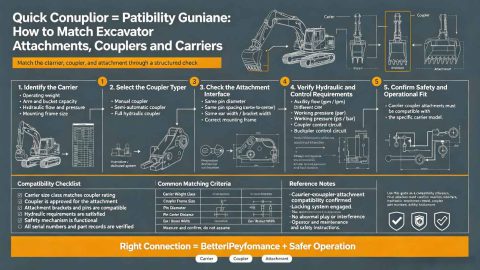
A breaker that fits the hydraulics but not the stick is a warehouse liability. Confirm:
- Pin centre distance and diameter
- Bracket type (straight, inclined, tunnel)
- Quick coupler compatibility — some couplers reduce breakout force when the breaker sits further from the stick
- Hose routing clearance at full rotation
OEM programs should supply stick photos and pin measurements with every RFQ. HCN cross-references major carrier interfaces daily and produces custom brackets when standard hangers do not apply. See manufacturing and fitment capability on the About HCN page.
Total Cost of Ownership for Dealers and Rental Fleets
Purchase price is a small fraction of breaker lifecycle cost. Model these line items in quotes:
- Wear parts — Bushings, seals, tool shank, retainer bars
- Downtime — A breaker offline on a rental fleet costs more than a seal kit
- Spare tool inventory — One spare tool per three breakers is a common rental ratio
- Rebuild intervals — Plan major overhaul at 3,000–5,000 impact hours depending on material
Breakers with documented PM schedules and available spare parts kits are easier to sell to contractors who track cost per cubic metre. Avoid suppliers who cannot commit to 24-month parts availability for the exact model you import.
Export Compliance: CE, Manuals, and Traceability
Breakers shipped to the EU, UK, Australia, and Middle East increasingly require:
- CE Declaration of Conformity (or equivalent conformity assessment)
- User manual in destination language
- Serial traceability for welded housing components
- Noise and vibration data where specified in tender documents
Verify documentation before payment — not after goods arrive at port. ISO 9001:2015 certification at the factory level supports audit trails but does not replace product-level conformity files. HCN maintains CE-certified breaker families with export documentation aligned to product pages in the attachments catalog.
Procurement Checklist Before You Place an Order
Use this checklist when evaluating any hydraulic breaker supplier:
- Carrier weight range matches your target fleet segment
- Flow/pressure envelope confirmed against real machine data
- Tool type and shank diameter specified for primary application
- Mounting pins or bracket drawings approved by engineering
- Wear parts list with lead times and MOQ
- Conformity documents and manuals for destination market
- Warranty terms covering housing, piston, and seals
- Sample or pilot order tested on customer machine before volume PO
Conclusion
Choosing a hydraulic breaker for excavator applications is an engineering decision, not a catalogue exercise. Match carrier weight, auxiliary hydraulics, tool profile, and mounting interface first — then evaluate supplier documentation, parts support, and conformity records. Dealers and OEM buyers who follow this process reduce returns, protect carrier warranties, and build repeat business with contractors who depend on uptime.
HCN Attachments manufactures hydraulic breakers for global export from Xuzhou, Jiangsu, with CE-certified models, ISO 9001:2015 quality systems, and engineering support for distributor and private-label programs. Browse the hydraulic breaker range, review our manufacturing credentials, or contact our export team with your carrier model, flow data, and target quantity for a technical recommendation within 24 hours.
Frequently Asked Questions
What size hydraulic breaker fits a 20-tonne excavator?
Most 20-tonne excavators use breakers in the 350–750 kg range with 68–100 mm tool diameter and approximately 70–120 L/min flow. Confirm against your specific machine’s auxiliary circuit before ordering.
Can I run a larger breaker if I increase hydraulic flow?
No. Exceeding the manufacturer’s carrier weight range transfers structural stress to the stick and coupler. Flow alone does not compensate for excessive impact mass.
How often should a hydraulic breaker be greased?
Grease the tool shank every 1–2 hours of operation, or per the manufacturer’s schedule. Dry shanks accelerate bushing wear and can cause tool seizure.
What is the difference between a hydraulic breaker and a hydraulic ripper?
Breakers deliver high-frequency impact for fracturing material. Rippers use static penetration force for tearing frozen ground or asphalt. They serve different applications and hydraulics profiles.
Should OEM buyers request a sample breaker before a volume order?
Yes. A pilot unit tested on a representative carrier validates fitment, flow tuning, and noise levels. Most reputable manufacturers support sample programs for qualified OEM and distributor accounts.
Need specs or export pricing? request a quotation with your carrier model and quantity.
Related Product Lines & Technical Guides
Use these HCN resources to compare specifications, carrier fit, and export procurement options referenced in this article.