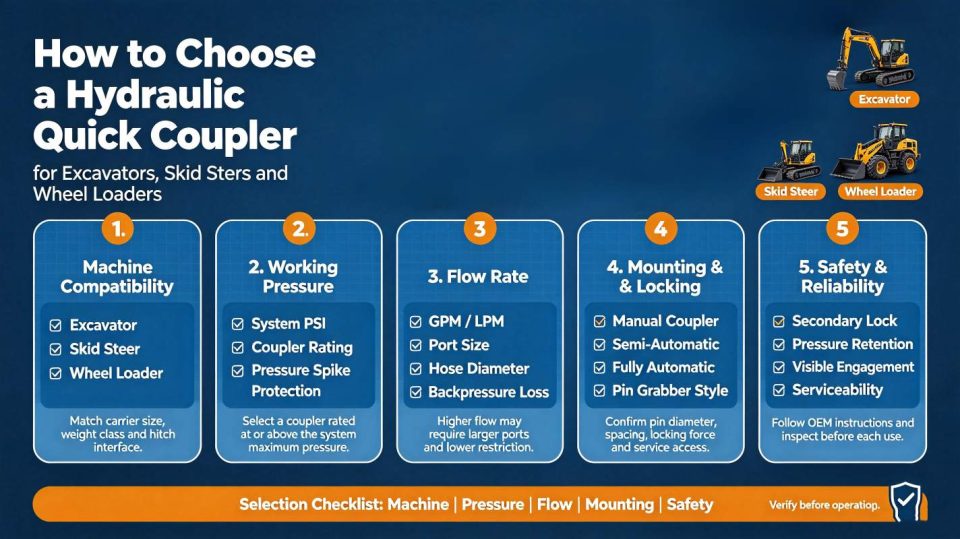
A quick coupler can turn a single excavator, skid steer loader, or wheel loader into a much more flexible attachment platform. Instead of treating the coupler as a simple connection between the machine and attachment, professional fleets should consider it part of the complete carrier–coupler–attachment system.
For contractors, equipment dealers, rental companies, distributors, OEMs, and fleet managers, the right quick coupler can reduce attachment changeover time, improve fleet utilization, and make a wider range of attachments practical across the same carrier platform. The wrong coupler, however, can create fitment problems, additional weight, hydraulic integration issues, or compatibility limitations.
HCN Attachments currently offers hydraulic quick-coupler solutions, including the BM07 H30 Hydraulic Quick Coupler for wheel loaders. The BM07 product family includes BM07H20, BM07H30, BM07H50, and BM07H60 configurations, with published carrier classes from 2-tonne to 6-tonne wheel loaders. Final configuration should always be confirmed against the exact carrier model and mounting requirements.
This guide explains how professional buyers should evaluate a quick coupler before placing an order.
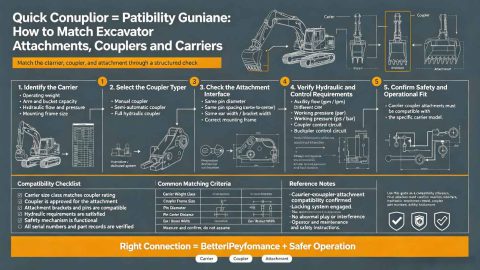
1. Start With the Carrier, Not the Coupler
The most common procurement mistake is selecting a quick coupler based only on attachment size.
A quick coupler must first match the carrier.
Before requesting a quotation, record:
- Carrier manufacturer and exact model
- Operating weight
- Existing attachment interface
- Pin dimensions where applicable
- Pin-to-pin distance
- Mounting width
- Mounting height
- Auxiliary hydraulic capability
- Hydraulic operating pressure
- Existing coupler or attachment standard
- Intended attachment types
This information is especially important for fleets operating several machine brands.
Two machines may appear to belong to the same size class while having different mounting dimensions or hydraulic configurations. A coupler that fits one carrier should not automatically be assumed to fit another.
For this reason, HCN’s current fitment process requires carrier information, mounting dimensions, operating weight, and hydraulic data before final configuration is confirmed.
2. Manual vs. Hydraulic Quick Coupler
One of the first decisions is whether the fleet actually needs a hydraulic quick coupler.
Manual quick couplers
Manual systems can be attractive where attachments are changed relatively infrequently.
Their main advantages are simplicity and potentially lower system complexity.
They may be suitable for:
- Contractors using one primary attachment for long periods
- Machines with low attachment-change frequency
- Simple fleet configurations
- Applications where ground-level attachment changes are acceptable
However, manual systems generally require more operator involvement during attachment changes.
Hydraulic quick couplers
Hydraulic quick couplers allow the locking mechanism to be controlled hydraulically, making them particularly attractive for fleets where attachments are changed frequently.
They can be valuable for:
- Rental fleets
- Multi-purpose contractors
- Municipal maintenance fleets
- Equipment dealers
- Fleets running several attachments on the same carrier
- Operations where minimizing changeover time is important
The key question is therefore not simply “Which coupler is better?”
It is:
How frequently will the attachment be changed, and how much is that changeover process worth to the fleet?
For high-utilization equipment, a hydraulic system may provide greater operational value even when its initial configuration is more complex.
3. Compare the Complete Carrier–Coupler–Attachment System
A quick coupler should never be evaluated independently.
The complete working system consists of:
Carrier → Quick Coupler → Attachment
Each interface must work correctly.
Mechanical interface
Check:
- Pin diameter
- Pin-to-pin distance
- Mounting width
- Coupler geometry
- Attachment engagement points
- Locking mechanism
- Clearance through the full working range
Hydraulic interface
For hydraulic couplers, also confirm:
- Hydraulic supply
- Operating pressure
- Hydraulic connections
- Hose routing
- Control arrangement
- Lock/unlock requirements
- Protection of hydraulic lines during operation
Operational interface
Finally, consider:
- Operator visibility
- Attachment-change procedure
- Ground clearance
- Transport position
- Attachment weight
- Carrier stability
- Compatibility with the fleet’s existing attachments
A coupler may satisfy one part of the system while creating a problem somewhere else.
That is why a professional fitment review should consider the carrier, coupler, and attachment together.
4. Attachment Weight Matters More Than Many Buyers Expect
Adding a quick coupler changes the working configuration of the machine.
The coupler itself has weight, and that weight sits between the carrier and attachment.
This can affect:
- Available lifting capacity
- Machine balance
- Working reach
- Breakout performance
- Transport weight
- Attachment geometry
The effect becomes increasingly important when the attachment is already relatively heavy.
For example, a fleet evaluating a coupler for buckets, grapples, breakers, or other heavy attachments should not look only at whether the attachment physically connects. The complete configuration should be checked against the carrier’s operating capacity.
HCN’s BM07 hydraulic quick-coupler family illustrates why model selection needs to be carrier-specific. Published reference weights range from 220 kg for BM07H20 to 545 kg for BM07H60, while the corresponding published wheel-loader classes range from 2T to 6T. These figures are model-specific and should not be generalized to other couplers or carriers.
For an actual purchase, request the exact specification for the selected configuration.
5. Understand the HCN BM07 Hydraulic Quick Coupler Range
HCN’s current BM07 product page identifies four configurations:
| Model | Published Wheel Loader Class | Reference Weight | Overall Width |
|---|---|---|---|
| BM07H20 | 2T | 220 kg | 940 mm |
| BM07H30 | 3T | 260 kg | 1,300 mm |
| BM07H50 | 5T | 450 kg | 1,345 mm |
| BM07H60 | 6T | 545 kg | 1,462 mm |
The same page lists hydraulic lock/unlock control across the four configurations. Published overall length ranges from 370 mm to 525 mm, while overall height ranges from 650 mm to 805 mm. HCN also notes that specifications may vary by model and that custom configurations are available.
These published values are useful for preliminary procurement screening, but they should not replace an engineering fitment confirmation.
In particular, buyers should not assume that the “3T” or “5T” classification alone establishes compatibility with a particular wheel loader.
The exact machine still needs to be checked.
6. Quick Coupler Compatibility Is More Than a Pin Measurement
A common purchasing shortcut is to send only pin dimensions to the supplier.
Pin dimensions are important, but they are not the entire interface.
A complete compatibility review may need to consider:
- Carrier make and model
- Operating weight
- Mounting geometry
- Existing attachment interface
- Coupler dimensions
- Hydraulic system
- Attachment dimensions
- Hydraulic hose routing
- Working clearance
- Intended duty cycle
This becomes especially important for OEM and private-label programs.
A dealer may be purchasing the same coupler for a fleet of machines that appear similar but have different mounting standards. In that situation, the supplier should confirm whether one configuration can serve the complete fleet or whether different coupler configurations are required.
7. When Should a Fleet Standardize on Hydraulic Quick Couplers?
Fleet standardization can make sense when multiple attachments are routinely shared between machines.
Typical examples include:
- Buckets
- Pallet forks
- Sweepers
- Snow equipment
- Grapples
- Material-handling attachments
- General-purpose tools
HCN’s product portfolio spans construction, road maintenance, snow and ice removal, forestry, mining, material handling, agricultural, and other attachment categories. This makes interface standardization particularly relevant for dealers and fleets that want to manage multiple attachment categories around a common carrier platform.
A standardized interface can simplify:
- Attachment allocation
- Operator training
- Fleet planning
- Rental inventory
- Spare attachment management
- Procurement
- Maintenance procedures
However, standardization should follow an engineering review rather than simply selecting the most common interface in the fleet.
8. Consider Total Cost of Ownership, Not Just Purchase Price
The purchase price of a quick coupler is only one part of its economic value.
Professional buyers should consider:
Initial acquisition cost
Compare the complete coupler package, including required hydraulic components and mounting configuration.
Changeover productivity
Estimate how frequently attachments are changed and how much productive time is affected by each change.
Fleet utilization
A coupler that allows one carrier to perform several tasks may reduce the need for additional dedicated machines.
Maintenance
Evaluate hydraulic components, locking mechanisms, wear areas, inspection requirements, and spare-part availability.
Downtime
For rental fleets and high-utilization contractors, an attachment interface problem can affect not only the coupler but also every attachment assigned to that machine.
Compatibility
A low-cost coupler that works with only one attachment configuration may have lower long-term value than a properly engineered system that supports a broader fleet strategy.
The right calculation is therefore not simply:
Coupler price = total cost
Instead, buyers should evaluate:
Purchase cost + maintenance + downtime + changeover efficiency + fleet utilization + compatibility risk
9. What Should OEM and Distributor Buyers Specify?
OEM procurement requires a more structured specification than a one-off contractor purchase.
Before starting a private-label or volume program, establish:
Carrier specification
- Machine make
- Exact model
- Operating weight
- Hydraulic system data
- Existing attachment interface
Coupler specification
- Coupler type
- Locking method
- Dimensions
- Reference weight
- Mounting configuration
- Hydraulic connections
- Required control arrangement
Attachment portfolio
List every attachment expected to use the coupler.
For example:
| Attachment | Primary Use | Compatibility Check |
|---|---|---|
| General-purpose bucket | Earthmoving | Mechanical interface |
| Pallet forks | Material handling | Load and interface |
| Sweeper | Road/site cleaning | Hydraulic + interface |
| Snow attachment | Winter maintenance | Interface + operating configuration |
| Grapple | Material handling | Hydraulic + mechanical |
| Breaker | Demolition | Hydraulic + mounting geometry |
This portfolio-level approach is much more useful than approving a coupler against only one attachment.
10. Request Technical Drawings Before Volume Production
For standard catalog purchases, the published specification may be enough for an initial assessment.
For OEM, distributor, fleet, or non-standard applications, technical drawings become much more important.
A drawing can help confirm:
- Overall dimensions
- Mounting points
- Pin locations
- Interface geometry
- Clearance
- Hydraulic connection locations
- Attachment engagement
- Transport dimensions
HCN’s current BM07 page explicitly recommends confirming the exact configuration and offers technical drawings and engineering fitment review before production.
This is particularly valuable when the coupler will become part of a long-term fleet standard.
11. Common Quick Coupler Procurement Mistakes
Mistake 1: Selecting by machine tonnage only
Machine class is a starting point, not a complete compatibility specification.
Mistake 2: Checking the coupler but not the attachment
The attachment must engage correctly with the selected coupler.
Mistake 3: Ignoring coupler weight
Additional weight can affect machine balance and lifting performance.
Mistake 4: Assuming hydraulic compatibility equals mechanical compatibility
A machine can provide adequate hydraulic capability and still have an incompatible mounting interface.
Mistake 5: Using one configuration across different carriers without verification
Different machine models can require different mounting solutions.
Mistake 6: Buying on price alone
A coupler is a fleet productivity component, not simply a steel adapter.
Mistake 7: Skipping the technical drawing stage
For OEM and volume procurement, drawings help prevent expensive interface errors before production.
12. A Practical RFQ Checklist
Before sending an RFQ to a quick-coupler manufacturer, prepare the following information:
Carrier
- Make and exact model
- Operating weight
- Existing attachment interface
- Hydraulic flow
- Hydraulic pressure
Mounting
- Pin diameter
- Pin-to-pin distance
- Mounting width
- Mounting height
- Coupler type, if replacing an existing system
Attachments
- Attachment types
- Attachment weights
- Number of attachments
- Expected changeover frequency
- Primary applications
Commercial requirements
- Quantity
- Standard or custom configuration
- OEM/private-label requirements
- Destination market
- Required documentation
- Technical drawing requirements
- Spare parts requirements
The more complete the RFQ, the easier it is for the engineering team to confirm the correct configuration.
HCN Quick Couplers: Engineering Before Production
HCN’s current website positions quick couplers within a broader engineering attachment portfolio rather than as isolated hardware. The company manufactures attachments for excavators, skid steers, wheel loaders, and municipal carriers, and supports OEM and custom configurations. Its manufacturing operation in Xuzhou includes a 21,000 m² campus, while the wider company portfolio includes 400+ attachment models and exports to more than 60 countries.
For buyers, the practical advantage is not simply access to a catalog model.
The more important step is the engineering review before production.
Provide the exact carrier, mounting information, hydraulic data, attachment portfolio, and intended working conditions. HCN can then confirm whether the standard configuration is appropriate or whether a customized mounting solution should be considered.
Final Recommendation
The best quick coupler is not necessarily the lightest, cheapest, or most heavily rated model.
It is the one that creates a reliable interface between the carrier and the attachments your fleet actually needs to use.
For low-frequency attachment changes, a simpler manual configuration may be practical.
For rental fleets, municipal operations, multi-purpose contractors, and high-utilization equipment, a hydraulic quick coupler can provide greater flexibility and productivity.
For OEMs and distributors, the decision should go one step further: standardize the interface only after confirming the complete carrier and attachment portfolio.
Before placing a purchase order, verify the exact machine model, operating weight, mounting dimensions, hydraulic requirements, attachment compatibility, and required configuration. For non-standard or volume applications, request an exact technical specification and drawing before production.
A properly specified quick coupler becomes more than an attachment connection. It becomes part of the fleet’s equipment strategy.
Frequently Asked Questions
1. What information is needed to select a hydraulic quick coupler?
At minimum, provide the exact carrier make and model, operating weight, mounting dimensions, existing attachment interface, hydraulic flow, hydraulic pressure, and intended attachment types. Additional information may be required for non-standard configurations.
2. Is a hydraulic quick coupler better than a manual quick coupler?
Not in every application. Hydraulic couplers are particularly useful when attachments are changed frequently, while manual couplers can remain practical for lower-frequency attachment changes.
3. Can one quick coupler fit different equipment brands?
Potentially, but brand name alone is not enough to confirm compatibility. The exact carrier model, mounting geometry, hydraulic system, and attachment interface should be verified before ordering.
4. Does a quick coupler affect machine lifting performance?
Yes. The coupler adds weight and changes the distance between the carrier and attachment. The complete configuration should therefore be evaluated against the carrier’s operating capacity and application.
5. What HCN quick coupler models are currently published?
HCN currently publishes the BM07H20, BM07H30, BM07H50, and BM07H60 configurations within the BM07 hydraulic quick-coupler family. The published wheel-loader classes range from 2T to 6T.
6. Can HCN provide a custom quick-coupler configuration?
HCN states that mounting interfaces and configurations can be customized according to carrier requirements. Buyers should submit the exact machine and mounting information for engineering confirmation.
7. Should OEM buyers request technical drawings before production?
Yes. For OEM, private-label, distributor, and non-standard programs, technical drawings help verify dimensions, mounting geometry, hydraulic connections, and attachment engagement before volume production.
8. What should I send HCN for a quick-coupler quotation?
Provide the machine make and exact model, operating weight, hydraulic flow and pressure, mounting dimensions, existing coupler or attachment interface, intended attachments, quantity, application, and destination market. HCN’s product pages recommend providing machine details so its engineering team can confirm the configuration before production.How to Choose a Hydraulic Quick Coupler for Excavators, Skid Steers and Wheel Loaders
A quick coupler can turn a single excavator, skid steer loader, or wheel loader into a much more flexible attachment platform. Instead of treating the coupler as a simple connection between the machine and attachment, professional fleets should consider it part of the complete carrier–coupler–attachment system.
For contractors, equipment dealers, rental companies, distributors, OEMs, and fleet managers, the right quick coupler can reduce attachment changeover time, improve fleet utilization, and make a wider range of attachments practical across the same carrier platform. The wrong coupler, however, can create fitment problems, additional weight, hydraulic integration issues, or compatibility limitations.
HCN Attachments currently offers hydraulic quick-coupler solutions, including the BM07 H30 Hydraulic Quick Coupler for wheel loaders. The BM07 product family includes BM07H20, BM07H30, BM07H50, and BM07H60 configurations, with published carrier classes from 2-tonne to 6-tonne wheel loaders. Final configuration should always be confirmed against the exact carrier model and mounting requirements.
This guide explains how professional buyers should evaluate a quick coupler before placing an order.
1. Start With the Carrier, Not the Coupler
The most common procurement mistake is selecting a quick coupler based only on attachment size.
A quick coupler must first match the carrier.
Before requesting a quotation, record:
- Carrier manufacturer and exact model
- Operating weight
- Existing attachment interface
- Pin dimensions where applicable
- Pin-to-pin distance
- Mounting width
- Mounting height
- Auxiliary hydraulic capability
- Hydraulic operating pressure
- Existing coupler or attachment standard
- Intended attachment types
This information is especially important for fleets operating several machine brands.
Two machines may appear to belong to the same size class while having different mounting dimensions or hydraulic configurations. A coupler that fits one carrier should not automatically be assumed to fit another.
For this reason, HCN’s current fitment process requires carrier information, mounting dimensions, operating weight, and hydraulic data before final configuration is confirmed.
2. Manual vs. Hydraulic Quick Coupler
One of the first decisions is whether the fleet actually needs a hydraulic quick coupler.
Manual quick couplers
Manual systems can be attractive where attachments are changed relatively infrequently.
Their main advantages are simplicity and potentially lower system complexity.
They may be suitable for:
- Contractors using one primary attachment for long periods
- Machines with low attachment-change frequency
- Simple fleet configurations
- Applications where ground-level attachment changes are acceptable
However, manual systems generally require more operator involvement during attachment changes.
Hydraulic quick couplers
Hydraulic quick couplers allow the locking mechanism to be controlled hydraulically, making them particularly attractive for fleets where attachments are changed frequently.
They can be valuable for:
- Rental fleets
- Multi-purpose contractors
- Municipal maintenance fleets
- Equipment dealers
- Fleets running several attachments on the same carrier
- Operations where minimizing changeover time is important
The key question is therefore not simply “Which coupler is better?”
It is:
How frequently will the attachment be changed, and how much is that changeover process worth to the fleet?
For high-utilization equipment, a hydraulic system may provide greater operational value even when its initial configuration is more complex.
3. Compare the Complete Carrier–Coupler–Attachment System
A quick coupler should never be evaluated independently.
The complete working system consists of:
Carrier → Quick Coupler → Attachment
Each interface must work correctly.
Mechanical interface
Check:
- Pin diameter
- Pin-to-pin distance
- Mounting width
- Coupler geometry
- Attachment engagement points
- Locking mechanism
- Clearance through the full working range
Hydraulic interface
For hydraulic couplers, also confirm:
- Hydraulic supply
- Operating pressure
- Hydraulic connections
- Hose routing
- Control arrangement
- Lock/unlock requirements
- Protection of hydraulic lines during operation
Operational interface
Finally, consider:
- Operator visibility
- Attachment-change procedure
- Ground clearance
- Transport position
- Attachment weight
- Carrier stability
- Compatibility with the fleet’s existing attachments
A coupler may satisfy one part of the system while creating a problem somewhere else.
That is why a professional fitment review should consider the carrier, coupler, and attachment together.
4. Attachment Weight Matters More Than Many Buyers Expect
Adding a quick coupler changes the working configuration of the machine.
The coupler itself has weight, and that weight sits between the carrier and attachment.
This can affect:
- Available lifting capacity
- Machine balance
- Working reach
- Breakout performance
- Transport weight
- Attachment geometry
The effect becomes increasingly important when the attachment is already relatively heavy.
For example, a fleet evaluating a coupler for buckets, grapples, breakers, or other heavy attachments should not look only at whether the attachment physically connects. The complete configuration should be checked against the carrier’s operating capacity.
HCN’s BM07 hydraulic quick-coupler family illustrates why model selection needs to be carrier-specific. Published reference weights range from 220 kg for BM07H20 to 545 kg for BM07H60, while the corresponding published wheel-loader classes range from 2T to 6T. These figures are model-specific and should not be generalized to other couplers or carriers.
For an actual purchase, request the exact specification for the selected configuration.
5. Understand the HCN BM07 Hydraulic Quick Coupler Range
HCN’s current BM07 product page identifies four configurations:
| Model | Published Wheel Loader Class | Reference Weight | Overall Width |
|---|---|---|---|
| BM07H20 | 2T | 220 kg | 940 mm |
| BM07H30 | 3T | 260 kg | 1,300 mm |
| BM07H50 | 5T | 450 kg | 1,345 mm |
| BM07H60 | 6T | 545 kg | 1,462 mm |
The same page lists hydraulic lock/unlock control across the four configurations. Published overall length ranges from 370 mm to 525 mm, while overall height ranges from 650 mm to 805 mm. HCN also notes that specifications may vary by model and that custom configurations are available.
These published values are useful for preliminary procurement screening, but they should not replace an engineering fitment confirmation.
In particular, buyers should not assume that the “3T” or “5T” classification alone establishes compatibility with a particular wheel loader.
The exact machine still needs to be checked.
6. Quick Coupler Compatibility Is More Than a Pin Measurement
A common purchasing shortcut is to send only pin dimensions to the supplier.
Pin dimensions are important, but they are not the entire interface.
A complete compatibility review may need to consider:
- Carrier make and model
- Operating weight
- Mounting geometry
- Existing attachment interface
- Coupler dimensions
- Hydraulic system
- Attachment dimensions
- Hydraulic hose routing
- Working clearance
- Intended duty cycle
This becomes especially important for OEM and private-label programs.
A dealer may be purchasing the same coupler for a fleet of machines that appear similar but have different mounting standards. In that situation, the supplier should confirm whether one configuration can serve the complete fleet or whether different coupler configurations are required.
7. When Should a Fleet Standardize on Hydraulic Quick Couplers?
Fleet standardization can make sense when multiple attachments are routinely shared between machines.
Typical examples include:
- Buckets
- Pallet forks
- Sweepers
- Snow equipment
- Grapples
- Material-handling attachments
- General-purpose tools
HCN’s product portfolio spans construction, road maintenance, snow and ice removal, forestry, mining, material handling, agricultural, and other attachment categories. This makes interface standardization particularly relevant for dealers and fleets that want to manage multiple attachment categories around a common carrier platform.
A standardized interface can simplify:
- Attachment allocation
- Operator training
- Fleet planning
- Rental inventory
- Spare attachment management
- Procurement
- Maintenance procedures
However, standardization should follow an engineering review rather than simply selecting the most common interface in the fleet.
8. Consider Total Cost of Ownership, Not Just Purchase Price
The purchase price of a quick coupler is only one part of its economic value.
Professional buyers should consider:
Initial acquisition cost
Compare the complete coupler package, including required hydraulic components and mounting configuration.
Changeover productivity
Estimate how frequently attachments are changed and how much productive time is affected by each change.
Fleet utilization
A coupler that allows one carrier to perform several tasks may reduce the need for additional dedicated machines.
Maintenance
Evaluate hydraulic components, locking mechanisms, wear areas, inspection requirements, and spare-part availability.
Downtime
For rental fleets and high-utilization contractors, an attachment interface problem can affect not only the coupler but also every attachment assigned to that machine.
Compatibility
A low-cost coupler that works with only one attachment configuration may have lower long-term value than a properly engineered system that supports a broader fleet strategy.
The right calculation is therefore not simply:
Coupler price = total cost
Instead, buyers should evaluate:
Purchase cost + maintenance + downtime + changeover efficiency + fleet utilization + compatibility risk
9. What Should OEM and Distributor Buyers Specify?
OEM procurement requires a more structured specification than a one-off contractor purchase.
Before starting a private-label or volume program, establish:
Carrier specification
- Machine make
- Exact model
- Operating weight
- Hydraulic system data
- Existing attachment interface
Coupler specification
- Coupler type
- Locking method
- Dimensions
- Reference weight
- Mounting configuration
- Hydraulic connections
- Required control arrangement
Attachment portfolio
List every attachment expected to use the coupler.
For example:
| Attachment | Primary Use | Compatibility Check |
|---|---|---|
| General-purpose bucket | Earthmoving | Mechanical interface |
| Pallet forks | Material handling | Load and interface |
| Sweeper | Road/site cleaning | Hydraulic + interface |
| Snow attachment | Winter maintenance | Interface + operating configuration |
| Grapple | Material handling | Hydraulic + mechanical |
| Breaker | Demolition | Hydraulic + mounting geometry |
This portfolio-level approach is much more useful than approving a coupler against only one attachment.
10. Request Technical Drawings Before Volume Production
For standard catalog purchases, the published specification may be enough for an initial assessment.
For OEM, distributor, fleet, or non-standard applications, technical drawings become much more important.
A drawing can help confirm:
- Overall dimensions
- Mounting points
- Pin locations
- Interface geometry
- Clearance
- Hydraulic connection locations
- Attachment engagement
- Transport dimensions
HCN’s current BM07 page explicitly recommends confirming the exact configuration and offers technical drawings and engineering fitment review before production.
This is particularly valuable when the coupler will become part of a long-term fleet standard.
11. Common Quick Coupler Procurement Mistakes
Mistake 1: Selecting by machine tonnage only
Machine class is a starting point, not a complete compatibility specification.
Mistake 2: Checking the coupler but not the attachment
The attachment must engage correctly with the selected coupler.
Mistake 3: Ignoring coupler weight
Additional weight can affect machine balance and lifting performance.
Mistake 4: Assuming hydraulic compatibility equals mechanical compatibility
A machine can provide adequate hydraulic capability and still have an incompatible mounting interface.
Mistake 5: Using one configuration across different carriers without verification
Different machine models can require different mounting solutions.
Mistake 6: Buying on price alone
A coupler is a fleet productivity component, not simply a steel adapter.
Mistake 7: Skipping the technical drawing stage
For OEM and volume procurement, drawings help prevent expensive interface errors before production.
12. A Practical RFQ Checklist
Before sending an RFQ to a quick-coupler manufacturer, prepare the following information:
Carrier
- Make and exact model
- Operating weight
- Existing attachment interface
- Hydraulic flow
- Hydraulic pressure
Mounting
- Pin diameter
- Pin-to-pin distance
- Mounting width
- Mounting height
- Coupler type, if replacing an existing system
Attachments
- Attachment types
- Attachment weights
- Number of attachments
- Expected changeover frequency
- Primary applications
Commercial requirements
- Quantity
- Standard or custom configuration
- OEM/private-label requirements
- Destination market
- Required documentation
- Technical drawing requirements
- Spare parts requirements
The more complete the RFQ, the easier it is for the engineering team to confirm the correct configuration.
HCN Quick Couplers: Engineering Before Production
HCN’s current website positions quick couplers within a broader engineering attachment portfolio rather than as isolated hardware. The company manufactures attachments for excavators, skid steers, wheel loaders, and municipal carriers, and supports OEM and custom configurations. Its manufacturing operation in Xuzhou includes a 21,000 m² campus, while the wider company portfolio includes 400+ attachment models and exports to more than 60 countries.
For buyers, the practical advantage is not simply access to a catalog model.
The more important step is the engineering review before production.
Provide the exact carrier, mounting information, hydraulic data, attachment portfolio, and intended working conditions. HCN can then confirm whether the standard configuration is appropriate or whether a customized mounting solution should be considered.
Final Recommendation
The best quick coupler is not necessarily the lightest, cheapest, or most heavily rated model.
It is the one that creates a reliable interface between the carrier and the attachments your fleet actually needs to use.
For low-frequency attachment changes, a simpler manual configuration may be practical.
For rental fleets, municipal operations, multi-purpose contractors, and high-utilization equipment, a hydraulic quick coupler can provide greater flexibility and productivity.
For OEMs and distributors, the decision should go one step further: standardize the interface only after confirming the complete carrier and attachment portfolio.
Before placing a purchase order, verify the exact machine model, operating weight, mounting dimensions, hydraulic requirements, attachment compatibility, and required configuration. For non-standard or volume applications, request an exact technical specification and drawing before production.
A properly specified quick coupler becomes more than an attachment connection. It becomes part of the fleet’s equipment strategy.
Frequently Asked Questions
1. What information is needed to select a hydraulic quick coupler?
At minimum, provide the exact carrier make and model, operating weight, mounting dimensions, existing attachment interface, hydraulic flow, hydraulic pressure, and intended attachment types. Additional information may be required for non-standard configurations.
2. Is a hydraulic quick coupler better than a manual quick coupler?
Not in every application. Hydraulic couplers are particularly useful when attachments are changed frequently, while manual couplers can remain practical for lower-frequency attachment changes.
3. Can one quick coupler fit different equipment brands?
Potentially, but brand name alone is not enough to confirm compatibility. The exact carrier model, mounting geometry, hydraulic system, and attachment interface should be verified before ordering.
4. Does a quick coupler affect machine lifting performance?
Yes. The coupler adds weight and changes the distance between the carrier and attachment. The complete configuration should therefore be evaluated against the carrier’s operating capacity and application.
5. What HCN quick coupler models are currently published?
HCN currently publishes the BM07H20, BM07H30, BM07H50, and BM07H60 configurations within the BM07 hydraulic quick-coupler family. The published wheel-loader classes range from 2T to 6T.
6. Can HCN provide a custom quick-coupler configuration?
HCN states that mounting interfaces and configurations can be customized according to carrier requirements. Buyers should submit the exact machine and mounting information for engineering confirmation.
7. Should OEM buyers request technical drawings before production?
Yes. For OEM, private-label, distributor, and non-standard programs, technical drawings help verify dimensions, mounting geometry, hydraulic connections, and attachment engagement before volume production.
8. What should I send HCN for a quick-coupler quotation?
Provide the machine make and exact model, operating weight, hydraulic flow and pressure, mounting dimensions, existing coupler or attachment interface, intended attachments, quantity, application, and destination market. HCN’s product pages recommend providing machine details so its engineering team can confirm the configuration before production.How to Choose a Hydraulic Quick Coupler for Excavators, Skid Steers and Wheel Loaders
A quick coupler can turn a single excavator, skid steer loader, or wheel loader into a much more flexible attachment platform. Instead of treating the coupler as a simple connection between the machine and attachment, professional fleets should consider it part of the complete carrier–coupler–attachment system.
For contractors, equipment dealers, rental companies, distributors, OEMs, and fleet managers, the right quick coupler can reduce attachment changeover time, improve fleet utilization, and make a wider range of attachments practical across the same carrier platform. The wrong coupler, however, can create fitment problems, additional weight, hydraulic integration issues, or compatibility limitations.
HCN Attachments currently offers hydraulic quick-coupler solutions, including the BM07 H30 Hydraulic Quick Coupler for wheel loaders. The BM07 product family includes BM07H20, BM07H30, BM07H50, and BM07H60 configurations, with published carrier classes from 2-tonne to 6-tonne wheel loaders. Final configuration should always be confirmed against the exact carrier model and mounting requirements.
This guide explains how professional buyers should evaluate a quick coupler before placing an order.
1. Start With the Carrier, Not the Coupler
The most common procurement mistake is selecting a quick coupler based only on attachment size.
A quick coupler must first match the carrier.
Before requesting a quotation, record:
- Carrier manufacturer and exact model
- Operating weight
- Existing attachment interface
- Pin dimensions where applicable
- Pin-to-pin distance
- Mounting width
- Mounting height
- Auxiliary hydraulic capability
- Hydraulic operating pressure
- Existing coupler or attachment standard
- Intended attachment types
This information is especially important for fleets operating several machine brands.
Two machines may appear to belong to the same size class while having different mounting dimensions or hydraulic configurations. A coupler that fits one carrier should not automatically be assumed to fit another.
For this reason, HCN’s current fitment process requires carrier information, mounting dimensions, operating weight, and hydraulic data before final configuration is confirmed.
2. Manual vs. Hydraulic Quick Coupler
One of the first decisions is whether the fleet actually needs a hydraulic quick coupler.
Manual quick couplers
Manual systems can be attractive where attachments are changed relatively infrequently.
Their main advantages are simplicity and potentially lower system complexity.
They may be suitable for:
- Contractors using one primary attachment for long periods
- Machines with low attachment-change frequency
- Simple fleet configurations
- Applications where ground-level attachment changes are acceptable
However, manual systems generally require more operator involvement during attachment changes.
Hydraulic quick couplers
Hydraulic quick couplers allow the locking mechanism to be controlled hydraulically, making them particularly attractive for fleets where attachments are changed frequently.
They can be valuable for:
- Rental fleets
- Multi-purpose contractors
- Municipal maintenance fleets
- Equipment dealers
- Fleets running several attachments on the same carrier
- Operations where minimizing changeover time is important
The key question is therefore not simply “Which coupler is better?”
It is:
How frequently will the attachment be changed, and how much is that changeover process worth to the fleet?
For high-utilization equipment, a hydraulic system may provide greater operational value even when its initial configuration is more complex.
3. Compare the Complete Carrier–Coupler–Attachment System
A quick coupler should never be evaluated independently.
The complete working system consists of:
Carrier → Quick Coupler → Attachment
Each interface must work correctly.
Mechanical interface
Check:
- Pin diameter
- Pin-to-pin distance
- Mounting width
- Coupler geometry
- Attachment engagement points
- Locking mechanism
- Clearance through the full working range
Hydraulic interface
For hydraulic couplers, also confirm:
- Hydraulic supply
- Operating pressure
- Hydraulic connections
- Hose routing
- Control arrangement
- Lock/unlock requirements
- Protection of hydraulic lines during operation
Operational interface
Finally, consider:
- Operator visibility
- Attachment-change procedure
- Ground clearance
- Transport position
- Attachment weight
- Carrier stability
- Compatibility with the fleet’s existing attachments
A coupler may satisfy one part of the system while creating a problem somewhere else.
That is why a professional fitment review should consider the carrier, coupler, and attachment together.
4. Attachment Weight Matters More Than Many Buyers Expect
Adding a quick coupler changes the working configuration of the machine.
The coupler itself has weight, and that weight sits between the carrier and attachment.
This can affect:
- Available lifting capacity
- Machine balance
- Working reach
- Breakout performance
- Transport weight
- Attachment geometry
The effect becomes increasingly important when the attachment is already relatively heavy.
For example, a fleet evaluating a coupler for buckets, grapples, breakers, or other heavy attachments should not look only at whether the attachment physically connects. The complete configuration should be checked against the carrier’s operating capacity.
HCN’s BM07 hydraulic quick-coupler family illustrates why model selection needs to be carrier-specific. Published reference weights range from 220 kg for BM07H20 to 545 kg for BM07H60, while the corresponding published wheel-loader classes range from 2T to 6T. These figures are model-specific and should not be generalized to other couplers or carriers.
For an actual purchase, request the exact specification for the selected configuration.
5. Understand the HCN BM07 Hydraulic Quick Coupler Range
HCN’s current BM07 product page identifies four configurations:
| Model | Published Wheel Loader Class | Reference Weight | Overall Width |
|---|---|---|---|
| BM07H20 | 2T | 220 kg | 940 mm |
| BM07H30 | 3T | 260 kg | 1,300 mm |
| BM07H50 | 5T | 450 kg | 1,345 mm |
| BM07H60 | 6T | 545 kg | 1,462 mm |
The same page lists hydraulic lock/unlock control across the four configurations. Published overall length ranges from 370 mm to 525 mm, while overall height ranges from 650 mm to 805 mm. HCN also notes that specifications may vary by model and that custom configurations are available.
These published values are useful for preliminary procurement screening, but they should not replace an engineering fitment confirmation.
In particular, buyers should not assume that the “3T” or “5T” classification alone establishes compatibility with a particular wheel loader.
The exact machine still needs to be checked.
6. Quick Coupler Compatibility Is More Than a Pin Measurement
A common purchasing shortcut is to send only pin dimensions to the supplier.
Pin dimensions are important, but they are not the entire interface.
A complete compatibility review may need to consider:
- Carrier make and model
- Operating weight
- Mounting geometry
- Existing attachment interface
- Coupler dimensions
- Hydraulic system
- Attachment dimensions
- Hydraulic hose routing
- Working clearance
- Intended duty cycle
This becomes especially important for OEM and private-label programs.
A dealer may be purchasing the same coupler for a fleet of machines that appear similar but have different mounting standards. In that situation, the supplier should confirm whether one configuration can serve the complete fleet or whether different coupler configurations are required.
7. When Should a Fleet Standardize on Hydraulic Quick Couplers?
Fleet standardization can make sense when multiple attachments are routinely shared between machines.
Typical examples include:
- Buckets
- Pallet forks
- Sweepers
- Snow equipment
- Grapples
- Material-handling attachments
- General-purpose tools
HCN’s product portfolio spans construction, road maintenance, snow and ice removal, forestry, mining, material handling, agricultural, and other attachment categories. This makes interface standardization particularly relevant for dealers and fleets that want to manage multiple attachment categories around a common carrier platform.
A standardized interface can simplify:
- Attachment allocation
- Operator training
- Fleet planning
- Rental inventory
- Spare attachment management
- Procurement
- Maintenance procedures
However, standardization should follow an engineering review rather than simply selecting the most common interface in the fleet.
8. Consider Total Cost of Ownership, Not Just Purchase Price
The purchase price of a quick coupler is only one part of its economic value.
Professional buyers should consider:
Initial acquisition cost
Compare the complete coupler package, including required hydraulic components and mounting configuration.
Changeover productivity
Estimate how frequently attachments are changed and how much productive time is affected by each change.
Fleet utilization
A coupler that allows one carrier to perform several tasks may reduce the need for additional dedicated machines.
Maintenance
Evaluate hydraulic components, locking mechanisms, wear areas, inspection requirements, and spare-part availability.
Downtime
For rental fleets and high-utilization contractors, an attachment interface problem can affect not only the coupler but also every attachment assigned to that machine.
Compatibility
A low-cost coupler that works with only one attachment configuration may have lower long-term value than a properly engineered system that supports a broader fleet strategy.
The right calculation is therefore not simply:
Coupler price = total cost
Instead, buyers should evaluate:
Purchase cost + maintenance + downtime + changeover efficiency + fleet utilization + compatibility risk
9. What Should OEM and Distributor Buyers Specify?
OEM procurement requires a more structured specification than a one-off contractor purchase.
Before starting a private-label or volume program, establish:
Carrier specification
- Machine make
- Exact model
- Operating weight
- Hydraulic system data
- Existing attachment interface
Coupler specification
- Coupler type
- Locking method
- Dimensions
- Reference weight
- Mounting configuration
- Hydraulic connections
- Required control arrangement
Attachment portfolio
List every attachment expected to use the coupler.
For example:
| Attachment | Primary Use | Compatibility Check |
|---|---|---|
| General-purpose bucket | Earthmoving | Mechanical interface |
| Pallet forks | Material handling | Load and interface |
| Sweeper | Road/site cleaning | Hydraulic + interface |
| Snow attachment | Winter maintenance | Interface + operating configuration |
| Grapple | Material handling | Hydraulic + mechanical |
| Breaker | Demolition | Hydraulic + mounting geometry |
This portfolio-level approach is much more useful than approving a coupler against only one attachment.
10. Request Technical Drawings Before Volume Production
For standard catalog purchases, the published specification may be enough for an initial assessment.
For OEM, distributor, fleet, or non-standard applications, technical drawings become much more important.
A drawing can help confirm:
- Overall dimensions
- Mounting points
- Pin locations
- Interface geometry
- Clearance
- Hydraulic connection locations
- Attachment engagement
- Transport dimensions
HCN’s current BM07 page explicitly recommends confirming the exact configuration and offers technical drawings and engineering fitment review before production.
This is particularly valuable when the coupler will become part of a long-term fleet standard.
11. Common Quick Coupler Procurement Mistakes
Mistake 1: Selecting by machine tonnage only
Machine class is a starting point, not a complete compatibility specification.
Mistake 2: Checking the coupler but not the attachment
The attachment must engage correctly with the selected coupler.
Mistake 3: Ignoring coupler weight
Additional weight can affect machine balance and lifting performance.
Mistake 4: Assuming hydraulic compatibility equals mechanical compatibility
A machine can provide adequate hydraulic capability and still have an incompatible mounting interface.
Mistake 5: Using one configuration across different carriers without verification
Different machine models can require different mounting solutions.
Mistake 6: Buying on price alone
A coupler is a fleet productivity component, not simply a steel adapter.
Mistake 7: Skipping the technical drawing stage
For OEM and volume procurement, drawings help prevent expensive interface errors before production.
12. A Practical RFQ Checklist
Before sending an RFQ to a quick-coupler manufacturer, prepare the following information:
Carrier
- Make and exact model
- Operating weight
- Existing attachment interface
- Hydraulic flow
- Hydraulic pressure
Mounting
- Pin diameter
- Pin-to-pin distance
- Mounting width
- Mounting height
- Coupler type, if replacing an existing system
Attachments
- Attachment types
- Attachment weights
- Number of attachments
- Expected changeover frequency
- Primary applications
Commercial requirements
- Quantity
- Standard or custom configuration
- OEM/private-label requirements
- Destination market
- Required documentation
- Technical drawing requirements
- Spare parts requirements
The more complete the RFQ, the easier it is for the engineering team to confirm the correct configuration.
HCN Quick Couplers: Engineering Before Production
HCN’s current website positions quick couplers within a broader engineering attachment portfolio rather than as isolated hardware. The company manufactures attachments for excavators, skid steers, wheel loaders, and municipal carriers, and supports OEM and custom configurations. Its manufacturing operation in Xuzhou includes a 21,000 m² campus, while the wider company portfolio includes 400+ attachment models and exports to more than 60 countries.
For buyers, the practical advantage is not simply access to a catalog model.
The more important step is the engineering review before production.
Provide the exact carrier, mounting information, hydraulic data, attachment portfolio, and intended working conditions. HCN can then confirm whether the standard configuration is appropriate or whether a customized mounting solution should be considered.
Final Recommendation
The best quick coupler is not necessarily the lightest, cheapest, or most heavily rated model.
It is the one that creates a reliable interface between the carrier and the attachments your fleet actually needs to use.
For low-frequency attachment changes, a simpler manual configuration may be practical.
For rental fleets, municipal operations, multi-purpose contractors, and high-utilization equipment, a hydraulic quick coupler can provide greater flexibility and productivity.
For OEMs and distributors, the decision should go one step further: standardize the interface only after confirming the complete carrier and attachment portfolio.
Before placing a purchase order, verify the exact machine model, operating weight, mounting dimensions, hydraulic requirements, attachment compatibility, and required configuration. For non-standard or volume applications, request an exact technical specification and drawing before production.
A properly specified quick coupler becomes more than an attachment connection. It becomes part of the fleet’s equipment strategy.
Frequently Asked Questions
1. What information is needed to select a hydraulic quick coupler?
At minimum, provide the exact carrier make and model, operating weight, mounting dimensions, existing attachment interface, hydraulic flow, hydraulic pressure, and intended attachment types. Additional information may be required for non-standard configurations.
2. Is a hydraulic quick coupler better than a manual quick coupler?
Not in every application. Hydraulic couplers are particularly useful when attachments are changed frequently, while manual couplers can remain practical for lower-frequency attachment changes.
3. Can one quick coupler fit different equipment brands?
Potentially, but brand name alone is not enough to confirm compatibility. The exact carrier model, mounting geometry, hydraulic system, and attachment interface should be verified before ordering.
4. Does a quick coupler affect machine lifting performance?
Yes. The coupler adds weight and changes the distance between the carrier and attachment. The complete configuration should therefore be evaluated against the carrier’s operating capacity and application.
5. What HCN quick coupler models are currently published?
HCN currently publishes the BM07H20, BM07H30, BM07H50, and BM07H60 configurations within the BM07 hydraulic quick-coupler family. The published wheel-loader classes range from 2T to 6T.
6. Can HCN provide a custom quick-coupler configuration?
HCN states that mounting interfaces and configurations can be customized according to carrier requirements. Buyers should submit the exact machine and mounting information for engineering confirmation.
7. Should OEM buyers request technical drawings before production?
Yes. For OEM, private-label, distributor, and non-standard programs, technical drawings help verify dimensions, mounting geometry, hydraulic connections, and attachment engagement before volume production.
8. What should I send HCN for a quick-coupler quotation?
Provide the machine make and exact model, operating weight, hydraulic flow and pressure, mounting dimensions, existing coupler or attachment interface, intended attachments, quantity, application, and destination market. HCN’s product pages recommend providing machine details so its engineering team can confirm the configuration before production.How to Choose a Hydraulic Quick Coupler for Excavators, Skid Steers and Wheel Loaders
A quick coupler can turn a single excavator, skid steer loader, or wheel loader into a much more flexible attachment platform. Instead of treating the coupler as a simple connection between the machine and attachment, professional fleets should consider it part of the complete carrier–coupler–attachment system.
For contractors, equipment dealers, rental companies, distributors, OEMs, and fleet managers, the right quick coupler can reduce attachment changeover time, improve fleet utilization, and make a wider range of attachments practical across the same carrier platform. The wrong coupler, however, can create fitment problems, additional weight, hydraulic integration issues, or compatibility limitations.
HCN Attachments currently offers hydraulic quick-coupler solutions, including the BM07 H30 Hydraulic Quick Coupler for wheel loaders. The BM07 product family includes BM07H20, BM07H30, BM07H50, and BM07H60 configurations, with published carrier classes from 2-tonne to 6-tonne wheel loaders. Final configuration should always be confirmed against the exact carrier model and mounting requirements.
This guide explains how professional buyers should evaluate a quick coupler before placing an order.
1. Start With the Carrier, Not the Coupler
The most common procurement mistake is selecting a quick coupler based only on attachment size.
A quick coupler must first match the carrier.
Before requesting a quotation, record:
- Carrier manufacturer and exact model
- Operating weight
- Existing attachment interface
- Pin dimensions where applicable
- Pin-to-pin distance
- Mounting width
- Mounting height
- Auxiliary hydraulic capability
- Hydraulic operating pressure
- Existing coupler or attachment standard
- Intended attachment types
This information is especially important for fleets operating several machine brands.
Two machines may appear to belong to the same size class while having different mounting dimensions or hydraulic configurations. A coupler that fits one carrier should not automatically be assumed to fit another.
For this reason, HCN’s current fitment process requires carrier information, mounting dimensions, operating weight, and hydraulic data before final configuration is confirmed.
2. Manual vs. Hydraulic Quick Coupler
One of the first decisions is whether the fleet actually needs a hydraulic quick coupler.
Manual quick couplers
Manual systems can be attractive where attachments are changed relatively infrequently.
Their main advantages are simplicity and potentially lower system complexity.
They may be suitable for:
- Contractors using one primary attachment for long periods
- Machines with low attachment-change frequency
- Simple fleet configurations
- Applications where ground-level attachment changes are acceptable
However, manual systems generally require more operator involvement during attachment changes.
Hydraulic quick couplers
Hydraulic quick couplers allow the locking mechanism to be controlled hydraulically, making them particularly attractive for fleets where attachments are changed frequently.
They can be valuable for:
- Rental fleets
- Multi-purpose contractors
- Municipal maintenance fleets
- Equipment dealers
- Fleets running several attachments on the same carrier
- Operations where minimizing changeover time is important
The key question is therefore not simply “Which coupler is better?”
It is:
How frequently will the attachment be changed, and how much is that changeover process worth to the fleet?
For high-utilization equipment, a hydraulic system may provide greater operational value even when its initial configuration is more complex.
3. Compare the Complete Carrier–Coupler–Attachment System
A quick coupler should never be evaluated independently.
The complete working system consists of:
Carrier → Quick Coupler → Attachment
Each interface must work correctly.
Mechanical interface
Check:
- Pin diameter
- Pin-to-pin distance
- Mounting width
- Coupler geometry
- Attachment engagement points
- Locking mechanism
- Clearance through the full working range
Hydraulic interface
For hydraulic couplers, also confirm:
- Hydraulic supply
- Operating pressure
- Hydraulic connections
- Hose routing
- Control arrangement
- Lock/unlock requirements
- Protection of hydraulic lines during operation
Operational interface
Finally, consider:
- Operator visibility
- Attachment-change procedure
- Ground clearance
- Transport position
- Attachment weight
- Carrier stability
- Compatibility with the fleet’s existing attachments
A coupler may satisfy one part of the system while creating a problem somewhere else.
That is why a professional fitment review should consider the carrier, coupler, and attachment together.
4. Attachment Weight Matters More Than Many Buyers Expect
Adding a quick coupler changes the working configuration of the machine.
The coupler itself has weight, and that weight sits between the carrier and attachment.
This can affect:
- Available lifting capacity
- Machine balance
- Working reach
- Breakout performance
- Transport weight
- Attachment geometry
The effect becomes increasingly important when the attachment is already relatively heavy.
For example, a fleet evaluating a coupler for buckets, grapples, breakers, or other heavy attachments should not look only at whether the attachment physically connects. The complete configuration should be checked against the carrier’s operating capacity.
HCN’s BM07 hydraulic quick-coupler family illustrates why model selection needs to be carrier-specific. Published reference weights range from 220 kg for BM07H20 to 545 kg for BM07H60, while the corresponding published wheel-loader classes range from 2T to 6T. These figures are model-specific and should not be generalized to other couplers or carriers.
For an actual purchase, request the exact specification for the selected configuration.
5. Understand the HCN BM07 Hydraulic Quick Coupler Range
HCN’s current BM07 product page identifies four configurations:
| Model | Published Wheel Loader Class | Reference Weight | Overall Width |
|---|---|---|---|
| BM07H20 | 2T | 220 kg | 940 mm |
| BM07H30 | 3T | 260 kg | 1,300 mm |
| BM07H50 | 5T | 450 kg | 1,345 mm |
| BM07H60 | 6T | 545 kg | 1,462 mm |
The same page lists hydraulic lock/unlock control across the four configurations. Published overall length ranges from 370 mm to 525 mm, while overall height ranges from 650 mm to 805 mm. HCN also notes that specifications may vary by model and that custom configurations are available.
These published values are useful for preliminary procurement screening, but they should not replace an engineering fitment confirmation.
In particular, buyers should not assume that the “3T” or “5T” classification alone establishes compatibility with a particular wheel loader.
The exact machine still needs to be checked.
6. Quick Coupler Compatibility Is More Than a Pin Measurement
A common purchasing shortcut is to send only pin dimensions to the supplier.
Pin dimensions are important, but they are not the entire interface.
A complete compatibility review may need to consider:
- Carrier make and model
- Operating weight
- Mounting geometry
- Existing attachment interface
- Coupler dimensions
- Hydraulic system
- Attachment dimensions
- Hydraulic hose routing
- Working clearance
- Intended duty cycle
This becomes especially important for OEM and private-label programs.
A dealer may be purchasing the same coupler for a fleet of machines that appear similar but have different mounting standards. In that situation, the supplier should confirm whether one configuration can serve the complete fleet or whether different coupler configurations are required.
7. When Should a Fleet Standardize on Hydraulic Quick Couplers?
Fleet standardization can make sense when multiple attachments are routinely shared between machines.
Typical examples include:
- Buckets
- Pallet forks
- Sweepers
- Snow equipment
- Grapples
- Material-handling attachments
- General-purpose tools
HCN’s product portfolio spans construction, road maintenance, snow and ice removal, forestry, mining, material handling, agricultural, and other attachment categories. This makes interface standardization particularly relevant for dealers and fleets that want to manage multiple attachment categories around a common carrier platform.
A standardized interface can simplify:
- Attachment allocation
- Operator training
- Fleet planning
- Rental inventory
- Spare attachment management
- Procurement
- Maintenance procedures
However, standardization should follow an engineering review rather than simply selecting the most common interface in the fleet.
8. Consider Total Cost of Ownership, Not Just Purchase Price
The purchase price of a quick coupler is only one part of its economic value.
Professional buyers should consider:
Initial acquisition cost
Compare the complete coupler package, including required hydraulic components and mounting configuration.
Changeover productivity
Estimate how frequently attachments are changed and how much productive time is affected by each change.
Fleet utilization
A coupler that allows one carrier to perform several tasks may reduce the need for additional dedicated machines.
Maintenance
Evaluate hydraulic components, locking mechanisms, wear areas, inspection requirements, and spare-part availability.
Downtime
For rental fleets and high-utilization contractors, an attachment interface problem can affect not only the coupler but also every attachment assigned to that machine.
Compatibility
A low-cost coupler that works with only one attachment configuration may have lower long-term value than a properly engineered system that supports a broader fleet strategy.
The right calculation is therefore not simply:
Coupler price = total cost
Instead, buyers should evaluate:
Purchase cost + maintenance + downtime + changeover efficiency + fleet utilization + compatibility risk
9. What Should OEM and Distributor Buyers Specify?
OEM procurement requires a more structured specification than a one-off contractor purchase.
Before starting a private-label or volume program, establish:
Carrier specification
- Machine make
- Exact model
- Operating weight
- Hydraulic system data
- Existing attachment interface
Coupler specification
- Coupler type
- Locking method
- Dimensions
- Reference weight
- Mounting configuration
- Hydraulic connections
- Required control arrangement
Attachment portfolio
List every attachment expected to use the coupler.
For example:
| Attachment | Primary Use | Compatibility Check |
|---|---|---|
| General-purpose bucket | Earthmoving | Mechanical interface |
| Pallet forks | Material handling | Load and interface |
| Sweeper | Road/site cleaning | Hydraulic + interface |
| Snow attachment | Winter maintenance | Interface + operating configuration |
| Grapple | Material handling | Hydraulic + mechanical |
| Breaker | Demolition | Hydraulic + mounting geometry |
This portfolio-level approach is much more useful than approving a coupler against only one attachment.
10. Request Technical Drawings Before Volume Production
For standard catalog purchases, the published specification may be enough for an initial assessment.
For OEM, distributor, fleet, or non-standard applications, technical drawings become much more important.
A drawing can help confirm:
- Overall dimensions
- Mounting points
- Pin locations
- Interface geometry
- Clearance
- Hydraulic connection locations
- Attachment engagement
- Transport dimensions
HCN’s current BM07 page explicitly recommends confirming the exact configuration and offers technical drawings and engineering fitment review before production.
This is particularly valuable when the coupler will become part of a long-term fleet standard.
11. Common Quick Coupler Procurement Mistakes
Mistake 1: Selecting by machine tonnage only
Machine class is a starting point, not a complete compatibility specification.
Mistake 2: Checking the coupler but not the attachment
The attachment must engage correctly with the selected coupler.
Mistake 3: Ignoring coupler weight
Additional weight can affect machine balance and lifting performance.
Mistake 4: Assuming hydraulic compatibility equals mechanical compatibility
A machine can provide adequate hydraulic capability and still have an incompatible mounting interface.
Mistake 5: Using one configuration across different carriers without verification
Different machine models can require different mounting solutions.
Mistake 6: Buying on price alone
A coupler is a fleet productivity component, not simply a steel adapter.
Mistake 7: Skipping the technical drawing stage
For OEM and volume procurement, drawings help prevent expensive interface errors before production.
12. A Practical RFQ Checklist
Before sending an RFQ to a quick-coupler manufacturer, prepare the following information:
Carrier
- Make and exact model
- Operating weight
- Existing attachment interface
- Hydraulic flow
- Hydraulic pressure
Mounting
- Pin diameter
- Pin-to-pin distance
- Mounting width
- Mounting height
- Coupler type, if replacing an existing system
Attachments
- Attachment types
- Attachment weights
- Number of attachments
- Expected changeover frequency
- Primary applications
Commercial requirements
- Quantity
- Standard or custom configuration
- OEM/private-label requirements
- Destination market
- Required documentation
- Technical drawing requirements
- Spare parts requirements
The more complete the RFQ, the easier it is for the engineering team to confirm the correct configuration.
HCN Quick Couplers: Engineering Before Production
HCN’s current website positions quick couplers within a broader engineering attachment portfolio rather than as isolated hardware. The company manufactures attachments for excavators, skid steers, wheel loaders, and municipal carriers, and supports OEM and custom configurations. Its manufacturing operation in Xuzhou includes a 21,000 m² campus, while the wider company portfolio includes 400+ attachment models and exports to more than 60 countries.
For buyers, the practical advantage is not simply access to a catalog model.
The more important step is the engineering review before production.
Provide the exact carrier, mounting information, hydraulic data, attachment portfolio, and intended working conditions. HCN can then confirm whether the standard configuration is appropriate or whether a customized mounting solution should be considered.
Final Recommendation
The best quick coupler is not necessarily the lightest, cheapest, or most heavily rated model.
It is the one that creates a reliable interface between the carrier and the attachments your fleet actually needs to use.
For low-frequency attachment changes, a simpler manual configuration may be practical.
For rental fleets, municipal operations, multi-purpose contractors, and high-utilization equipment, a hydraulic quick coupler can provide greater flexibility and productivity.
For OEMs and distributors, the decision should go one step further: standardize the interface only after confirming the complete carrier and attachment portfolio.
Before placing a purchase order, verify the exact machine model, operating weight, mounting dimensions, hydraulic requirements, attachment compatibility, and required configuration. For non-standard or volume applications, request an exact technical specification and drawing before production.
A properly specified quick coupler becomes more than an attachment connection. It becomes part of the fleet’s equipment strategy.
Frequently Asked Questions
1. What information is needed to select a hydraulic quick coupler?
At minimum, provide the exact carrier make and model, operating weight, mounting dimensions, existing attachment interface, hydraulic flow, hydraulic pressure, and intended attachment types. Additional information may be required for non-standard configurations.
2. Is a hydraulic quick coupler better than a manual quick coupler?
Not in every application. Hydraulic couplers are particularly useful when attachments are changed frequently, while manual couplers can remain practical for lower-frequency attachment changes.
3. Can one quick coupler fit different equipment brands?
Potentially, but brand name alone is not enough to confirm compatibility. The exact carrier model, mounting geometry, hydraulic system, and attachment interface should be verified before ordering.
4. Does a quick coupler affect machine lifting performance?
Yes. The coupler adds weight and changes the distance between the carrier and attachment. The complete configuration should therefore be evaluated against the carrier’s operating capacity and application.
5. What HCN quick coupler models are currently published?
HCN currently publishes the BM07H20, BM07H30, BM07H50, and BM07H60 configurations within the BM07 hydraulic quick-coupler family. The published wheel-loader classes range from 2T to 6T.
6. Can HCN provide a custom quick-coupler configuration?
HCN states that mounting interfaces and configurations can be customized according to carrier requirements. Buyers should submit the exact machine and mounting information for engineering confirmation.
7. Should OEM buyers request technical drawings before production?
Yes. For OEM, private-label, distributor, and non-standard programs, technical drawings help verify dimensions, mounting geometry, hydraulic connections, and attachment engagement before volume production.
8. What should I send HCN for a quick-coupler quotation?
Provide the machine make and exact model, operating weight, hydraulic flow and pressure, mounting dimensions, existing coupler or attachment interface, intended attachments, quantity, application, and destination market. HCN’s product pages recommend providing machine details so its engineering team can confirm the configuration before production.How to Choose a Hydraulic Quick Coupler for Excavators, Skid Steers and Wheel Loaders
A quick coupler can turn a single excavator, skid steer loader, or wheel loader into a much more flexible attachment platform. Instead of treating the coupler as a simple connection between the machine and attachment, professional fleets should consider it part of the complete carrier–coupler–attachment system.
For contractors, equipment dealers, rental companies, distributors, OEMs, and fleet managers, the right quick coupler can reduce attachment changeover time, improve fleet utilization, and make a wider range of attachments practical across the same carrier platform. The wrong coupler, however, can create fitment problems, additional weight, hydraulic integration issues, or compatibility limitations.
HCN Attachments currently offers hydraulic quick-coupler solutions, including the BM07 H30 Hydraulic Quick Coupler for wheel loaders. The BM07 product family includes BM07H20, BM07H30, BM07H50, and BM07H60 configurations, with published carrier classes from 2-tonne to 6-tonne wheel loaders. Final configuration should always be confirmed against the exact carrier model and mounting requirements.
This guide explains how professional buyers should evaluate a quick coupler before placing an order.
1. Start With the Carrier, Not the Coupler
The most common procurement mistake is selecting a quick coupler based only on attachment size.
A quick coupler must first match the carrier.
Before requesting a quotation, record:
- Carrier manufacturer and exact model
- Operating weight
- Existing attachment interface
- Pin dimensions where applicable
- Pin-to-pin distance
- Mounting width
- Mounting height
- Auxiliary hydraulic capability
- Hydraulic operating pressure
- Existing coupler or attachment standard
- Intended attachment types
This information is especially important for fleets operating several machine brands.
Two machines may appear to belong to the same size class while having different mounting dimensions or hydraulic configurations. A coupler that fits one carrier should not automatically be assumed to fit another.
For this reason, HCN’s current fitment process requires carrier information, mounting dimensions, operating weight, and hydraulic data before final configuration is confirmed.
2. Manual vs. Hydraulic Quick Coupler
One of the first decisions is whether the fleet actually needs a hydraulic quick coupler.
Manual quick couplers
Manual systems can be attractive where attachments are changed relatively infrequently.
Their main advantages are simplicity and potentially lower system complexity.
They may be suitable for:
- Contractors using one primary attachment for long periods
- Machines with low attachment-change frequency
- Simple fleet configurations
- Applications where ground-level attachment changes are acceptable
However, manual systems generally require more operator involvement during attachment changes.
Hydraulic quick couplers
Hydraulic quick couplers allow the locking mechanism to be controlled hydraulically, making them particularly attractive for fleets where attachments are changed frequently.
They can be valuable for:
- Rental fleets
- Multi-purpose contractors
- Municipal maintenance fleets
- Equipment dealers
- Fleets running several attachments on the same carrier
- Operations where minimizing changeover time is important
The key question is therefore not simply “Which coupler is better?”
It is:
How frequently will the attachment be changed, and how much is that changeover process worth to the fleet?
For high-utilization equipment, a hydraulic system may provide greater operational value even when its initial configuration is more complex.
3. Compare the Complete Carrier–Coupler–Attachment System
A quick coupler should never be evaluated independently.
The complete working system consists of:
Carrier → Quick Coupler → Attachment
Each interface must work correctly.
Mechanical interface
Check:
- Pin diameter
- Pin-to-pin distance
- Mounting width
- Coupler geometry
- Attachment engagement points
- Locking mechanism
- Clearance through the full working range
Hydraulic interface
For hydraulic couplers, also confirm:
- Hydraulic supply
- Operating pressure
- Hydraulic connections
- Hose routing
- Control arrangement
- Lock/unlock requirements
- Protection of hydraulic lines during operation
Operational interface
Finally, consider:
- Operator visibility
- Attachment-change procedure
- Ground clearance
- Transport position
- Attachment weight
- Carrier stability
- Compatibility with the fleet’s existing attachments
A coupler may satisfy one part of the system while creating a problem somewhere else.
That is why a professional fitment review should consider the carrier, coupler, and attachment together.
4. Attachment Weight Matters More Than Many Buyers Expect
Adding a quick coupler changes the working configuration of the machine.
The coupler itself has weight, and that weight sits between the carrier and attachment.
This can affect:
- Available lifting capacity
- Machine balance
- Working reach
- Breakout performance
- Transport weight
- Attachment geometry
The effect becomes increasingly important when the attachment is already relatively heavy.
For example, a fleet evaluating a coupler for buckets, grapples, breakers, or other heavy attachments should not look only at whether the attachment physically connects. The complete configuration should be checked against the carrier’s operating capacity.
HCN’s BM07 hydraulic quick-coupler family illustrates why model selection needs to be carrier-specific. Published reference weights range from 220 kg for BM07H20 to 545 kg for BM07H60, while the corresponding published wheel-loader classes range from 2T to 6T. These figures are model-specific and should not be generalized to other couplers or carriers.
For an actual purchase, request the exact specification for the selected configuration.
5. Understand the HCN BM07 Hydraulic Quick Coupler Range
HCN’s current BM07 product page identifies four configurations:
| Model | Published Wheel Loader Class | Reference Weight | Overall Width |
|---|---|---|---|
| BM07H20 | 2T | 220 kg | 940 mm |
| BM07H30 | 3T | 260 kg | 1,300 mm |
| BM07H50 | 5T | 450 kg | 1,345 mm |
| BM07H60 | 6T | 545 kg | 1,462 mm |
The same page lists hydraulic lock/unlock control across the four configurations. Published overall length ranges from 370 mm to 525 mm, while overall height ranges from 650 mm to 805 mm. HCN also notes that specifications may vary by model and that custom configurations are available.
These published values are useful for preliminary procurement screening, but they should not replace an engineering fitment confirmation.
In particular, buyers should not assume that the “3T” or “5T” classification alone establishes compatibility with a particular wheel loader.
The exact machine still needs to be checked.
6. Quick Coupler Compatibility Is More Than a Pin Measurement
A common purchasing shortcut is to send only pin dimensions to the supplier.
Pin dimensions are important, but they are not the entire interface.
A complete compatibility review may need to consider:
- Carrier make and model
- Operating weight
- Mounting geometry
- Existing attachment interface
- Coupler dimensions
- Hydraulic system
- Attachment dimensions
- Hydraulic hose routing
- Working clearance
- Intended duty cycle
This becomes especially important for OEM and private-label programs.
A dealer may be purchasing the same coupler for a fleet of machines that appear similar but have different mounting standards. In that situation, the supplier should confirm whether one configuration can serve the complete fleet or whether different coupler configurations are required.
7. When Should a Fleet Standardize on Hydraulic Quick Couplers?
Fleet standardization can make sense when multiple attachments are routinely shared between machines.
Typical examples include:
- Buckets
- Pallet forks
- Sweepers
- Snow equipment
- Grapples
- Material-handling attachments
- General-purpose tools
HCN’s product portfolio spans construction, road maintenance, snow and ice removal, forestry, mining, material handling, agricultural, and other attachment categories. This makes interface standardization particularly relevant for dealers and fleets that want to manage multiple attachment categories around a common carrier platform.
A standardized interface can simplify:
- Attachment allocation
- Operator training
- Fleet planning
- Rental inventory
- Spare attachment management
- Procurement
- Maintenance procedures
However, standardization should follow an engineering review rather than simply selecting the most common interface in the fleet.
8. Consider Total Cost of Ownership, Not Just Purchase Price
The purchase price of a quick coupler is only one part of its economic value.
Professional buyers should consider:
Initial acquisition cost
Compare the complete coupler package, including required hydraulic components and mounting configuration.
Changeover productivity
Estimate how frequently attachments are changed and how much productive time is affected by each change.
Fleet utilization
A coupler that allows one carrier to perform several tasks may reduce the need for additional dedicated machines.
Maintenance
Evaluate hydraulic components, locking mechanisms, wear areas, inspection requirements, and spare-part availability.
Downtime
For rental fleets and high-utilization contractors, an attachment interface problem can affect not only the coupler but also every attachment assigned to that machine.
Compatibility
A low-cost coupler that works with only one attachment configuration may have lower long-term value than a properly engineered system that supports a broader fleet strategy.
The right calculation is therefore not simply:
Coupler price = total cost
Instead, buyers should evaluate:
Purchase cost + maintenance + downtime + changeover efficiency + fleet utilization + compatibility risk
9. What Should OEM and Distributor Buyers Specify?
OEM procurement requires a more structured specification than a one-off contractor purchase.
Before starting a private-label or volume program, establish:
Carrier specification
- Machine make
- Exact model
- Operating weight
- Hydraulic system data
- Existing attachment interface
Coupler specification
- Coupler type
- Locking method
- Dimensions
- Reference weight
- Mounting configuration
- Hydraulic connections
- Required control arrangement
Attachment portfolio
List every attachment expected to use the coupler.
For example:
| Attachment | Primary Use | Compatibility Check |
|---|---|---|
| General-purpose bucket | Earthmoving | Mechanical interface |
| Pallet forks | Material handling | Load and interface |
| Sweeper | Road/site cleaning | Hydraulic + interface |
| Snow attachment | Winter maintenance | Interface + operating configuration |
| Grapple | Material handling | Hydraulic + mechanical |
| Breaker | Demolition | Hydraulic + mounting geometry |
This portfolio-level approach is much more useful than approving a coupler against only one attachment.
10. Request Technical Drawings Before Volume Production
For standard catalog purchases, the published specification may be enough for an initial assessment.
For OEM, distributor, fleet, or non-standard applications, technical drawings become much more important.
A drawing can help confirm:
- Overall dimensions
- Mounting points
- Pin locations
- Interface geometry
- Clearance
- Hydraulic connection locations
- Attachment engagement
- Transport dimensions
HCN’s current BM07 page explicitly recommends confirming the exact configuration and offers technical drawings and engineering fitment review before production.
This is particularly valuable when the coupler will become part of a long-term fleet standard.
11. Common Quick Coupler Procurement Mistakes
Mistake 1: Selecting by machine tonnage only
Machine class is a starting point, not a complete compatibility specification.
Mistake 2: Checking the coupler but not the attachment
The attachment must engage correctly with the selected coupler.
Mistake 3: Ignoring coupler weight
Additional weight can affect machine balance and lifting performance.
Mistake 4: Assuming hydraulic compatibility equals mechanical compatibility
A machine can provide adequate hydraulic capability and still have an incompatible mounting interface.
Mistake 5: Using one configuration across different carriers without verification
Different machine models can require different mounting solutions.
Mistake 6: Buying on price alone
A coupler is a fleet productivity component, not simply a steel adapter.
Mistake 7: Skipping the technical drawing stage
For OEM and volume procurement, drawings help prevent expensive interface errors before production.
12. A Practical RFQ Checklist
Before sending an RFQ to a quick-coupler manufacturer, prepare the following information:
Carrier
- Make and exact model
- Operating weight
- Existing attachment interface
- Hydraulic flow
- Hydraulic pressure
Mounting
- Pin diameter
- Pin-to-pin distance
- Mounting width
- Mounting height
- Coupler type, if replacing an existing system
Attachments
- Attachment types
- Attachment weights
- Number of attachments
- Expected changeover frequency
- Primary applications
Commercial requirements
- Quantity
- Standard or custom configuration
- OEM/private-label requirements
- Destination market
- Required documentation
- Technical drawing requirements
- Spare parts requirements
The more complete the RFQ, the easier it is for the engineering team to confirm the correct configuration.
HCN Quick Couplers: Engineering Before Production
HCN’s current website positions quick couplers within a broader engineering attachment portfolio rather than as isolated hardware. The company manufactures attachments for excavators, skid steers, wheel loaders, and municipal carriers, and supports OEM and custom configurations. Its manufacturing operation in Xuzhou includes a 21,000 m² campus, while the wider company portfolio includes 400+ attachment models and exports to more than 60 countries.
For buyers, the practical advantage is not simply access to a catalog model.
The more important step is the engineering review before production.
Provide the exact carrier, mounting information, hydraulic data, attachment portfolio, and intended working conditions. HCN can then confirm whether the standard configuration is appropriate or whether a customized mounting solution should be considered.
Final Recommendation
The best quick coupler is not necessarily the lightest, cheapest, or most heavily rated model.
It is the one that creates a reliable interface between the carrier and the attachments your fleet actually needs to use.
For low-frequency attachment changes, a simpler manual configuration may be practical.
For rental fleets, municipal operations, multi-purpose contractors, and high-utilization equipment, a hydraulic quick coupler can provide greater flexibility and productivity.
For OEMs and distributors, the decision should go one step further: standardize the interface only after confirming the complete carrier and attachment portfolio.
Before placing a purchase order, verify the exact machine model, operating weight, mounting dimensions, hydraulic requirements, attachment compatibility, and required configuration. For non-standard or volume applications, request an exact technical specification and drawing before production.
A properly specified quick coupler becomes more than an attachment connection. It becomes part of the fleet’s equipment strategy.
Frequently Asked Questions
1. What information is needed to select a hydraulic quick coupler?
At minimum, provide the exact carrier make and model, operating weight, mounting dimensions, existing attachment interface, hydraulic flow, hydraulic pressure, and intended attachment types. Additional information may be required for non-standard configurations.
2. Is a hydraulic quick coupler better than a manual quick coupler?
Not in every application. Hydraulic couplers are particularly useful when attachments are changed frequently, while manual couplers can remain practical for lower-frequency attachment changes.
3. Can one quick coupler fit different equipment brands?
Potentially, but brand name alone is not enough to confirm compatibility. The exact carrier model, mounting geometry, hydraulic system, and attachment interface should be verified before ordering.
4. Does a quick coupler affect machine lifting performance?
Yes. The coupler adds weight and changes the distance between the carrier and attachment. The complete configuration should therefore be evaluated against the carrier’s operating capacity and application.
5. What HCN quick coupler models are currently published?
HCN currently publishes the BM07H20, BM07H30, BM07H50, and BM07H60 configurations within the BM07 hydraulic quick-coupler family. The published wheel-loader classes range from 2T to 6T.
6. Can HCN provide a custom quick-coupler configuration?
HCN states that mounting interfaces and configurations can be customized according to carrier requirements. Buyers should submit the exact machine and mounting information for engineering confirmation.
7. Should OEM buyers request technical drawings before production?
Yes. For OEM, private-label, distributor, and non-standard programs, technical drawings help verify dimensions, mounting geometry, hydraulic connections, and attachment engagement before volume production.
8. What should I send HCN for a quick-coupler quotation?
Provide the machine make and exact model, operating weight, hydraulic flow and pressure, mounting dimensions, existing coupler or attachment interface, intended attachments, quantity, application, and destination market. HCN’s product pages recommend providing machine details so its engineering team can confirm the configuration before production.How to Choose a Hydraulic Quick Coupler for Excavators, Skid Steers and Wheel Loaders
A quick coupler can turn a single excavator, skid steer loader, or wheel loader into a much more flexible attachment platform. Instead of treating the coupler as a simple connection between the machine and attachment, professional fleets should consider it part of the complete carrier–coupler–attachment system.
For contractors, equipment dealers, rental companies, distributors, OEMs, and fleet managers, the right quick coupler can reduce attachment changeover time, improve fleet utilization, and make a wider range of attachments practical across the same carrier platform. The wrong coupler, however, can create fitment problems, additional weight, hydraulic integration issues, or compatibility limitations.
HCN Attachments currently offers hydraulic quick-coupler solutions, including the BM07 H30 Hydraulic Quick Coupler for wheel loaders. The BM07 product family includes BM07H20, BM07H30, BM07H50, and BM07H60 configurations, with published carrier classes from 2-tonne to 6-tonne wheel loaders. Final configuration should always be confirmed against the exact carrier model and mounting requirements.
This guide explains how professional buyers should evaluate a quick coupler before placing an order.
1. Start With the Carrier, Not the Coupler
The most common procurement mistake is selecting a quick coupler based only on attachment size.
A quick coupler must first match the carrier.
Before requesting a quotation, record:
- Carrier manufacturer and exact model
- Operating weight
- Existing attachment interface
- Pin dimensions where applicable
- Pin-to-pin distance
- Mounting width
- Mounting height
- Auxiliary hydraulic capability
- Hydraulic operating pressure
- Existing coupler or attachment standard
- Intended attachment types
This information is especially important for fleets operating several machine brands.
Two machines may appear to belong to the same size class while having different mounting dimensions or hydraulic configurations. A coupler that fits one carrier should not automatically be assumed to fit another.
For this reason, HCN’s current fitment process requires carrier information, mounting dimensions, operating weight, and hydraulic data before final configuration is confirmed.
2. Manual vs. Hydraulic Quick Coupler
One of the first decisions is whether the fleet actually needs a hydraulic quick coupler.
Manual quick couplers
Manual systems can be attractive where attachments are changed relatively infrequently.
Their main advantages are simplicity and potentially lower system complexity.
They may be suitable for:
- Contractors using one primary attachment for long periods
- Machines with low attachment-change frequency
- Simple fleet configurations
- Applications where ground-level attachment changes are acceptable
However, manual systems generally require more operator involvement during attachment changes.
Hydraulic quick couplers
Hydraulic quick couplers allow the locking mechanism to be controlled hydraulically, making them particularly attractive for fleets where attachments are changed frequently.
They can be valuable for:
- Rental fleets
- Multi-purpose contractors
- Municipal maintenance fleets
- Equipment dealers
- Fleets running several attachments on the same carrier
- Operations where minimizing changeover time is important
The key question is therefore not simply “Which coupler is better?”
It is:
How frequently will the attachment be changed, and how much is that changeover process worth to the fleet?
For high-utilization equipment, a hydraulic system may provide greater operational value even when its initial configuration is more complex.
3. Compare the Complete Carrier–Coupler–Attachment System
A quick coupler should never be evaluated independently.
The complete working system consists of:
Carrier → Quick Coupler → Attachment
Each interface must work correctly.
Mechanical interface
Check:
- Pin diameter
- Pin-to-pin distance
- Mounting width
- Coupler geometry
- Attachment engagement points
- Locking mechanism
- Clearance through the full working range
Hydraulic interface
For hydraulic couplers, also confirm:
- Hydraulic supply
- Operating pressure
- Hydraulic connections
- Hose routing
- Control arrangement
- Lock/unlock requirements
- Protection of hydraulic lines during operation
Operational interface
Finally, consider:
- Operator visibility
- Attachment-change procedure
- Ground clearance
- Transport position
- Attachment weight
- Carrier stability
- Compatibility with the fleet’s existing attachments
A coupler may satisfy one part of the system while creating a problem somewhere else.
That is why a professional fitment review should consider the carrier, coupler, and attachment together.
4. Attachment Weight Matters More Than Many Buyers Expect
Adding a quick coupler changes the working configuration of the machine.
The coupler itself has weight, and that weight sits between the carrier and attachment.
This can affect:
- Available lifting capacity
- Machine balance
- Working reach
- Breakout performance
- Transport weight
- Attachment geometry
The effect becomes increasingly important when the attachment is already relatively heavy.
For example, a fleet evaluating a coupler for buckets, grapples, breakers, or other heavy attachments should not look only at whether the attachment physically connects. The complete configuration should be checked against the carrier’s operating capacity.
HCN’s BM07 hydraulic quick-coupler family illustrates why model selection needs to be carrier-specific. Published reference weights range from 220 kg for BM07H20 to 545 kg for BM07H60, while the corresponding published wheel-loader classes range from 2T to 6T. These figures are model-specific and should not be generalized to other couplers or carriers.
For an actual purchase, request the exact specification for the selected configuration.
5. Understand the HCN BM07 Hydraulic Quick Coupler Range
HCN’s current BM07 product page identifies four configurations:
| Model | Published Wheel Loader Class | Reference Weight | Overall Width |
|---|---|---|---|
| BM07H20 | 2T | 220 kg | 940 mm |
| BM07H30 | 3T | 260 kg | 1,300 mm |
| BM07H50 | 5T | 450 kg | 1,345 mm |
| BM07H60 | 6T | 545 kg | 1,462 mm |
The same page lists hydraulic lock/unlock control across the four configurations. Published overall length ranges from 370 mm to 525 mm, while overall height ranges from 650 mm to 805 mm. HCN also notes that specifications may vary by model and that custom configurations are available.
These published values are useful for preliminary procurement screening, but they should not replace an engineering fitment confirmation.
In particular, buyers should not assume that the “3T” or “5T” classification alone establishes compatibility with a particular wheel loader.
The exact machine still needs to be checked.
6. Quick Coupler Compatibility Is More Than a Pin Measurement
A common purchasing shortcut is to send only pin dimensions to the supplier.
Pin dimensions are important, but they are not the entire interface.
A complete compatibility review may need to consider:
- Carrier make and model
- Operating weight
- Mounting geometry
- Existing attachment interface
- Coupler dimensions
- Hydraulic system
- Attachment dimensions
- Hydraulic hose routing
- Working clearance
- Intended duty cycle
This becomes especially important for OEM and private-label programs.
A dealer may be purchasing the same coupler for a fleet of machines that appear similar but have different mounting standards. In that situation, the supplier should confirm whether one configuration can serve the complete fleet or whether different coupler configurations are required.
7. When Should a Fleet Standardize on Hydraulic Quick Couplers?
Fleet standardization can make sense when multiple attachments are routinely shared between machines.
Typical examples include:
- Buckets
- Pallet forks
- Sweepers
- Snow equipment
- Grapples
- Material-handling attachments
- General-purpose tools
HCN’s product portfolio spans construction, road maintenance, snow and ice removal, forestry, mining, material handling, agricultural, and other attachment categories. This makes interface standardization particularly relevant for dealers and fleets that want to manage multiple attachment categories around a common carrier platform.
A standardized interface can simplify:
- Attachment allocation
- Operator training
- Fleet planning
- Rental inventory
- Spare attachment management
- Procurement
- Maintenance procedures
However, standardization should follow an engineering review rather than simply selecting the most common interface in the fleet.
8. Consider Total Cost of Ownership, Not Just Purchase Price
The purchase price of a quick coupler is only one part of its economic value.
Professional buyers should consider:
Initial acquisition cost
Compare the complete coupler package, including required hydraulic components and mounting configuration.
Changeover productivity
Estimate how frequently attachments are changed and how much productive time is affected by each change.
Fleet utilization
A coupler that allows one carrier to perform several tasks may reduce the need for additional dedicated machines.
Maintenance
Evaluate hydraulic components, locking mechanisms, wear areas, inspection requirements, and spare-part availability.
Downtime
For rental fleets and high-utilization contractors, an attachment interface problem can affect not only the coupler but also every attachment assigned to that machine.
Compatibility
A low-cost coupler that works with only one attachment configuration may have lower long-term value than a properly engineered system that supports a broader fleet strategy.
The right calculation is therefore not simply:
Coupler price = total cost
Instead, buyers should evaluate:
Purchase cost + maintenance + downtime + changeover efficiency + fleet utilization + compatibility risk
9. What Should OEM and Distributor Buyers Specify?
OEM procurement requires a more structured specification than a one-off contractor purchase.
Before starting a private-label or volume program, establish:
Carrier specification
- Machine make
- Exact model
- Operating weight
- Hydraulic system data
- Existing attachment interface
Coupler specification
- Coupler type
- Locking method
- Dimensions
- Reference weight
- Mounting configuration
- Hydraulic connections
- Required control arrangement
Attachment portfolio
List every attachment expected to use the coupler.
For example:
| Attachment | Primary Use | Compatibility Check |
|---|---|---|
| General-purpose bucket | Earthmoving | Mechanical interface |
| Pallet forks | Material handling | Load and interface |
| Sweeper | Road/site cleaning | Hydraulic + interface |
| Snow attachment | Winter maintenance | Interface + operating configuration |
| Grapple | Material handling | Hydraulic + mechanical |
| Breaker | Demolition | Hydraulic + mounting geometry |
This portfolio-level approach is much more useful than approving a coupler against only one attachment.
10. Request Technical Drawings Before Volume Production
For standard catalog purchases, the published specification may be enough for an initial assessment.
For OEM, distributor, fleet, or non-standard applications, technical drawings become much more important.
A drawing can help confirm:
- Overall dimensions
- Mounting points
- Pin locations
- Interface geometry
- Clearance
- Hydraulic connection locations
- Attachment engagement
- Transport dimensions
HCN’s current BM07 page explicitly recommends confirming the exact configuration and offers technical drawings and engineering fitment review before production.
This is particularly valuable when the coupler will become part of a long-term fleet standard.
11. Common Quick Coupler Procurement Mistakes
Mistake 1: Selecting by machine tonnage only
Machine class is a starting point, not a complete compatibility specification.
Mistake 2: Checking the coupler but not the attachment
The attachment must engage correctly with the selected coupler.
Mistake 3: Ignoring coupler weight
Additional weight can affect machine balance and lifting performance.
Mistake 4: Assuming hydraulic compatibility equals mechanical compatibility
A machine can provide adequate hydraulic capability and still have an incompatible mounting interface.
Mistake 5: Using one configuration across different carriers without verification
Different machine models can require different mounting solutions.
Mistake 6: Buying on price alone
A coupler is a fleet productivity component, not simply a steel adapter.
Mistake 7: Skipping the technical drawing stage
For OEM and volume procurement, drawings help prevent expensive interface errors before production.
12. A Practical RFQ Checklist
Before sending an RFQ to a quick-coupler manufacturer, prepare the following information:
Carrier
- Make and exact model
- Operating weight
- Existing attachment interface
- Hydraulic flow
- Hydraulic pressure
Mounting
- Pin diameter
- Pin-to-pin distance
- Mounting width
- Mounting height
- Coupler type, if replacing an existing system
Attachments
- Attachment types
- Attachment weights
- Number of attachments
- Expected changeover frequency
- Primary applications
Commercial requirements
- Quantity
- Standard or custom configuration
- OEM/private-label requirements
- Destination market
- Required documentation
- Technical drawing requirements
- Spare parts requirements
The more complete the RFQ, the easier it is for the engineering team to confirm the correct configuration.
HCN Quick Couplers: Engineering Before Production
HCN’s current website positions quick couplers within a broader engineering attachment portfolio rather than as isolated hardware. The company manufactures attachments for excavators, skid steers, wheel loaders, and municipal carriers, and supports OEM and custom configurations. Its manufacturing operation in Xuzhou includes a 21,000 m² campus, while the wider company portfolio includes 400+ attachment models and exports to more than 60 countries.
For buyers, the practical advantage is not simply access to a catalog model.
The more important step is the engineering review before production.
Provide the exact carrier, mounting information, hydraulic data, attachment portfolio, and intended working conditions. HCN can then confirm whether the standard configuration is appropriate or whether a customized mounting solution should be considered.
Final Recommendation
The best quick coupler is not necessarily the lightest, cheapest, or most heavily rated model.
It is the one that creates a reliable interface between the carrier and the attachments your fleet actually needs to use.
For low-frequency attachment changes, a simpler manual configuration may be practical.
For rental fleets, municipal operations, multi-purpose contractors, and high-utilization equipment, a hydraulic quick coupler can provide greater flexibility and productivity.
For OEMs and distributors, the decision should go one step further: standardize the interface only after confirming the complete carrier and attachment portfolio.
Before placing a purchase order, verify the exact machine model, operating weight, mounting dimensions, hydraulic requirements, attachment compatibility, and required configuration. For non-standard or volume applications, request an exact technical specification and drawing before production.
A properly specified quick coupler becomes more than an attachment connection. It becomes part of the fleet’s equipment strategy.
Frequently Asked Questions
1. What information is needed to select a hydraulic quick coupler?
At minimum, provide the exact carrier make and model, operating weight, mounting dimensions, existing attachment interface, hydraulic flow, hydraulic pressure, and intended attachment types. Additional information may be required for non-standard configurations.
2. Is a hydraulic quick coupler better than a manual quick coupler?
Not in every application. Hydraulic couplers are particularly useful when attachments are changed frequently, while manual couplers can remain practical for lower-frequency attachment changes.
3. Can one quick coupler fit different equipment brands?
Potentially, but brand name alone is not enough to confirm compatibility. The exact carrier model, mounting geometry, hydraulic system, and attachment interface should be verified before ordering.
4. Does a quick coupler affect machine lifting performance?
Yes. The coupler adds weight and changes the distance between the carrier and attachment. The complete configuration should therefore be evaluated against the carrier’s operating capacity and application.
5. What HCN quick coupler models are currently published?
HCN currently publishes the BM07H20, BM07H30, BM07H50, and BM07H60 configurations within the BM07 hydraulic quick-coupler family. The published wheel-loader classes range from 2T to 6T.
6. Can HCN provide a custom quick-coupler configuration?
HCN states that mounting interfaces and configurations can be customized according to carrier requirements. Buyers should submit the exact machine and mounting information for engineering confirmation.
7. Should OEM buyers request technical drawings before production?
Yes. For OEM, private-label, distributor, and non-standard programs, technical drawings help verify dimensions, mounting geometry, hydraulic connections, and attachment engagement before volume production.
8. What should I send HCN for a quick-coupler quotation?
Provide the machine make and exact model, operating weight, hydraulic flow and pressure, mounting dimensions, existing coupler or attachment interface, intended attachments, quantity, application, and destination market. HCN’s product pages recommend providing machine details so its engineering team can confirm the configuration before production.How to Choose a Hydraulic Quick Coupler for Excavators, Skid Steers and Wheel Loaders
A quick coupler can turn a single excavator, skid steer loader, or wheel loader into a much more flexible attachment platform. Instead of treating the coupler as a simple connection between the machine and attachment, professional fleets should consider it part of the complete carrier–coupler–attachment system.
For contractors, equipment dealers, rental companies, distributors, OEMs, and fleet managers, the right quick coupler can reduce attachment changeover time, improve fleet utilization, and make a wider range of attachments practical across the same carrier platform. The wrong coupler, however, can create fitment problems, additional weight, hydraulic integration issues, or compatibility limitations.
HCN Attachments currently offers hydraulic quick-coupler solutions, including the BM07 H30 Hydraulic Quick Coupler for wheel loaders. The BM07 product family includes BM07H20, BM07H30, BM07H50, and BM07H60 configurations, with published carrier classes from 2-tonne to 6-tonne wheel loaders. Final configuration should always be confirmed against the exact carrier model and mounting requirements.
This guide explains how professional buyers should evaluate a quick coupler before placing an order.
1. Start With the Carrier, Not the Coupler
The most common procurement mistake is selecting a quick coupler based only on attachment size.
A quick coupler must first match the carrier.
Before requesting a quotation, record:
- Carrier manufacturer and exact model
- Operating weight
- Existing attachment interface
- Pin dimensions where applicable
- Pin-to-pin distance
- Mounting width
- Mounting height
- Auxiliary hydraulic capability
- Hydraulic operating pressure
- Existing coupler or attachment standard
- Intended attachment types
This information is especially important for fleets operating several machine brands.
Two machines may appear to belong to the same size class while having different mounting dimensions or hydraulic configurations. A coupler that fits one carrier should not automatically be assumed to fit another.
For this reason, HCN’s current fitment process requires carrier information, mounting dimensions, operating weight, and hydraulic data before final configuration is confirmed.
2. Manual vs. Hydraulic Quick Coupler
One of the first decisions is whether the fleet actually needs a hydraulic quick coupler.
Manual quick couplers
Manual systems can be attractive where attachments are changed relatively infrequently.
Their main advantages are simplicity and potentially lower system complexity.
They may be suitable for:
- Contractors using one primary attachment for long periods
- Machines with low attachment-change frequency
- Simple fleet configurations
- Applications where ground-level attachment changes are acceptable
However, manual systems generally require more operator involvement during attachment changes.
Hydraulic quick couplers
Hydraulic quick couplers allow the locking mechanism to be controlled hydraulically, making them particularly attractive for fleets where attachments are changed frequently.
They can be valuable for:
- Rental fleets
- Multi-purpose contractors
- Municipal maintenance fleets
- Equipment dealers
- Fleets running several attachments on the same carrier
- Operations where minimizing changeover time is important
The key question is therefore not simply “Which coupler is better?”
It is:
How frequently will the attachment be changed, and how much is that changeover process worth to the fleet?
For high-utilization equipment, a hydraulic system may provide greater operational value even when its initial configuration is more complex.
3. Compare the Complete Carrier–Coupler–Attachment System
A quick coupler should never be evaluated independently.
The complete working system consists of:
Carrier → Quick Coupler → Attachment
Each interface must work correctly.
Mechanical interface
Check:
- Pin diameter
- Pin-to-pin distance
- Mounting width
- Coupler geometry
- Attachment engagement points
- Locking mechanism
- Clearance through the full working range
Hydraulic interface
For hydraulic couplers, also confirm:
- Hydraulic supply
- Operating pressure
- Hydraulic connections
- Hose routing
- Control arrangement
- Lock/unlock requirements
- Protection of hydraulic lines during operation
Operational interface
Finally, consider:
- Operator visibility
- Attachment-change procedure
- Ground clearance
- Transport position
- Attachment weight
- Carrier stability
- Compatibility with the fleet’s existing attachments
A coupler may satisfy one part of the system while creating a problem somewhere else.
That is why a professional fitment review should consider the carrier, coupler, and attachment together.
4. Attachment Weight Matters More Than Many Buyers Expect
Adding a quick coupler changes the working configuration of the machine.
The coupler itself has weight, and that weight sits between the carrier and attachment.
This can affect:
- Available lifting capacity
- Machine balance
- Working reach
- Breakout performance
- Transport weight
- Attachment geometry
The effect becomes increasingly important when the attachment is already relatively heavy.
For example, a fleet evaluating a coupler for buckets, grapples, breakers, or other heavy attachments should not look only at whether the attachment physically connects. The complete configuration should be checked against the carrier’s operating capacity.
HCN’s BM07 hydraulic quick-coupler family illustrates why model selection needs to be carrier-specific. Published reference weights range from 220 kg for BM07H20 to 545 kg for BM07H60, while the corresponding published wheel-loader classes range from 2T to 6T. These figures are model-specific and should not be generalized to other couplers or carriers.
For an actual purchase, request the exact specification for the selected configuration.
5. Understand the HCN BM07 Hydraulic Quick Coupler Range
HCN’s current BM07 product page identifies four configurations:
| Model | Published Wheel Loader Class | Reference Weight | Overall Width |
|---|---|---|---|
| BM07H20 | 2T | 220 kg | 940 mm |
| BM07H30 | 3T | 260 kg | 1,300 mm |
| BM07H50 | 5T | 450 kg | 1,345 mm |
| BM07H60 | 6T | 545 kg | 1,462 mm |
The same page lists hydraulic lock/unlock control across the four configurations. Published overall length ranges from 370 mm to 525 mm, while overall height ranges from 650 mm to 805 mm. HCN also notes that specifications may vary by model and that custom configurations are available.
These published values are useful for preliminary procurement screening, but they should not replace an engineering fitment confirmation.
In particular, buyers should not assume that the “3T” or “5T” classification alone establishes compatibility with a particular wheel loader.
The exact machine still needs to be checked.
6. Quick Coupler Compatibility Is More Than a Pin Measurement
A common purchasing shortcut is to send only pin dimensions to the supplier.
Pin dimensions are important, but they are not the entire interface.
A complete compatibility review may need to consider:
- Carrier make and model
- Operating weight
- Mounting geometry
- Existing attachment interface
- Coupler dimensions
- Hydraulic system
- Attachment dimensions
- Hydraulic hose routing
- Working clearance
- Intended duty cycle
This becomes especially important for OEM and private-label programs.
A dealer may be purchasing the same coupler for a fleet of machines that appear similar but have different mounting standards. In that situation, the supplier should confirm whether one configuration can serve the complete fleet or whether different coupler configurations are required.
7. When Should a Fleet Standardize on Hydraulic Quick Couplers?
Fleet standardization can make sense when multiple attachments are routinely shared between machines.
Typical examples include:
- Buckets
- Pallet forks
- Sweepers
- Snow equipment
- Grapples
- Material-handling attachments
- General-purpose tools
HCN’s product portfolio spans construction, road maintenance, snow and ice removal, forestry, mining, material handling, agricultural, and other attachment categories. This makes interface standardization particularly relevant for dealers and fleets that want to manage multiple attachment categories around a common carrier platform.
A standardized interface can simplify:
- Attachment allocation
- Operator training
- Fleet planning
- Rental inventory
- Spare attachment management
- Procurement
- Maintenance procedures
However, standardization should follow an engineering review rather than simply selecting the most common interface in the fleet.
8. Consider Total Cost of Ownership, Not Just Purchase Price
The purchase price of a quick coupler is only one part of its economic value.
Professional buyers should consider:
Initial acquisition cost
Compare the complete coupler package, including required hydraulic components and mounting configuration.
Changeover productivity
Estimate how frequently attachments are changed and how much productive time is affected by each change.
Fleet utilization
A coupler that allows one carrier to perform several tasks may reduce the need for additional dedicated machines.
Maintenance
Evaluate hydraulic components, locking mechanisms, wear areas, inspection requirements, and spare-part availability.
Downtime
For rental fleets and high-utilization contractors, an attachment interface problem can affect not only the coupler but also every attachment assigned to that machine.
Compatibility
A low-cost coupler that works with only one attachment configuration may have lower long-term value than a properly engineered system that supports a broader fleet strategy.
The right calculation is therefore not simply:
Coupler price = total cost
Instead, buyers should evaluate:
Purchase cost + maintenance + downtime + changeover efficiency + fleet utilization + compatibility risk
9. What Should OEM and Distributor Buyers Specify?
OEM procurement requires a more structured specification than a one-off contractor purchase.
Before starting a private-label or volume program, establish:
Carrier specification
- Machine make
- Exact model
- Operating weight
- Hydraulic system data
- Existing attachment interface
Coupler specification
- Coupler type
- Locking method
- Dimensions
- Reference weight
- Mounting configuration
- Hydraulic connections
- Required control arrangement
Attachment portfolio
List every attachment expected to use the coupler.
For example:
| Attachment | Primary Use | Compatibility Check |
|---|---|---|
| General-purpose bucket | Earthmoving | Mechanical interface |
| Pallet forks | Material handling | Load and interface |
| Sweeper | Road/site cleaning | Hydraulic + interface |
| Snow attachment | Winter maintenance | Interface + operating configuration |
| Grapple | Material handling | Hydraulic + mechanical |
| Breaker | Demolition | Hydraulic + mounting geometry |
This portfolio-level approach is much more useful than approving a coupler against only one attachment.
10. Request Technical Drawings Before Volume Production
For standard catalog purchases, the published specification may be enough for an initial assessment.
For OEM, distributor, fleet, or non-standard applications, technical drawings become much more important.
A drawing can help confirm:
- Overall dimensions
- Mounting points
- Pin locations
- Interface geometry
- Clearance
- Hydraulic connection locations
- Attachment engagement
- Transport dimensions
HCN’s current BM07 page explicitly recommends confirming the exact configuration and offers technical drawings and engineering fitment review before production.
This is particularly valuable when the coupler will become part of a long-term fleet standard.
11. Common Quick Coupler Procurement Mistakes
Mistake 1: Selecting by machine tonnage only
Machine class is a starting point, not a complete compatibility specification.
Mistake 2: Checking the coupler but not the attachment
The attachment must engage correctly with the selected coupler.
Mistake 3: Ignoring coupler weight
Additional weight can affect machine balance and lifting performance.
Mistake 4: Assuming hydraulic compatibility equals mechanical compatibility
A machine can provide adequate hydraulic capability and still have an incompatible mounting interface.
Mistake 5: Using one configuration across different carriers without verification
Different machine models can require different mounting solutions.
Mistake 6: Buying on price alone
A coupler is a fleet productivity component, not simply a steel adapter.
Mistake 7: Skipping the technical drawing stage
For OEM and volume procurement, drawings help prevent expensive interface errors before production.
12. A Practical RFQ Checklist
Before sending an RFQ to a quick-coupler manufacturer, prepare the following information:
Carrier
- Make and exact model
- Operating weight
- Existing attachment interface
- Hydraulic flow
- Hydraulic pressure
Mounting
- Pin diameter
- Pin-to-pin distance
- Mounting width
- Mounting height
- Coupler type, if replacing an existing system
Attachments
- Attachment types
- Attachment weights
- Number of attachments
- Expected changeover frequency
- Primary applications
Commercial requirements
- Quantity
- Standard or custom configuration
- OEM/private-label requirements
- Destination market
- Required documentation
- Technical drawing requirements
- Spare parts requirements
The more complete the RFQ, the easier it is for the engineering team to confirm the correct configuration.
HCN Quick Couplers: Engineering Before Production
HCN’s current website positions quick couplers within a broader engineering attachment portfolio rather than as isolated hardware. The company manufactures attachments for excavators, skid steers, wheel loaders, and municipal carriers, and supports OEM and custom configurations. Its manufacturing operation in Xuzhou includes a 21,000 m² campus, while the wider company portfolio includes 400+ attachment models and exports to more than 60 countries.
For buyers, the practical advantage is not simply access to a catalog model.
The more important step is the engineering review before production.
Provide the exact carrier, mounting information, hydraulic data, attachment portfolio, and intended working conditions. HCN can then confirm whether the standard configuration is appropriate or whether a customized mounting solution should be considered.
Final Recommendation
The best quick coupler is not necessarily the lightest, cheapest, or most heavily rated model.
It is the one that creates a reliable interface between the carrier and the attachments your fleet actually needs to use.
For low-frequency attachment changes, a simpler manual configuration may be practical.
For rental fleets, municipal operations, multi-purpose contractors, and high-utilization equipment, a hydraulic quick coupler can provide greater flexibility and productivity.
For OEMs and distributors, the decision should go one step further: standardize the interface only after confirming the complete carrier and attachment portfolio.
Before placing a purchase order, verify the exact machine model, operating weight, mounting dimensions, hydraulic requirements, attachment compatibility, and required configuration. For non-standard or volume applications, request an exact technical specification and drawing before production.
A properly specified quick coupler becomes more than an attachment connection. It becomes part of the fleet’s equipment strategy.
Frequently Asked Questions
1. What information is needed to select a hydraulic quick coupler?
At minimum, provide the exact carrier make and model, operating weight, mounting dimensions, existing attachment interface, hydraulic flow, hydraulic pressure, and intended attachment types. Additional information may be required for non-standard configurations.
2. Is a hydraulic quick coupler better than a manual quick coupler?
Not in every application. Hydraulic couplers are particularly useful when attachments are changed frequently, while manual couplers can remain practical for lower-frequency attachment changes.
3. Can one quick coupler fit different equipment brands?
Potentially, but brand name alone is not enough to confirm compatibility. The exact carrier model, mounting geometry, hydraulic system, and attachment interface should be verified before ordering.
4. Does a quick coupler affect machine lifting performance?
Yes. The coupler adds weight and changes the distance between the carrier and attachment. The complete configuration should therefore be evaluated against the carrier’s operating capacity and application.
5. What HCN quick coupler models are currently published?
HCN currently publishes the BM07H20, BM07H30, BM07H50, and BM07H60 configurations within the BM07 hydraulic quick-coupler family. The published wheel-loader classes range from 2T to 6T.
6. Can HCN provide a custom quick-coupler configuration?
HCN states that mounting interfaces and configurations can be customized according to carrier requirements. Buyers should submit the exact machine and mounting information for engineering confirmation.
7. Should OEM buyers request technical drawings before production?
Yes. For OEM, private-label, distributor, and non-standard programs, technical drawings help verify dimensions, mounting geometry, hydraulic connections, and attachment engagement before volume production.
8. What should I send HCN for a quick-coupler quotation?
Provide the machine make and exact model, operating weight, hydraulic flow and pressure, mounting dimensions, existing coupler or attachment interface, intended attachments, quantity, application, and destination market. HCN’s product pages recommend providing machine details so its engineering team can confirm the configuration before production.How to Choose a Hydraulic Quick Coupler for Excavators, Skid Steers and Wheel Loaders
A quick coupler can turn a single excavator, skid steer loader, or wheel loader into a much more flexible attachment platform. Instead of treating the coupler as a simple connection between the machine and attachment, professional fleets should consider it part of the complete carrier–coupler–attachment system.
For contractors, equipment dealers, rental companies, distributors, OEMs, and fleet managers, the right quick coupler can reduce attachment changeover time, improve fleet utilization, and make a wider range of attachments practical across the same carrier platform. The wrong coupler, however, can create fitment problems, additional weight, hydraulic integration issues, or compatibility limitations.
HCN Attachments currently offers hydraulic quick-coupler solutions, including the BM07 H30 Hydraulic Quick Coupler for wheel loaders. The BM07 product family includes BM07H20, BM07H30, BM07H50, and BM07H60 configurations, with published carrier classes from 2-tonne to 6-tonne wheel loaders. Final configuration should always be confirmed against the exact carrier model and mounting requirements.
This guide explains how professional buyers should evaluate a quick coupler before placing an order.
1. Start With the Carrier, Not the Coupler
The most common procurement mistake is selecting a quick coupler based only on attachment size.
A quick coupler must first match the carrier.
Before requesting a quotation, record:
- Carrier manufacturer and exact model
- Operating weight
- Existing attachment interface
- Pin dimensions where applicable
- Pin-to-pin distance
- Mounting width
- Mounting height
- Auxiliary hydraulic capability
- Hydraulic operating pressure
- Existing coupler or attachment standard
- Intended attachment types
This information is especially important for fleets operating several machine brands.
Two machines may appear to belong to the same size class while having different mounting dimensions or hydraulic configurations. A coupler that fits one carrier should not automatically be assumed to fit another.
For this reason, HCN’s current fitment process requires carrier information, mounting dimensions, operating weight, and hydraulic data before final configuration is confirmed.
2. Manual vs. Hydraulic Quick Coupler
One of the first decisions is whether the fleet actually needs a hydraulic quick coupler.
Manual quick couplers
Manual systems can be attractive where attachments are changed relatively infrequently.
Their main advantages are simplicity and potentially lower system complexity.
They may be suitable for:
- Contractors using one primary attachment for long periods
- Machines with low attachment-change frequency
- Simple fleet configurations
- Applications where ground-level attachment changes are acceptable
However, manual systems generally require more operator involvement during attachment changes.
Hydraulic quick couplers
Hydraulic quick couplers allow the locking mechanism to be controlled hydraulically, making them particularly attractive for fleets where attachments are changed frequently.
They can be valuable for:
- Rental fleets
- Multi-purpose contractors
- Municipal maintenance fleets
- Equipment dealers
- Fleets running several attachments on the same carrier
- Operations where minimizing changeover time is important
The key question is therefore not simply “Which coupler is better?”
It is:
How frequently will the attachment be changed, and how much is that changeover process worth to the fleet?
For high-utilization equipment, a hydraulic system may provide greater operational value even when its initial configuration is more complex.
3. Compare the Complete Carrier–Coupler–Attachment System
A quick coupler should never be evaluated independently.
The complete working system consists of:
Carrier → Quick Coupler → Attachment
Each interface must work correctly.
Mechanical interface
Check:
- Pin diameter
- Pin-to-pin distance
- Mounting width
- Coupler geometry
- Attachment engagement points
- Locking mechanism
- Clearance through the full working range
Hydraulic interface
For hydraulic couplers, also confirm:
- Hydraulic supply
- Operating pressure
- Hydraulic connections
- Hose routing
- Control arrangement
- Lock/unlock requirements
- Protection of hydraulic lines during operation
Operational interface
Finally, consider:
- Operator visibility
- Attachment-change procedure
- Ground clearance
- Transport position
- Attachment weight
- Carrier stability
- Compatibility with the fleet’s existing attachments
A coupler may satisfy one part of the system while creating a problem somewhere else.
That is why a professional fitment review should consider the carrier, coupler, and attachment together.
4. Attachment Weight Matters More Than Many Buyers Expect
Adding a quick coupler changes the working configuration of the machine.
The coupler itself has weight, and that weight sits between the carrier and attachment.
This can affect:
- Available lifting capacity
- Machine balance
- Working reach
- Breakout performance
- Transport weight
- Attachment geometry
The effect becomes increasingly important when the attachment is already relatively heavy.
For example, a fleet evaluating a coupler for buckets, grapples, breakers, or other heavy attachments should not look only at whether the attachment physically connects. The complete configuration should be checked against the carrier’s operating capacity.
HCN’s BM07 hydraulic quick-coupler family illustrates why model selection needs to be carrier-specific. Published reference weights range from 220 kg for BM07H20 to 545 kg for BM07H60, while the corresponding published wheel-loader classes range from 2T to 6T. These figures are model-specific and should not be generalized to other couplers or carriers.
For an actual purchase, request the exact specification for the selected configuration.
5. Understand the HCN BM07 Hydraulic Quick Coupler Range
HCN’s current BM07 product page identifies four configurations:
| Model | Published Wheel Loader Class | Reference Weight | Overall Width |
|---|---|---|---|
| BM07H20 | 2T | 220 kg | 940 mm |
| BM07H30 | 3T | 260 kg | 1,300 mm |
| BM07H50 | 5T | 450 kg | 1,345 mm |
| BM07H60 | 6T | 545 kg | 1,462 mm |
The same page lists hydraulic lock/unlock control across the four configurations. Published overall length ranges from 370 mm to 525 mm, while overall height ranges from 650 mm to 805 mm. HCN also notes that specifications may vary by model and that custom configurations are available.
These published values are useful for preliminary procurement screening, but they should not replace an engineering fitment confirmation.
In particular, buyers should not assume that the “3T” or “5T” classification alone establishes compatibility with a particular wheel loader.
The exact machine still needs to be checked.
6. Quick Coupler Compatibility Is More Than a Pin Measurement
A common purchasing shortcut is to send only pin dimensions to the supplier.
Pin dimensions are important, but they are not the entire interface.
A complete compatibility review may need to consider:
- Carrier make and model
- Operating weight
- Mounting geometry
- Existing attachment interface
- Coupler dimensions
- Hydraulic system
- Attachment dimensions
- Hydraulic hose routing
- Working clearance
- Intended duty cycle
This becomes especially important for OEM and private-label programs.
A dealer may be purchasing the same coupler for a fleet of machines that appear similar but have different mounting standards. In that situation, the supplier should confirm whether one configuration can serve the complete fleet or whether different coupler configurations are required.
7. When Should a Fleet Standardize on Hydraulic Quick Couplers?
Fleet standardization can make sense when multiple attachments are routinely shared between machines.
Typical examples include:
- Buckets
- Pallet forks
- Sweepers
- Snow equipment
- Grapples
- Material-handling attachments
- General-purpose tools
HCN’s product portfolio spans construction, road maintenance, snow and ice removal, forestry, mining, material handling, agricultural, and other attachment categories. This makes interface standardization particularly relevant for dealers and fleets that want to manage multiple attachment categories around a common carrier platform.
A standardized interface can simplify:
- Attachment allocation
- Operator training
- Fleet planning
- Rental inventory
- Spare attachment management
- Procurement
- Maintenance procedures
However, standardization should follow an engineering review rather than simply selecting the most common interface in the fleet.
8. Consider Total Cost of Ownership, Not Just Purchase Price
The purchase price of a quick coupler is only one part of its economic value.
Professional buyers should consider:
Initial acquisition cost
Compare the complete coupler package, including required hydraulic components and mounting configuration.
Changeover productivity
Estimate how frequently attachments are changed and how much productive time is affected by each change.
Fleet utilization
A coupler that allows one carrier to perform several tasks may reduce the need for additional dedicated machines.
Maintenance
Evaluate hydraulic components, locking mechanisms, wear areas, inspection requirements, and spare-part availability.
Downtime
For rental fleets and high-utilization contractors, an attachment interface problem can affect not only the coupler but also every attachment assigned to that machine.
Compatibility
A low-cost coupler that works with only one attachment configuration may have lower long-term value than a properly engineered system that supports a broader fleet strategy.
The right calculation is therefore not simply:
Coupler price = total cost
Instead, buyers should evaluate:
Purchase cost + maintenance + downtime + changeover efficiency + fleet utilization + compatibility risk
9. What Should OEM and Distributor Buyers Specify?
OEM procurement requires a more structured specification than a one-off contractor purchase.
Before starting a private-label or volume program, establish:
Carrier specification
- Machine make
- Exact model
- Operating weight
- Hydraulic system data
- Existing attachment interface
Coupler specification
- Coupler type
- Locking method
- Dimensions
- Reference weight
- Mounting configuration
- Hydraulic connections
- Required control arrangement
Attachment portfolio
List every attachment expected to use the coupler.
For example:
| Attachment | Primary Use | Compatibility Check |
|---|---|---|
| General-purpose bucket | Earthmoving | Mechanical interface |
| Pallet forks | Material handling | Load and interface |
| Sweeper | Road/site cleaning | Hydraulic + interface |
| Snow attachment | Winter maintenance | Interface + operating configuration |
| Grapple | Material handling | Hydraulic + mechanical |
| Breaker | Demolition | Hydraulic + mounting geometry |
This portfolio-level approach is much more useful than approving a coupler against only one attachment.
10. Request Technical Drawings Before Volume Production
For standard catalog purchases, the published specification may be enough for an initial assessment.
For OEM, distributor, fleet, or non-standard applications, technical drawings become much more important.
A drawing can help confirm:
- Overall dimensions
- Mounting points
- Pin locations
- Interface geometry
- Clearance
- Hydraulic connection locations
- Attachment engagement
- Transport dimensions
HCN’s current BM07 page explicitly recommends confirming the exact configuration and offers technical drawings and engineering fitment review before production.
This is particularly valuable when the coupler will become part of a long-term fleet standard.
11. Common Quick Coupler Procurement Mistakes
Mistake 1: Selecting by machine tonnage only
Machine class is a starting point, not a complete compatibility specification.
Mistake 2: Checking the coupler but not the attachment
The attachment must engage correctly with the selected coupler.
Mistake 3: Ignoring coupler weight
Additional weight can affect machine balance and lifting performance.
Mistake 4: Assuming hydraulic compatibility equals mechanical compatibility
A machine can provide adequate hydraulic capability and still have an incompatible mounting interface.
Mistake 5: Using one configuration across different carriers without verification
Different machine models can require different mounting solutions.
Mistake 6: Buying on price alone
A coupler is a fleet productivity component, not simply a steel adapter.
Mistake 7: Skipping the technical drawing stage
For OEM and volume procurement, drawings help prevent expensive interface errors before production.
12. A Practical RFQ Checklist
Before sending an RFQ to a quick-coupler manufacturer, prepare the following information:
Carrier
- Make and exact model
- Operating weight
- Existing attachment interface
- Hydraulic flow
- Hydraulic pressure
Mounting
- Pin diameter
- Pin-to-pin distance
- Mounting width
- Mounting height
- Coupler type, if replacing an existing system
Attachments
- Attachment types
- Attachment weights
- Number of attachments
- Expected changeover frequency
- Primary applications
Commercial requirements
- Quantity
- Standard or custom configuration
- OEM/private-label requirements
- Destination market
- Required documentation
- Technical drawing requirements
- Spare parts requirements
The more complete the RFQ, the easier it is for the engineering team to confirm the correct configuration.
HCN Quick Couplers: Engineering Before Production
HCN’s current website positions quick couplers within a broader engineering attachment portfolio rather than as isolated hardware. The company manufactures attachments for excavators, skid steers, wheel loaders, and municipal carriers, and supports OEM and custom configurations. Its manufacturing operation in Xuzhou includes a 21,000 m² campus, while the wider company portfolio includes 400+ attachment models and exports to more than 60 countries.
For buyers, the practical advantage is not simply access to a catalog model.
The more important step is the engineering review before production.
Provide the exact carrier, mounting information, hydraulic data, attachment portfolio, and intended working conditions. HCN can then confirm whether the standard configuration is appropriate or whether a customized mounting solution should be considered.
Final Recommendation
The best quick coupler is not necessarily the lightest, cheapest, or most heavily rated model.
It is the one that creates a reliable interface between the carrier and the attachments your fleet actually needs to use.
For low-frequency attachment changes, a simpler manual configuration may be practical.
For rental fleets, municipal operations, multi-purpose contractors, and high-utilization equipment, a hydraulic quick coupler can provide greater flexibility and productivity.
For OEMs and distributors, the decision should go one step further: standardize the interface only after confirming the complete carrier and attachment portfolio.
Before placing a purchase order, verify the exact machine model, operating weight, mounting dimensions, hydraulic requirements, attachment compatibility, and required configuration. For non-standard or volume applications, request an exact technical specification and drawing before production.
A properly specified quick coupler becomes more than an attachment connection. It becomes part of the fleet’s equipment strategy.
Frequently Asked Questions
1. What information is needed to select a hydraulic quick coupler?
At minimum, provide the exact carrier make and model, operating weight, mounting dimensions, existing attachment interface, hydraulic flow, hydraulic pressure, and intended attachment types. Additional information may be required for non-standard configurations.
2. Is a hydraulic quick coupler better than a manual quick coupler?
Not in every application. Hydraulic couplers are particularly useful when attachments are changed frequently, while manual couplers can remain practical for lower-frequency attachment changes.
3. Can one quick coupler fit different equipment brands?
Potentially, but brand name alone is not enough to confirm compatibility. The exact carrier model, mounting geometry, hydraulic system, and attachment interface should be verified before ordering.
4. Does a quick coupler affect machine lifting performance?
Yes. The coupler adds weight and changes the distance between the carrier and attachment. The complete configuration should therefore be evaluated against the carrier’s operating capacity and application.
5. What HCN quick coupler models are currently published?
HCN currently publishes the BM07H20, BM07H30, BM07H50, and BM07H60 configurations within the BM07 hydraulic quick-coupler family. The published wheel-loader classes range from 2T to 6T.
6. Can HCN provide a custom quick-coupler configuration?
HCN states that mounting interfaces and configurations can be customized according to carrier requirements. Buyers should submit the exact machine and mounting information for engineering confirmation.
7. Should OEM buyers request technical drawings before production?
Yes. For OEM, private-label, distributor, and non-standard programs, technical drawings help verify dimensions, mounting geometry, hydraulic connections, and attachment engagement before volume production.
8. What should I send HCN for a quick-coupler quotation?
Provide the machine make and exact model, operating weight, hydraulic flow and pressure, mounting dimensions, existing coupler or attachment interface, intended attachments, quantity, application, and destination market. HCN’s product pages recommend providing machine details so its engineering team can confirm the configuration before production.How to Choose a Hydraulic Quick Coupler for Excavators, Skid Steers and Wheel Loaders
A quick coupler can turn a single excavator, skid steer loader, or wheel loader into a much more flexible attachment platform. Instead of treating the coupler as a simple connection between the machine and attachment, professional fleets should consider it part of the complete carrier–coupler–attachment system.
For contractors, equipment dealers, rental companies, distributors, OEMs, and fleet managers, the right quick coupler can reduce attachment changeover time, improve fleet utilization, and make a wider range of attachments practical across the same carrier platform. The wrong coupler, however, can create fitment problems, additional weight, hydraulic integration issues, or compatibility limitations.
HCN Attachments currently offers hydraulic quick-coupler solutions, including the BM07 H30 Hydraulic Quick Coupler for wheel loaders. The BM07 product family includes BM07H20, BM07H30, BM07H50, and BM07H60 configurations, with published carrier classes from 2-tonne to 6-tonne wheel loaders. Final configuration should always be confirmed against the exact carrier model and mounting requirements.
This guide explains how professional buyers should evaluate a quick coupler before placing an order.
1. Start With the Carrier, Not the Coupler
The most common procurement mistake is selecting a quick coupler based only on attachment size.
A quick coupler must first match the carrier.
Before requesting a quotation, record:
- Carrier manufacturer and exact model
- Operating weight
- Existing attachment interface
- Pin dimensions where applicable
- Pin-to-pin distance
- Mounting width
- Mounting height
- Auxiliary hydraulic capability
- Hydraulic operating pressure
- Existing coupler or attachment standard
- Intended attachment types
This information is especially important for fleets operating several machine brands.
Two machines may appear to belong to the same size class while having different mounting dimensions or hydraulic configurations. A coupler that fits one carrier should not automatically be assumed to fit another.
For this reason, HCN’s current fitment process requires carrier information, mounting dimensions, operating weight, and hydraulic data before final configuration is confirmed.
2. Manual vs. Hydraulic Quick Coupler
One of the first decisions is whether the fleet actually needs a hydraulic quick coupler.
Manual quick couplers
Manual systems can be attractive where attachments are changed relatively infrequently.
Their main advantages are simplicity and potentially lower system complexity.
They may be suitable for:
- Contractors using one primary attachment for long periods
- Machines with low attachment-change frequency
- Simple fleet configurations
- Applications where ground-level attachment changes are acceptable
However, manual systems generally require more operator involvement during attachment changes.
Hydraulic quick couplers
Hydraulic quick couplers allow the locking mechanism to be controlled hydraulically, making them particularly attractive for fleets where attachments are changed frequently.
They can be valuable for:
- Rental fleets
- Multi-purpose contractors
- Municipal maintenance fleets
- Equipment dealers
- Fleets running several attachments on the same carrier
- Operations where minimizing changeover time is important
The key question is therefore not simply “Which coupler is better?”
It is:
How frequently will the attachment be changed, and how much is that changeover process worth to the fleet?
For high-utilization equipment, a hydraulic system may provide greater operational value even when its initial configuration is more complex.
3. Compare the Complete Carrier–Coupler–Attachment System
A quick coupler should never be evaluated independently.
The complete working system consists of:
Carrier → Quick Coupler → Attachment
Each interface must work correctly.
Mechanical interface
Check:
- Pin diameter
- Pin-to-pin distance
- Mounting width
- Coupler geometry
- Attachment engagement points
- Locking mechanism
- Clearance through the full working range
Hydraulic interface
For hydraulic couplers, also confirm:
- Hydraulic supply
- Operating pressure
- Hydraulic connections
- Hose routing
- Control arrangement
- Lock/unlock requirements
- Protection of hydraulic lines during operation
Operational interface
Finally, consider:
- Operator visibility
- Attachment-change procedure
- Ground clearance
- Transport position
- Attachment weight
- Carrier stability
- Compatibility with the fleet’s existing attachments
A coupler may satisfy one part of the system while creating a problem somewhere else.
That is why a professional fitment review should consider the carrier, coupler, and attachment together.
4. Attachment Weight Matters More Than Many Buyers Expect
Adding a quick coupler changes the working configuration of the machine.
The coupler itself has weight, and that weight sits between the carrier and attachment.
This can affect:
- Available lifting capacity
- Machine balance
- Working reach
- Breakout performance
- Transport weight
- Attachment geometry
The effect becomes increasingly important when the attachment is already relatively heavy.
For example, a fleet evaluating a coupler for buckets, grapples, breakers, or other heavy attachments should not look only at whether the attachment physically connects. The complete configuration should be checked against the carrier’s operating capacity.
HCN’s BM07 hydraulic quick-coupler family illustrates why model selection needs to be carrier-specific. Published reference weights range from 220 kg for BM07H20 to 545 kg for BM07H60, while the corresponding published wheel-loader classes range from 2T to 6T. These figures are model-specific and should not be generalized to other couplers or carriers.
For an actual purchase, request the exact specification for the selected configuration.
5. Understand the HCN BM07 Hydraulic Quick Coupler Range
HCN’s current BM07 product page identifies four configurations:
| Model | Published Wheel Loader Class | Reference Weight | Overall Width |
|---|---|---|---|
| BM07H20 | 2T | 220 kg | 940 mm |
| BM07H30 | 3T | 260 kg | 1,300 mm |
| BM07H50 | 5T | 450 kg | 1,345 mm |
| BM07H60 | 6T | 545 kg | 1,462 mm |
The same page lists hydraulic lock/unlock control across the four configurations. Published overall length ranges from 370 mm to 525 mm, while overall height ranges from 650 mm to 805 mm. HCN also notes that specifications may vary by model and that custom configurations are available.
These published values are useful for preliminary procurement screening, but they should not replace an engineering fitment confirmation.
In particular, buyers should not assume that the “3T” or “5T” classification alone establishes compatibility with a particular wheel loader.
The exact machine still needs to be checked.
6. Quick Coupler Compatibility Is More Than a Pin Measurement
A common purchasing shortcut is to send only pin dimensions to the supplier.
Pin dimensions are important, but they are not the entire interface.
A complete compatibility review may need to consider:
- Carrier make and model
- Operating weight
- Mounting geometry
- Existing attachment interface
- Coupler dimensions
- Hydraulic system
- Attachment dimensions
- Hydraulic hose routing
- Working clearance
- Intended duty cycle
This becomes especially important for OEM and private-label programs.
A dealer may be purchasing the same coupler for a fleet of machines that appear similar but have different mounting standards. In that situation, the supplier should confirm whether one configuration can serve the complete fleet or whether different coupler configurations are required.
7. When Should a Fleet Standardize on Hydraulic Quick Couplers?
Fleet standardization can make sense when multiple attachments are routinely shared between machines.
Typical examples include:
- Buckets
- Pallet forks
- Sweepers
- Snow equipment
- Grapples
- Material-handling attachments
- General-purpose tools
HCN’s product portfolio spans construction, road maintenance, snow and ice removal, forestry, mining, material handling, agricultural, and other attachment categories. This makes interface standardization particularly relevant for dealers and fleets that want to manage multiple attachment categories around a common carrier platform.
A standardized interface can simplify:
- Attachment allocation
- Operator training
- Fleet planning
- Rental inventory
- Spare attachment management
- Procurement
- Maintenance procedures
However, standardization should follow an engineering review rather than simply selecting the most common interface in the fleet.
8. Consider Total Cost of Ownership, Not Just Purchase Price
The purchase price of a quick coupler is only one part of its economic value.
Professional buyers should consider:
Initial acquisition cost
Compare the complete coupler package, including required hydraulic components and mounting configuration.
Changeover productivity
Estimate how frequently attachments are changed and how much productive time is affected by each change.
Fleet utilization
A coupler that allows one carrier to perform several tasks may reduce the need for additional dedicated machines.
Maintenance
Evaluate hydraulic components, locking mechanisms, wear areas, inspection requirements, and spare-part availability.
Downtime
For rental fleets and high-utilization contractors, an attachment interface problem can affect not only the coupler but also every attachment assigned to that machine.
Compatibility
A low-cost coupler that works with only one attachment configuration may have lower long-term value than a properly engineered system that supports a broader fleet strategy.
The right calculation is therefore not simply:
Coupler price = total cost
Instead, buyers should evaluate:
Purchase cost + maintenance + downtime + changeover efficiency + fleet utilization + compatibility risk
9. What Should OEM and Distributor Buyers Specify?
OEM procurement requires a more structured specification than a one-off contractor purchase.
Before starting a private-label or volume program, establish:
Carrier specification
- Machine make
- Exact model
- Operating weight
- Hydraulic system data
- Existing attachment interface
Coupler specification
- Coupler type
- Locking method
- Dimensions
- Reference weight
- Mounting configuration
- Hydraulic connections
- Required control arrangement
Attachment portfolio
List every attachment expected to use the coupler.
For example:
| Attachment | Primary Use | Compatibility Check |
|---|---|---|
| General-purpose bucket | Earthmoving | Mechanical interface |
| Pallet forks | Material handling | Load and interface |
| Sweeper | Road/site cleaning | Hydraulic + interface |
| Snow attachment | Winter maintenance | Interface + operating configuration |
| Grapple | Material handling | Hydraulic + mechanical |
| Breaker | Demolition | Hydraulic + mounting geometry |
This portfolio-level approach is much more useful than approving a coupler against only one attachment.
10. Request Technical Drawings Before Volume Production
For standard catalog purchases, the published specification may be enough for an initial assessment.
For OEM, distributor, fleet, or non-standard applications, technical drawings become much more important.
A drawing can help confirm:
- Overall dimensions
- Mounting points
- Pin locations
- Interface geometry
- Clearance
- Hydraulic connection locations
- Attachment engagement
- Transport dimensions
HCN’s current BM07 page explicitly recommends confirming the exact configuration and offers technical drawings and engineering fitment review before production.
This is particularly valuable when the coupler will become part of a long-term fleet standard.
11. Common Quick Coupler Procurement Mistakes
Mistake 1: Selecting by machine tonnage only
Machine class is a starting point, not a complete compatibility specification.
Mistake 2: Checking the coupler but not the attachment
The attachment must engage correctly with the selected coupler.
Mistake 3: Ignoring coupler weight
Additional weight can affect machine balance and lifting performance.
Mistake 4: Assuming hydraulic compatibility equals mechanical compatibility
A machine can provide adequate hydraulic capability and still have an incompatible mounting interface.
Mistake 5: Using one configuration across different carriers without verification
Different machine models can require different mounting solutions.
Mistake 6: Buying on price alone
A coupler is a fleet productivity component, not simply a steel adapter.
Mistake 7: Skipping the technical drawing stage
For OEM and volume procurement, drawings help prevent expensive interface errors before production.
12. A Practical RFQ Checklist
Before sending an RFQ to a quick-coupler manufacturer, prepare the following information:
Carrier
- Make and exact model
- Operating weight
- Existing attachment interface
- Hydraulic flow
- Hydraulic pressure
Mounting
- Pin diameter
- Pin-to-pin distance
- Mounting width
- Mounting height
- Coupler type, if replacing an existing system
Attachments
- Attachment types
- Attachment weights
- Number of attachments
- Expected changeover frequency
- Primary applications
Commercial requirements
- Quantity
- Standard or custom configuration
- OEM/private-label requirements
- Destination market
- Required documentation
- Technical drawing requirements
- Spare parts requirements
The more complete the RFQ, the easier it is for the engineering team to confirm the correct configuration.
HCN Quick Couplers: Engineering Before Production
HCN’s current website positions quick couplers within a broader engineering attachment portfolio rather than as isolated hardware. The company manufactures attachments for excavators, skid steers, wheel loaders, and municipal carriers, and supports OEM and custom configurations. Its manufacturing operation in Xuzhou includes a 21,000 m² campus, while the wider company portfolio includes 400+ attachment models and exports to more than 60 countries.
For buyers, the practical advantage is not simply access to a catalog model.
The more important step is the engineering review before production.
Provide the exact carrier, mounting information, hydraulic data, attachment portfolio, and intended working conditions. HCN can then confirm whether the standard configuration is appropriate or whether a customized mounting solution should be considered.
Final Recommendation
The best quick coupler is not necessarily the lightest, cheapest, or most heavily rated model.
It is the one that creates a reliable interface between the carrier and the attachments your fleet actually needs to use.
For low-frequency attachment changes, a simpler manual configuration may be practical.
For rental fleets, municipal operations, multi-purpose contractors, and high-utilization equipment, a hydraulic quick coupler can provide greater flexibility and productivity.
For OEMs and distributors, the decision should go one step further: standardize the interface only after confirming the complete carrier and attachment portfolio.
Before placing a purchase order, verify the exact machine model, operating weight, mounting dimensions, hydraulic requirements, attachment compatibility, and required configuration. For non-standard or volume applications, request an exact technical specification and drawing before production.
A properly specified quick coupler becomes more than an attachment connection. It becomes part of the fleet’s equipment strategy.
Frequently Asked Questions
1. What information is needed to select a hydraulic quick coupler?
At minimum, provide the exact carrier make and model, operating weight, mounting dimensions, existing attachment interface, hydraulic flow, hydraulic pressure, and intended attachment types. Additional information may be required for non-standard configurations.
2. Is a hydraulic quick coupler better than a manual quick coupler?
Not in every application. Hydraulic couplers are particularly useful when attachments are changed frequently, while manual couplers can remain practical for lower-frequency attachment changes.
3. Can one quick coupler fit different equipment brands?
Potentially, but brand name alone is not enough to confirm compatibility. The exact carrier model, mounting geometry, hydraulic system, and attachment interface should be verified before ordering.
4. Does a quick coupler affect machine lifting performance?
Yes. The coupler adds weight and changes the distance between the carrier and attachment. The complete configuration should therefore be evaluated against the carrier’s operating capacity and application.
5. What HCN quick coupler models are currently published?
HCN currently publishes the BM07H20, BM07H30, BM07H50, and BM07H60 configurations within the BM07 hydraulic quick-coupler family. The published wheel-loader classes range from 2T to 6T.
6. Can HCN provide a custom quick-coupler configuration?
HCN states that mounting interfaces and configurations can be customized according to carrier requirements. Buyers should submit the exact machine and mounting information for engineering confirmation.
7. Should OEM buyers request technical drawings before production?
Yes. For OEM, private-label, distributor, and non-standard programs, technical drawings help verify dimensions, mounting geometry, hydraulic connections, and attachment engagement before volume production.
8. What should I send HCN for a quick-coupler quotation?
Provide the machine make and exact model, operating weight, hydraulic flow and pressure, mounting dimensions, existing coupler or attachment interface, intended attachments, quantity, application, and destination market. HCN’s product pages recommend providing machine details so its engineering team can confirm the configuration before production.
Related Product Lines & Technical Guides
Use these HCN resources to compare specifications, carrier fit, and export procurement options referenced in this article.