Contractors, rental companies, and equipment dealers rarely operate excavators with a single bucket. The machine becomes productive when the right excavator attachments comparison framework guides tool selection — matching hydraulic breakers, augers, grapples, thumbs, and specialty buckets to material type, cycle time, and carrier capability. Specifying the wrong attachment does not just slow production. It increases fuel burn, accelerates wear on pins and couplers, and creates safety exposure on congested job sites.
This article compares the most common hydraulic and mechanical excavator attachments used in construction, utility, demolition, forestry, and material handling. It is written for B2B buyers — distributors building attachment inventories, rental managers optimising fleet mix, and OEM procurement teams defining product lineups for export markets. HCN Attachments manufactures and exports attachment families across these categories from a CE-certified, ISO 9001:2015 facility serving customers in the USA, Canada, Australia, Europe, the Middle East, and Southeast Asia.
The Attachment Selection Framework: Application First, Tonnage Second
Before comparing individual tools, define the primary work phase:
- Breaking and demolition — Fracture concrete, rock, or asphalt
- Earthmoving and grading — Cut, fill, and finish surfaces
- Utility and foundation — Drill holes, trench, install structures
- Material handling — Load, sort, and place debris or timber
- Land clearing — Reduce vegetation, stumps, or root mass
Each phase demands different hydraulic characteristics. A breaker needs high-frequency impact. An auger needs high torque at controlled speed. A grapple needs stable flow for open/close cycles without pressure spikes. Start with application, then narrow to carrier tonnage and auxiliary circuit capacity. Explore category options in the HCN attachments catalog.
Hydraulic Breakers vs Augers: Impact Energy vs Rotational Torque
These two attachments are often purchased for the same excavator class but serve opposite mechanical principles.
Hydraulic breakers
- Best for: Concrete demolition, rock fragmentation, trenching in hard ground
- Hydraulic demand: High flow at moderate pressure; continuous cycling
- Wear focus: Tool shank, bushings, seals, nitrogen charge
- Typical fleet ratio (rental): 1 breaker per 2–3 excavators in urban demolition markets
Hydraulic augers
- Best for: Pole holes, foundation piers, tree planting, sign posts
- Hydraulic demand: High torque; speed control via flow regulation
- Wear focus: Pilot teeth, flight edges, planetary drive seals
- Typical fleet ratio: Seasonal — high demand in utility and fencing contracts
| Factor | Hydraulic breaker | Hydraulic auger |
|---|---|---|
| Primary output | Impact blows | Rotational torque |
| Misuse risk | Stick damage if oversized | Stalled motor if undersized |
| Changeover time | 15–45 min without quick coupler | Similar |
| Best margin category (dealer) | Wear parts + rebuild kits | Drive units + teeth |
For breaker-specific sizing, see our guide on hydraulic breaker selection. Auger buyers should specify soil type — clay, sand, fractured rock — because flight design and drive ratio change accordingly.
Grapples, Thumbs, and Material Handling Attachments
Fixed and rotating grapples
Grapples excel at loading irregular material — demolition debris, logs, scrap metal, and sorted waste. Rotating models add placement precision without repositioning the excavator.
- Key spec: Jaw opening width vs carrier lift capacity
- Hydraulic note: Verify return line filtration; debris ingress damages valves
- Applications: C&D recycling, forestry, port handling
Hydraulic thumbs
Thumbs pair with buckets for grasping pipes, boulders, and timber. They are lower cost than grapples but limited to objects that fit within bucket width.
- Key spec: Pin-on vs progressive-link designs
- Best for: Land clearing, pipe setting, general construction
Dealers serving mixed contractor bases often bundle a thumb with every GP bucket sale above 14 tonnes. Grapples justify separate SKUs for demolition and recycling specialists.
Selector tip for procurement teams
When two attachments appear to serve the same job — for example, a ripper tooth versus a small breaker on frozen ground — run a half-day field trial and measure cubic metres per hour and fuel burn. Published catalogue data rarely reflects local material density. Document results in your dealer CRM so sales teams recommend tools from evidence, not habit.
Buckets: GP, Rock, Trench, and Tilt — When Each Earns Its Place
Buckets remain the highest-hour attachment on most excavators.
- General-purpose (GP) — Mixed soils; standard on new machine packages
- Rock buckets — Reinforced plate for quarry and mining; Hardox or equivalent wear steel
- Trench buckets — Utility width control; narrow profiles reduce over-dig fines
- Tilt buckets — Slope finishing without repositioning; adds hydraulic circuit demand
A rental fleet in civil infrastructure might run 60% GP, 25% trench, 10% rock, and 5% tilt across its bucket inventory. Construction dealers should align bucket tooth systems (ESCO, CAT, Komatsu style) with local consumable supply so customers are not locked into proprietary parts.
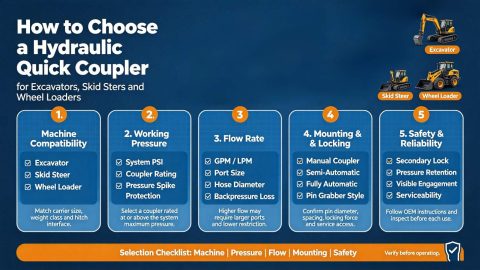
Quick Couplers and Fleet Productivity
Attachment change frequency determines whether a quick coupler pays back in one season.
- Mechanical couplers — Lower capital cost; suited to fleets with 1–2 changes per week
- Hydraulic couplers — Change in under two minutes; essential for multi-tool urban jobs
- Safety standards — EU and UK buyers should reference ISO 13031 locking requirements
Coupler weight shifts the excavator’s centre of gravity. Document adapter mass in quotes — especially when stacking breaker + coupler + long stick on a 20-tonne class machine.
Integration with telematics
Forward-thinking rental fleets log attachment hours separately from carrier hours using QR tags or RFID on each tool. When a breaker reaches 500 hours, the system triggers a bushing inspection work order automatically. This level of tracking improves resale documentation and reduces arguments over wear versus misuse at end of lease.
Building a Rental or Dealer Attachment Mix by Market
North America & Australia
Strong demand for breakers, augers, thumbs, and GP/rock buckets. Utility seasons drive auger peaks; demolition cycles drive breaker demand.
Europe
CE conformity, noise limits, and quick coupler safety documentation are tender requirements. Silenced breaker variants and certified couplers differentiate suppliers.
Middle East & Southeast Asia
Hard rock and infrastructure projects favour heavy breakers and rock buckets. Humidity and abrasive dust require sealed hydraulic motors and robust filtration advice in operator manuals.
OEM buyers should regionalise SKU lists rather than importing a single global mix. HCN supports private-label programs with product-level documentation for each market — details on the About HCN page.
Seasonal demand patterns
In temperate markets, auger and compaction tool demand peaks in spring and autumn utility seasons, while breaker utilisation stays relatively flat in urban demolition. Rental managers who map seasonality avoid over-purchasing breakers that sit idle while auger drives wear out from overtime. Dealers can offer seasonal rental packages — breaker winter / auger summer — to improve attachment utilisation and parts turnover.
ROI: Attachment Revenue Beyond the Initial Sale
For dealers, attachments generate margin through:
- Initial tool sale
- Wear parts and rebuild kits
- Service contracts on breakers and auger drives
- Trade-in and refurbishment at end of lease
For rental companies, attachment utilisation rate matters more than purchase price. A grapple at 70% utilisation in a recycling yard outperforms a cheap thumb sitting in storage. Model cost per productive hour when comparing suppliers.
Conclusion
An effective excavator attachments comparison starts with application, then evaluates hydraulic demand, changeover workflow, wear economics, and regional compliance. Breakers, augers, grapples, thumbs, and buckets each occupy distinct niches — no single tool covers every job profitably. Dealers and OEM buyers who map attachments to customer segments build recurring revenue through parts and service, not one-time margin alone.
HCN Attachments supplies breakers, buckets, couplers, snow tools, forestry equipment, and custom OEM attachments for export worldwide. Review the full product catalog, explore hydraulic breaker models, or request a quotation with your carrier fleet list and target applications.
Frequently Asked Questions
What is the most versatile excavator attachment for general contractors?
A general-purpose bucket paired with a hydraulic thumb covers the widest range of earthmoving and material handling tasks. Breakers and augers are best added for specialised revenue streams.
Can one excavator run a breaker and an auger on the same auxiliary circuit?
Yes, if flow and pressure settings are adjusted when switching tools. A quick coupler reduces changeover time. Always verify settings in the operator manual for each attachment.
Which attachment generates the highest parts revenue for dealers?
Hydraulic breakers typically lead in wear parts — tools, bushings, and seals — followed by bucket teeth and auger drive components.
Do I need separate carriers for demolition and utility work?
Not necessarily. Many 20–30 tonne excavators switch between breakers and augers seasonally. Fleet planning should account for hydraulic tuning and storage logistics.
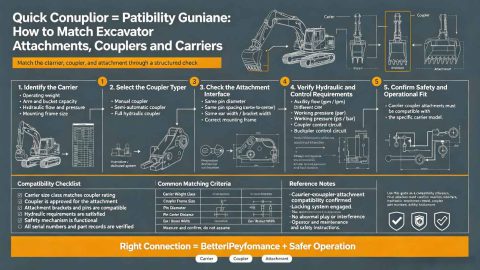
How do I verify quick coupler compatibility across brands?
Supply pin centre distance, hanger width, and coupler type (ISO, S-type, proprietary). Request drop-test or lock integrity documentation for regulated markets.
Need specs or export pricing? request a quotation with your carrier model and quantity.
Related Product Lines & Technical Guides
Use these HCN resources to compare specifications, carrier fit, and export procurement options referenced in this article.
- Hydraulic Breakers & Rock Hammers →
- Snow Removal Equipment & Attachments →
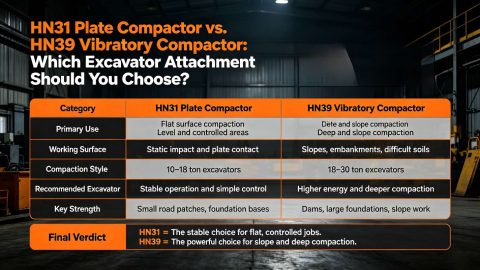
- Soil Compaction Machines & Vibratory Compactors →
- Excavator Buckets & Grapples →
- Forestry Mulchers & Land Clearing Attachments →
- Mining & Port Loader Attachments →
- Construction Attachments →
- Material Handling Grapples & Clamps →