Road repair projects often involve more than simply removing damaged pavement. Contractors and municipal maintenance teams need to determine whether the job requires controlled material removal, localized demolition, surface preparation, or deeper structural repair. Choosing the wrong attachment can lead to unnecessary passes, poor surface control, excessive wear, or a repair process that is difficult to manage.
Two hydraulic attachment types are particularly relevant to pavement and infrastructure work: the cold planer and the hydraulic breaker. Although both can be used on construction and road-maintenance carriers, they perform fundamentally different tasks.
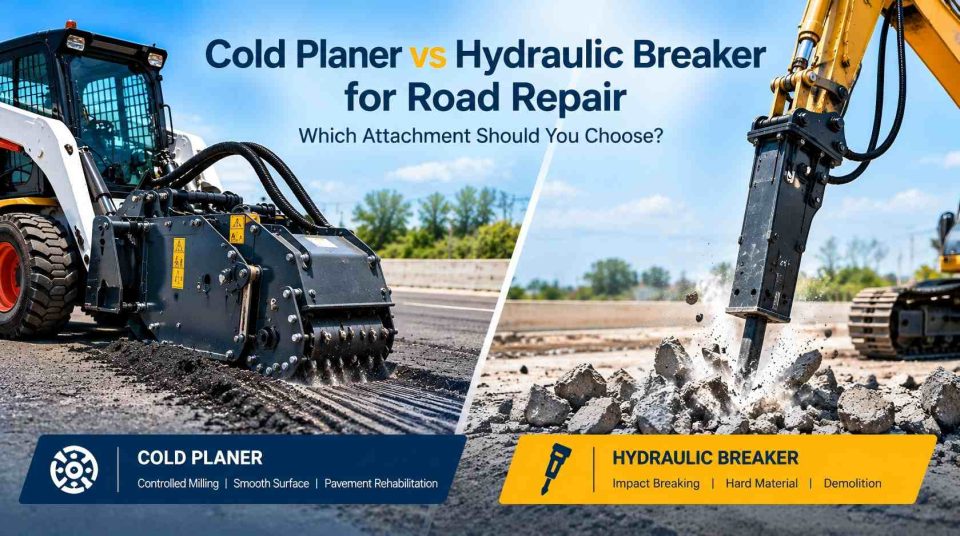
A cold planer is designed to remove a controlled layer of asphalt or concrete using a rotating milling drum and cutting tools. A hydraulic breaker, by contrast, delivers repeated impact energy to fracture concrete, rock, and other hard materials.
For contractors, equipment dealers, rental companies, municipal fleets, and procurement teams, the correct choice depends less on the carrier name and more on the required removal method, material condition, working depth, surface finish, hydraulic capability, and mounting configuration.
Cold Planer vs Hydraulic Breaker: The Basic Difference
The simplest way to distinguish the two attachments is to consider how the material needs to be removed.
| Selection Factor | Cold Planer | Hydraulic Breaker |
|---|---|---|
| Primary function | Controlled milling and removal of pavement | Impact breaking and demolition |
| Typical material | Asphalt and selected concrete milling applications | Concrete, rock and other hard materials |
| Removal method | Rotating drum with cutting tools | Repeated hydraulic impact |
| Depth control | Designed for controlled milling depth | Material is fractured rather than milled to a uniform profile |
| Typical road application | Pavement rehabilitation, resurfacing preparation and localized milling | Concrete demolition, hard-material breaking and heavy-duty removal |
| Surface finish | Produces a controlled milled surface | Produces fractured material |
| Best procurement question | How much pavement needs to be removed and at what depth? | How much hard material needs to be fractured? |
HCN’s current road-maintenance product range includes cold planers, hydraulic breakers, manhole milling equipment, compactors and other pavement-maintenance attachments, making this distinction particularly relevant when building an attachment package for municipal or contractor fleets.
When a Cold Planer Is the Better Choice
A cold planer is generally the better choice when the objective is to remove a controlled layer of pavement rather than completely demolish the material.
Cold planers are commonly associated with asphalt milling, pavement rehabilitation, pothole preparation, resurfacing preparation, utility trench restoration, parking-area repairs and surface profiling.
HCN’s road-maintenance range describes cold planers as attachments for removing damaged asphalt or concrete surfaces at ambient temperature. The company’s published road-equipment information identifies milling widths from 300 mm to 1,200 mm across its cold-planer range, with milling depth reaching up to 250 mm depending on configuration.
1. Pavement rehabilitation
If a damaged asphalt layer needs to be removed before new material is installed, controlled milling is usually more appropriate than impact breaking.
The objective is not necessarily to destroy the entire pavement structure. Instead, the contractor may need to remove a defined layer and leave a consistent surface for the next stage of construction.
2. Pothole and localized pavement repair
Localized road repairs often require precise removal around the damaged area. A cold planer can be advantageous when the repair specification requires a predictable milling depth and defined working area.
This is particularly useful for contractors carrying out repeated road-maintenance work with a skid steer or compact loader.
3. Utility trench restoration
After underground utility work, contractors may need to remove and restore pavement around a trench. A milling attachment can help create a controlled repair area instead of relying on uncontrolled demolition.
4. Resurfacing preparation
When an existing surface must be prepared for a new asphalt layer, controlled milling can provide a more predictable interface between the existing pavement and the replacement material.
The objective is to remove the required material while maintaining a suitable surface profile for subsequent paving work.
When a Hydraulic Breaker Is the Better Choice
A hydraulic breaker becomes more appropriate when the job requires fracturing hard material rather than producing a controlled milled surface.
Hydraulic breakers are commonly used for concrete demolition, hard rock breaking, structural removal and other applications where impact energy is the primary requirement.
HCN’s current hydraulic-breaker range includes breakers for excavators, skid steer loaders and wheel loaders. The published range covers different carrier classes and configurations, while individual models specify their own hydraulic and mechanical requirements.
1. Concrete demolition
When an old concrete structure, slab, foundation or heavily reinforced section needs to be broken into removable pieces, a hydraulic breaker can be more suitable than a milling attachment.
The impact mechanism allows the operator to concentrate energy on hard material until it fractures.
2. Hard material removal
Some road and infrastructure projects involve rock or concrete that cannot be efficiently removed through conventional milling. In these situations, impact breaking may be the more practical approach.
3. Heavy-duty demolition work
Hydraulic breakers are also better suited to demolition tasks where the desired result is fragmentation rather than a smooth or controlled milled surface.
For example, HCN’s BM16 hydraulic breaker is listed for wheel loaders and has published operating pressure and impact-frequency specifications. The product page also identifies a published compatibility range that includes 11–16 tonne excavators and 5 tonne wheel loaders, demonstrating why breaker selection should be based on the exact attachment configuration rather than simply choosing by visual size.
Cold Planer vs Hydraulic Breaker for Asphalt
For asphalt repair, the cold planer will normally be the more relevant attachment when the objective is to remove a defined pavement layer.
A breaker can fracture asphalt, but breaking does not provide the same type of controlled milling process. If the repair specification calls for a predictable width and depth, the milling process is usually better aligned with the job.
| Asphalt Repair Requirement | Preferred Attachment | Reason |
|---|---|---|
| Remove a defined surface layer | Cold planer | Controlled milling depth |
| Prepare pavement for resurfacing | Cold planer | Creates a defined milled surface |
| Localized asphalt removal | Cold planer | Better control of working area |
| Break heavily damaged concrete structures beneath pavement | Hydraulic breaker | Impact energy is more appropriate |
| Fracture hard concrete | Hydraulic breaker | Designed for repeated impact |
Cold Planer vs Hydraulic Breaker for Concrete
Concrete requires a more application-specific decision.
A hydraulic breaker is generally the more natural choice when the objective is demolition or fragmentation. However, a suitable milling configuration may be useful when the objective is controlled surface removal or profiling rather than complete structural demolition.
Buyers should therefore define the required result before selecting the attachment:
- Remove the entire concrete structure: consider a hydraulic breaker.
- Break concrete into removable pieces: consider a hydraulic breaker.
- Remove a controlled surface layer: evaluate a suitable cold planer.
- Prepare a pavement surface for subsequent work: evaluate milling equipment.
- Work around a specific utility or infrastructure feature: consider whether a specialized milling attachment is more appropriate.
HCN’s road-maintenance range also includes specialized equipment such as the BM14 Manhole Miller for wheel loaders. Its published specification includes a 40 mm milling slot width and a dedicated manhole-maintenance configuration, illustrating that specialized pavement problems may require a purpose-built attachment rather than either a general cold planer or breaker.
Carrier Compatibility Still Matters
Choosing between a cold planer and hydraulic breaker is only the first stage of procurement.
The selected attachment must also be compatible with the carrier’s hydraulic and mechanical systems.
Hydraulic flow and pressure
Powered attachments rely on the carrier’s auxiliary hydraulic circuit. A cold planer may require substantial hydraulic flow to drive the milling system, while a hydraulic breaker has its own operating pressure, flow and impact-performance requirements.
HCN’s current product pages provide model-level hydraulic requirements rather than treating all attachments as interchangeable. For example, the BM16 hydraulic breaker lists an operating pressure of 150–170 bar, while individual road-maintenance attachments have different hydraulic requirements.
Never assume that a carrier capable of operating one hydraulic attachment will automatically operate another attachment at the correct performance level.
Carrier operating weight
Attachment weight affects machine stability, lift capacity, working reach and overall balance.
The appropriate attachment-to-carrier relationship also varies by attachment category. A breaker, cold planer, sweeper and compactor do not place identical demands on the carrier.
For procurement, the exact carrier model and operating weight should therefore be provided to the attachment manufacturer for fitment review.
Mounting interface
Hydraulic compatibility does not guarantee mechanical compatibility.
Before ordering, confirm:
- Mounting type
- Pin dimensions where applicable
- Pin-to-pin distance
- Quick coupler interface
- Attachment plate dimensions
- Mounting height
- Hydraulic hose routing
- Clearance through the carrier’s working range
HCN states that its fitment review checks submitted carrier model information, mounting dimensions, operating weight, hydraulic flow and pressure before production.
Cold Planer vs Hydraulic Breaker: Procurement Comparison
| Procurement Question | Cold Planer | Hydraulic Breaker |
|---|---|---|
| Do you need controlled material removal? | Strong fit | Limited fit |
| Do you need impact demolition? | Not the primary function | Strong fit |
| Is milling depth important? | Yes | No |
| Is surface profile important? | Yes | Usually not |
| Is concrete demolition required? | Application dependent | Strong fit |
| Is asphalt resurfacing preparation required? | Strong fit | Generally not the preferred solution |
| Is rock breaking required? | No | Strong fit |
| Is the attachment likely to be changed frequently? | Consider quick coupler and fleet configuration | Consider quick coupler and fleet configuration |
Should Contractors Buy Both?
For fleets performing a broad range of infrastructure and municipal work, the answer can be yes.
A cold planer and hydraulic breaker are complementary rather than competing attachments.
A contractor may use a breaker for structural demolition and hard-material removal, then use a cold planer for controlled pavement preparation during reconstruction. A compactor can subsequently be used for subbase or backfill work, while a sweeper can support final cleanup.
This approach allows one carrier platform to perform multiple stages of a project when the machine has the appropriate hydraulic capacity and attachment interfaces.
HCN’s current road-maintenance catalog includes cold planers, hydraulic breakers, vibratory compactors, sweepers, manhole milling equipment and other specialized tools, making it possible for fleet managers to evaluate attachments as part of a broader workflow rather than as isolated products.
How to Choose the Right Attachment: A Practical Decision Process
Step 1: Define the material
Identify whether the work involves asphalt, concrete, rock, compacted material or a combination of materials.
Step 2: Define the desired result
Ask whether the project requires controlled removal or fragmentation.
If the answer is controlled removal, investigate cold planing. If the objective is demolition or breaking, investigate hydraulic breakers.
Step 3: Define the required depth
For milling projects, specify the required removal depth. For demolition projects, determine the thickness and strength of the material that must be broken.
Step 4: Check the carrier
Prepare the carrier make, model, operating weight, auxiliary hydraulic flow, hydraulic pressure and mounting configuration.
Step 5: Check the working width
For milling applications, working width directly affects the number of passes required. HCN’s road-equipment range covers cold-planer configurations from narrower repair applications through wider pavement-milling applications.
Step 6: Consider wear parts
Cold planers depend on cutting teeth, while breakers depend on appropriate working tools and wear components. Procurement teams should understand replacement-part availability, expected maintenance requirements and service support before selecting a supplier.
Step 7: Request exact technical confirmation
For standard configurations, the published product specification can provide an initial reference. For OEM programs, unusual carrier models, customized brackets or non-standard hydraulic configurations, request an exact technical drawing and compatibility confirmation before production.
Common Procurement Mistakes
Choosing by carrier size alone
A machine’s operating weight does not provide enough information to determine hydraulic compatibility, mounting configuration or attachment suitability.
Using a breaker when controlled milling is required
If the project specification requires a defined removal depth and predictable pavement profile, impact breaking may create unnecessary secondary work.
Choosing a planer without checking hydraulic capacity
A cold planer is a powered hydraulic attachment. The carrier must supply the required hydraulic performance for the selected configuration.
Ignoring the mounting interface
An attachment can have the correct hydraulic requirements and still fail to fit the carrier mechanically.
Buying on attachment price alone
For professional fleets, total ownership cost includes productivity, wear parts, downtime, maintenance, transport, fitment and technical support. The lowest purchase price is not necessarily the lowest operating cost.
What Information Should You Send to an Attachment Manufacturer?
A complete RFQ helps the manufacturer provide a more accurate recommendation.
For a cold planer or hydraulic breaker, procurement teams should ideally provide:
- Carrier make and exact model
- Carrier operating weight
- Auxiliary hydraulic flow
- Hydraulic pressure
- Mounting or quick-coupler type
- Pin or mounting dimensions where applicable
- Primary material to be processed
- Required working width or tool configuration
- Required working depth where applicable
- Typical duty cycle
- Intended application
- Destination market
- Required quantity
- OEM or private-label requirements if applicable
Providing this information at the RFQ stage reduces the risk of selecting an attachment that looks suitable in a catalog but requires modification after delivery.
FAQ
Is a cold planer better than a hydraulic breaker for asphalt?
For controlled asphalt removal, milling and resurfacing preparation, a cold planer is generally the more appropriate attachment. A hydraulic breaker is better suited to impact demolition and hard-material breaking.
Can a hydraulic breaker be used for road repair?
Yes. Hydraulic breakers can be useful for concrete demolition, hard-material removal and other road-maintenance tasks. The attachment should be selected according to the material and required work result.
Can a cold planer remove concrete?
Some cold-planer configurations can be used for concrete milling when the attachment and cutting tools are suitable for the application. The exact configuration should be confirmed with the manufacturer before ordering.
Which attachment gives better depth control?
A cold planer is designed specifically for controlled milling depth. A hydraulic breaker fractures material through repeated impact and is not primarily intended to create a uniform milled profile.
What hydraulic information is needed before buying either attachment?
Buyers should provide the carrier’s auxiliary hydraulic flow and pressure and compare them with the exact attachment model requirements. HCN recommends confirming the carrier model and hydraulic data before final configuration.
Can the same skid steer use both a cold planer and hydraulic breaker?
Potentially, provided the carrier has the required hydraulic capacity, mounting interface and operating capability for both attachments. The exact compatibility should be confirmed for each attachment separately.
Is a cold planer suitable for pothole repair?
Yes. Cold planers can be useful for controlled pavement removal during pothole preparation and localized road rehabilitation, particularly where consistent milling depth is important.
Should I request a technical drawing before ordering?
For non-standard mounting, OEM programs, customized configurations or uncertain compatibility, requesting an exact technical drawing and fitment confirmation before production is strongly recommended.
Final Procurement Recommendation
The decision between a cold planer and hydraulic breaker should start with the required method of material removal, not the attachment’s appearance or carrier size.
Choose a cold planer when the project requires controlled asphalt or pavement removal, defined milling depth, resurfacing preparation, localized pavement rehabilitation or surface profiling.
Choose a hydraulic breaker when the project requires impact energy for concrete demolition, rock breaking, structural removal or other hard-material fragmentation.
For larger road-maintenance fleets, the two attachment types can complement each other. A breaker can handle demolition and hard-material removal, while a cold planer can provide controlled pavement preparation during reconstruction. Additional attachments such as compactors, sweepers and specialized milling tools can then support subsequent stages of the workflow.
Before releasing a purchase order, confirm the exact carrier model, operating weight, hydraulic flow, hydraulic pressure, mounting interface, application conditions and required configuration. When the application is outside a standard catalog configuration, request an engineering compatibility review, technical drawing and exact specification before production.
HCN’s current product portfolio covers hydraulic breakers, cold planers, compactors, sweepers, manhole milling equipment and other construction and municipal attachments. This broader product structure allows contractors, distributors, rental fleets and OEM procurement teams to evaluate road-maintenance attachments according to the complete workflow rather than selecting individual tools in isolation.
The right attachment is not simply the one that fits the machine. It is the one that matches the material, the required result, the hydraulic system, the mounting interface and the actual duty cycle.
Related Product Lines & Technical Guides
Use these HCN resources to compare specifications, carrier fit, and export procurement options referenced in this article.